Deck: If something happens to you, will your family know you own crypto, where it is, and how to reach it? Here's a plain-English look at the three parts of a crypto estate plan, and where an attorney and our free planning kit fit in.
Last reviewed: October 24, 2026
This is a topic I put off for a long time. Thinking about your own death isn't fun, and crypto adds a twist: some of it can only be reached with information that exists in one place, sometimes only in your head.
This guide covers the general idea of planning so your crypto can be found and passed on. It's education, not legal or tax advice. Estate law differs from state to state, and an estate planning attorney is the person who can make a plan legally work for you.
The short version
- Crypto in a self-custody wallet can only be moved with its recovery phrase or keys. If no one can find them, no one can move it.
- Crypto on an exchange sits in an account that a platform holds, so access usually goes through that platform's process and legal paperwork.
- A plan has three layers: an inventory of what you own, a private plan for how to reach it, and legal documents made with an attorney.
- Keep secrets out of your will. A will can become a public record in probate. Write down where secrets are kept, not the secrets themselves.
- Our free Crypto Estate Planning Kit walks through the pieces step by step.
Why crypto needs extra planning
With a bank account, an executor can usually show the bank the right documents and get access. Some crypto works that way too. If you hold it on an exchange, the account is held by a company, and your family or executor would work through that company's process.
Self-custody is different. A wallet you control is unlocked by a recovery phrase (often 12 or 24 words) or private keys, not by a customer service line. Our wallets and keys guide explains how that works. If the phrase is lost, the coins can't be moved by anyone.
There's a quieter problem too: family members may not know the crypto exists at all.
The three layers of a plan
Think of a plan as three separate pieces that point to each other:
- What you own. An inventory your executor can read.
- How to reach it. A private access plan that says where the secrets are kept.
- Who decides. Your will or trust and the people you name, set up with an attorney.
Keeping them separate means each one can be shared, or kept private, in the right way.
Layer 1: the inventory
The inventory answers "what is there, and where?" It's useful to list:
- Each exchange or app where you have an account, and the email address used to log in.
- Each self-custody wallet, which blockchains it's used on, and which coins sit there.
- Any hardware wallets and where the devices are kept.
- Rough amounts, so your executor knows what to look for.
- People who can help, like your attorney, an accountant, or a tech-savvy friend.
The inventory should hold no secrets. No recovery phrases, no passwords, no PINs. That way it can be shared with your executor without putting anything at risk.
Layer 2: the access plan
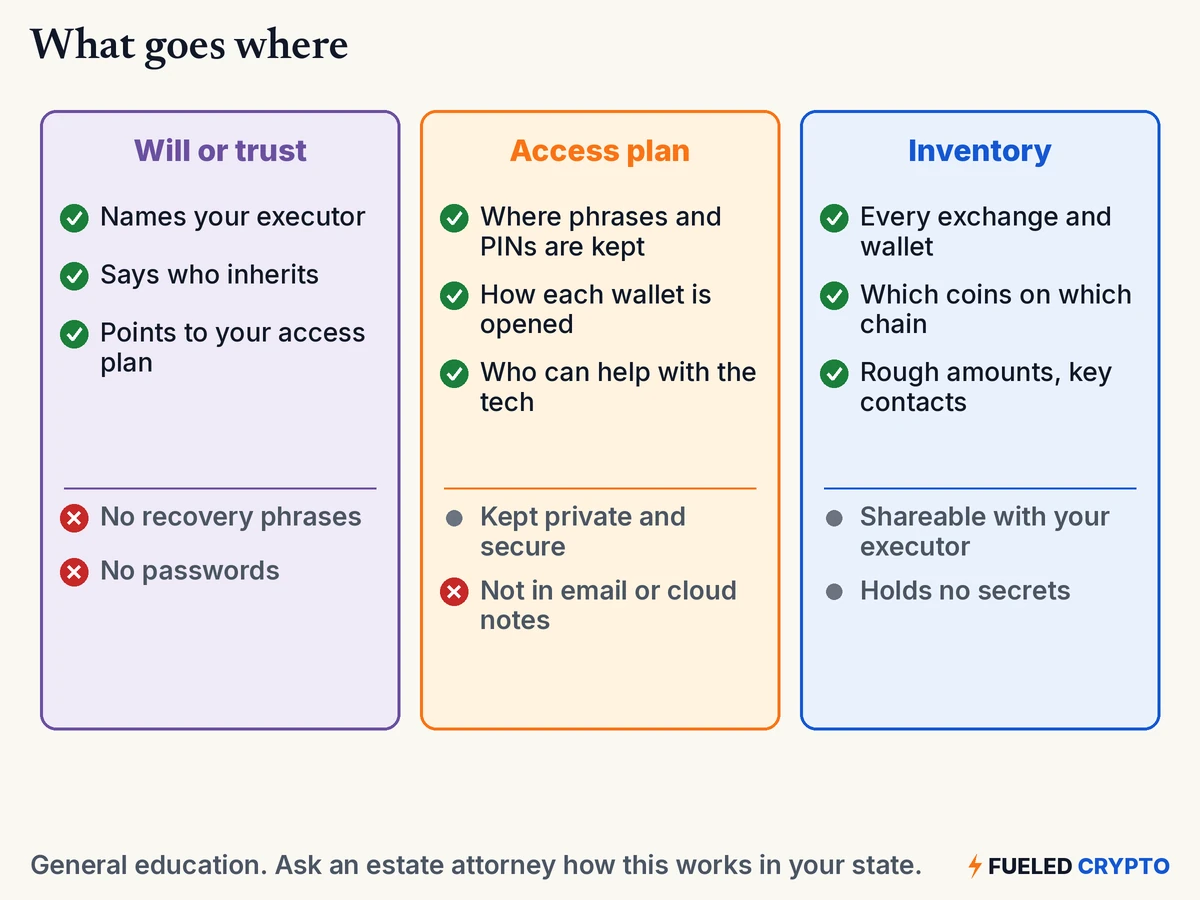
The access plan answers "how would someone actually reach it?" Our planning kit puts the core rule plainly: "Never type seed phrases, private keys, or passwords into this page or any worksheet. Write down where they are physically stored instead."
So instead of writing out a recovery phrase, an access plan says where it lives. A made-up example: "The recovery phrase for my main wallet is on a metal plate in the fireproof safe at home. The wallet's PIN is in a sealed envelope my attorney holds."
A few ideas commonly found in planning checklists, including ours:
- Durable storage. Recovery phrases on durable media, somewhere secure, fireproof and waterproof. Our seed phrase guide covers the basics.
- Separation. Hardware wallet PINs stored apart from the devices themselves.
- No digital copies of secrets in email, cloud notes or screenshots.
- Plain instructions. A short note on how each wallet is opened, written for someone who isn't technical.
Some people use setups that need more than one key, like multisig. These can lower the risk of one lost or stolen key, but they add steps your heirs would need to understand. That's worth talking through with whoever will carry out the plan.
Layer 3: the legal side, with an attorney
This is the part that makes the plan legally work, and it's where an estate planning attorney comes in. Some points to know before that conversation:
- A will can become public. For example, the Texas State Law Library notes that "once a will is filed for probate, it becomes a public record." Rules vary by state, which is one reason to keep secrets out of a will and point to the access plan instead.
- Fiduciaries and digital assets. The Uniform Law Commission's Revised Uniform Fiduciary Access to Digital Assets Act (RUFADAA) "governs access to a person's online accounts when the account owner dies or loses the ability to manage the account." It allows fiduciaries to manage digital property, including virtual currency. Many states have adopted a version of it. Your attorney can explain how your state handles this.
- Questions to bring to an attorney: Should crypto be covered in a will, a trust, or both? Who should be the executor, and who could act as a "digital executor" for the technical side? Do any of my exchanges have their own beneficiary or transfer-on-death features, and how do those fit with my will?
Taxes your heirs may ask about
This is general IRS information, not tax advice.
- Basis of inherited property. IRS Publication 551 says the basis of inherited property is generally "the FMV of the property at the date of the individual's death" (or an alternate valuation date, if the estate elects it). That can be higher or lower than what the original owner paid.
- Estate tax. For 2026, the IRS says the basic exclusion amount for federal estate tax is $15,000,000 (IR-2025-103). Some states have their own estate or inheritance taxes.
- Gifts during life. The 2026 annual gift exclusion is $19,000 per recipient. Going over it can mean filing Form 709. Our crypto tax guide covers how gifts and sales are reported.
Getting started with our kit
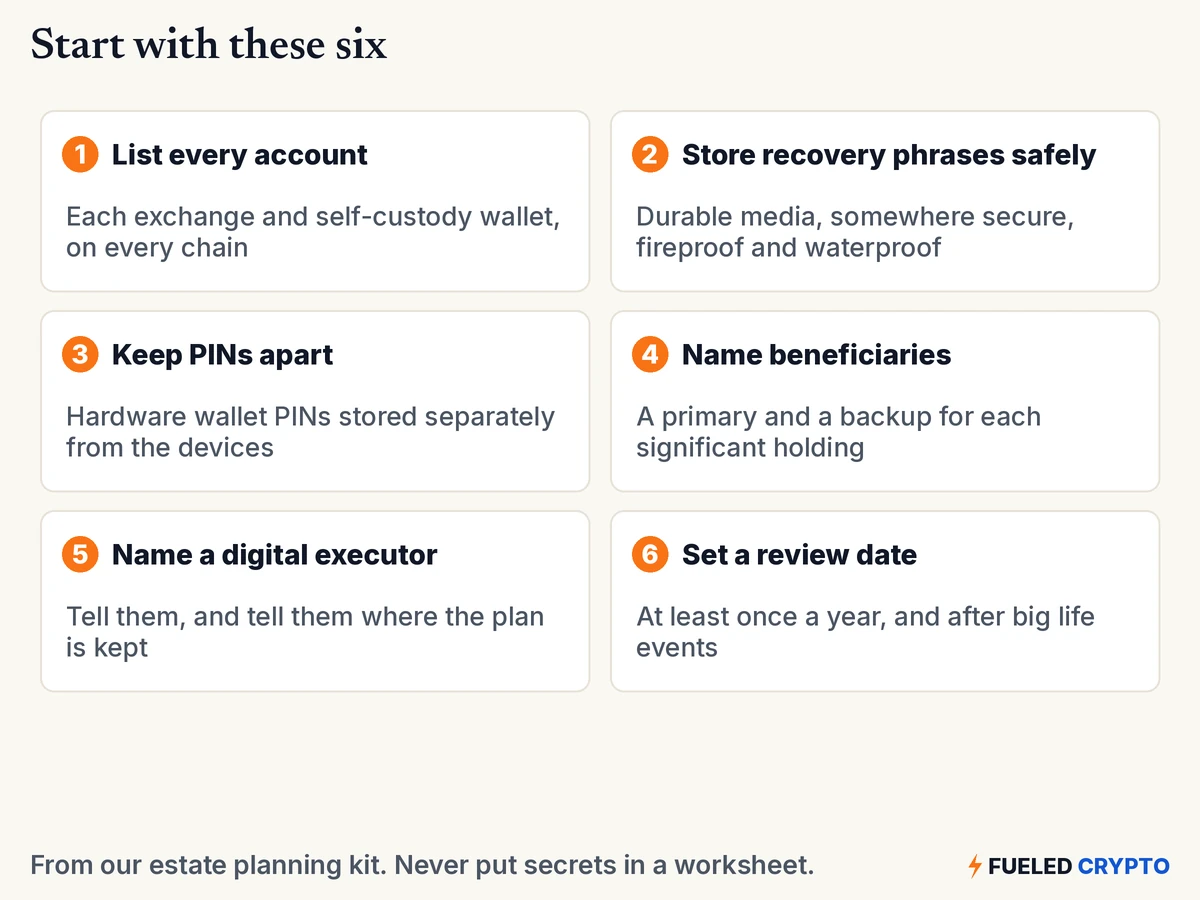
Our free Crypto Estate Planning Kit breaks a plan into seven sections: inventory, access and recovery locations, beneficiaries, a digital executor, legal and tax, security, and review. It's built to help you get organized before you meet with an attorney, not to replace one.
Plans go stale. New wallets, closed accounts and life changes all mean updates. Reviewing at least once a year, and after big events like a move, a marriage or a new child, keeps the plan useful.
Common mix-ups
- "I'll put my seed phrase in my will." A will can become a public record in probate. Point to where the phrase is kept instead.
- "My family will figure it out." Without knowing a wallet exists and where its recovery phrase is, they may not be able to reach it.
- "The inventory and the access plan are the same document." Keeping them separate lets you share the inventory without exposing secrets.
- "Inherited crypto keeps the original owner's cost." IRS Publication 551 says the basis is generally the fair market value at the date of death.
- "Once it's done, it's done." Accounts and wallets change. A yearly review keeps the plan accurate.
Words you'll keep hearing
- Executor: the person named in a will to settle the estate.
- Digital executor: someone you trust to handle the technical side of digital assets. Whether this is a formal role depends on your documents and state law.
- Probate: the court process for settling an estate under a will or state law.
- Beneficiary: a person who receives assets from an estate, trust or account.
- Trust: a legal arrangement where a trustee holds assets for beneficiaries.
- Recovery phrase (seed phrase): the words that can restore a self-custody wallet.
- RUFADAA: a uniform law many states use for fiduciary access to digital assets.
More terms are in our crypto glossary.
Frequently asked questions
What happens to crypto when someone dies without a plan? Crypto on an exchange is held in an account, so heirs usually work through the platform's process with legal documents. Crypto in a self-custody wallet can only be moved with its recovery phrase or keys, so if no one can find them, it may not be reachable.
Should I put my seed phrase in my will? A will can become a public record once it's filed for probate. The common approach is to keep the phrase stored securely and have your plan say where it is. An estate planning attorney can advise on your situation.
What is a crypto access plan? It's a private document that says where your recovery phrases, PINs and backups are physically kept and how each wallet is opened. It doesn't contain the secrets themselves.
Do I need an attorney? Estate law varies by state, and an attorney is the person who can make a will or trust legally effective. Our planning kit helps you get organized before that meeting.
How is inherited crypto taxed? IRS Publication 551 says inherited property's basis is generally its fair market value at the date of death. A tax professional can explain how that applies to a specific estate.
What is RUFADAA? It's a uniform law from the Uniform Law Commission that governs fiduciaries' access to a person's online accounts and digital assets when the owner dies or can't manage them. Many states have adopted a version.
How often should I update my plan? Our planning kit suggests reviewing at least once a year, and after big life events or when you open or close accounts and wallets.
Where to go next
- Crypto Estate Planning Kit, our free step-by-step planning tool.
- Seed Phrase Best Practices, for storing recovery phrases.
- Multisig, Explained, for setups that need more than one key.
- Exchange vs. Self-Custody, for how each kind of holding works.
- How to Report Crypto on Your Taxes, for gifts and sales.
- Crypto Glossary, for any other term.
Sources
- Fueled Crypto: Crypto Estate Planning Kit (kit sections, starter steps and the "never type seed phrases" rule).
- Uniform Law Commission: Fiduciary Access to Digital Assets Act, Revised.
- Texas State Law Library: Probating a will (example of a will becoming a public record once filed).
- IRS: Publication 551, Basis of Assets (inherited property).
- IRS: IR-2025-103, tax inflation adjustments for tax year 2026 (October 9, 2025; $15,000,000 estate basic exclusion and $19,000 annual gift exclusion).
- IRS: Digital assets (Form 709 for gifts).
All diagrams and animations are original Fueled Crypto graphics. Ana is a made-up example.
Fueled Crypto publishes news and education, not investment, tax, or legal advice. Crypto assets are volatile and can lose value. Do your own research and consider a licensed professional before making financial decisions. See our full disclaimer.
Want plain-English crypto news once a week? Subscribe to Fueled Crypto.