Deck: Strip away the jargon and a blockchain is a shared record book that thousands of strangers can keep in sync without trusting each other. Here's how the pieces fit together, one concept at a time.
Last reviewed: October 24, 2026
If you've ever nodded along while someone said "it's on the blockchain" and quietly wondered what that actually means, you're in good company. Most of us bought our first coin, or at least read about one, long before anyone explained the plumbing underneath.
The good news is that the core idea is simpler than the buzzwords make it sound. You don't need to know any math or code to get it. By the end of this guide you'll know what a block is, why they're "chained," who keeps the records, and how a network of strangers agrees on what's true. Everything else on this site, from seed phrases to sending XRP, builds on these few ideas.
The one-sentence version
A blockchain is a shared list of transactions, grouped into pages called blocks, where every page is sealed with a fingerprint of the page before it, and many independent computers keep their own copy and check each other's work.
That's it. The rest of this guide just unpacks that sentence.
Start with a ledger
A ledger is just a record of who paid whom. Your bank keeps one for your checking account. When you swipe your card, the bank writes down the transaction, and its copy of the ledger is the official version. You trust it because it's the bank.
Bitcoin's creator, writing under the name Satoshi Nakamoto, set out to build a way for people to pay each other online "without going through a financial institution" (Bitcoin whitepaper). That raises an obvious problem. If there's no bank keeping the official ledger, who does? And what stops someone from spending the same money twice?
The answer is the blockchain: instead of one company holding the record book, everyone on the network holds a copy, and the copies are built in a way that makes cheating easy to spot.
What's inside a block
Think of a block as one page in the record book. Each one holds three main things:
- A batch of transactions. "Ana sends Ben 2 coins," "Ben sends Cy 1 coin," and so on. A real block can hold thousands of them.
- A timestamp, so there's an order to everything.
- The fingerprint of the previous block. This is the clever part, and it's what makes it a chain.
Blocks get added one after another, and each new block points back to the one before it, all the way to the very first block (often called the "genesis block") (Bitcoin developer guide, ethereum.org).
The fingerprint: what a "hash" is
A hash is a fingerprint for data. You feed any amount of information into a hash function, and it spits out a short string of letters and numbers. Bitcoin uses one called SHA-256, a standard published by the U.S. National Institute of Standards and Technology (NIST FIPS 180-4, Bitcoin whitepaper). Ethereum uses a different one, but the idea is the same.
Three things make a hash useful:
- The same input always gives the same fingerprint.
- A tiny change gives a completely different fingerprint. One extra character is enough (see the example below).
- You can't work backward. Knowing the fingerprint doesn't tell you what went in.
Here's a real example using SHA-256:
| What goes in | Fingerprint (first 16 of 64 characters) |
|---|---|
| Ana pays Ben 2 | b6b28511f099b265… |
| Ana pays Ben 20 | 03cef51a68511b6e… |
So a block's fingerprint is a compact seal on everything inside it. Change one detail in the block, and the seal changes.
How blocks link together
Here's where it comes together. When a new block is built, it includes the fingerprint of the block before it. That fingerprint becomes part of the new block's contents, so it also feeds into the new block's own fingerprint. The whitepaper describes it simply: "Each timestamp includes the previous timestamp in its hash, forming a chain, with each additional timestamp reinforcing the ones before it" (Bitcoin whitepaper).
That's the whole trick. The blocks are tied together by fingerprints, like a row of envelopes where each one has the previous envelope's wax seal pressed into it.
Why old entries are so hard to change
Now imagine someone wants to quietly rewrite history. Say they go back to Block 1 and change "Ana pays Ben 2" to "Ana pays Ben 20."
Here's what happens:
- Block 1's contents changed, so its fingerprint changes.
- Block 2 still holds the old fingerprint, so the link between them no longer matches.
- To hide the edit, the cheater would have to rebuild Block 2, then Block 3, and every block after that.
- And they'd have to do it on most copies of the network at once, which brings us to the next part.
On a network like Bitcoin, rebuilding blocks is deliberately expensive (more on that below). The whitepaper's point is that as long as honest participants control most of the network's computing power, an attacker can't catch up (Bitcoin whitepaper). That's why people describe confirmed blockchain transactions as practically permanent. It's also why a mistaken or stolen transfer usually can't be undone. (If that's happened to you, see Crypto Stolen? What to Do Right Now.)
Who keeps the ledger? Everyone
A blockchain doesn't live on one company's server. It lives on many independent computers called nodes, run by different people and organizations around the world. A "full node" keeps its own complete copy of the ledger and checks every new block against the network's rules for itself (ethereum.org: nodes and clients).
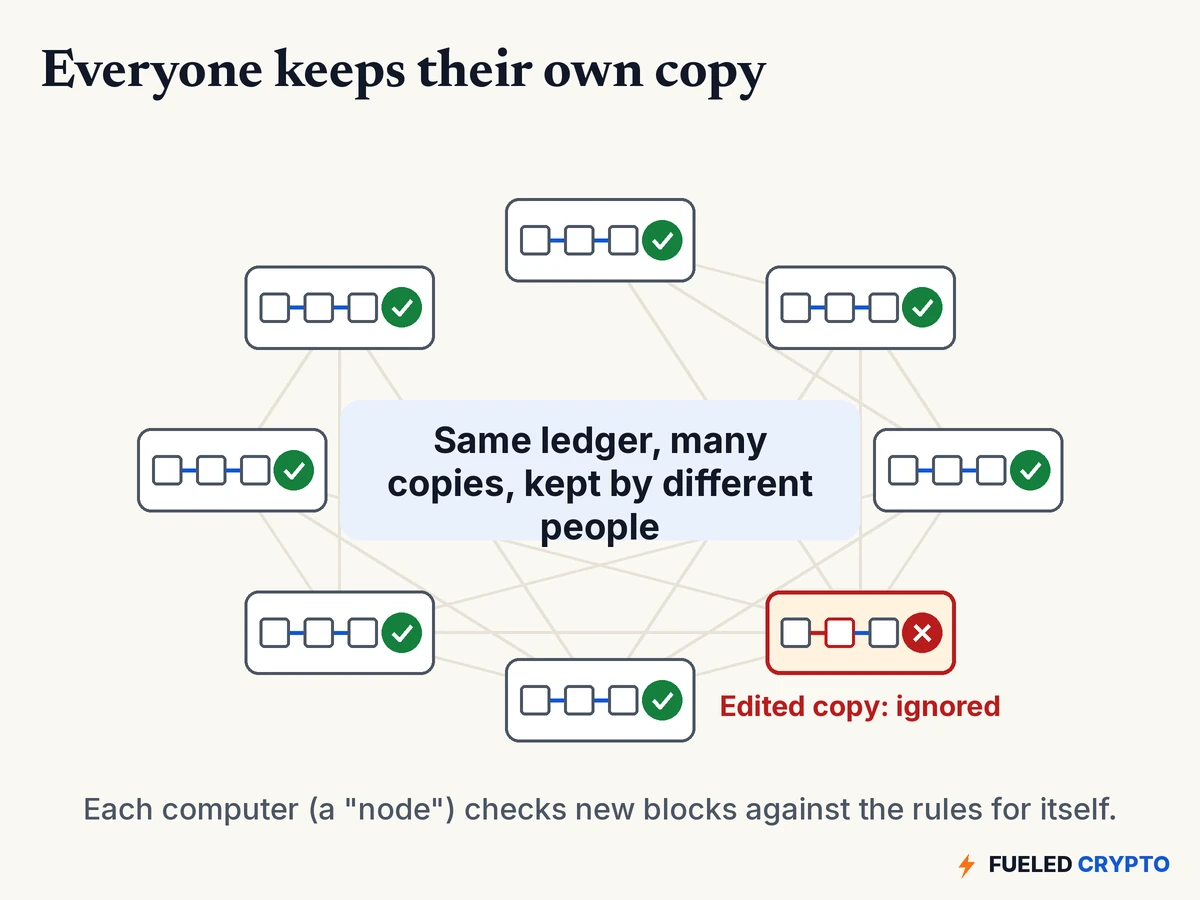
When someone sends a transaction, it gets broadcast to the network. Nodes pass it along, check that it follows the rules (for example, that the sender actually has the coins and hasn't already spent them), and eventually it lands in a block (Bitcoin whitepaper, section 5).
Because there are so many copies, there's no single record to hack, bribe, or shut down. A doctored copy just doesn't match everyone else's, so the rest of the network ignores it.
How the network agrees on the next block
If thousands of computers each hold a copy, someone still has to decide which block comes next, and everyone has to agree. That agreement process is called consensus. The two best-known methods work like this.
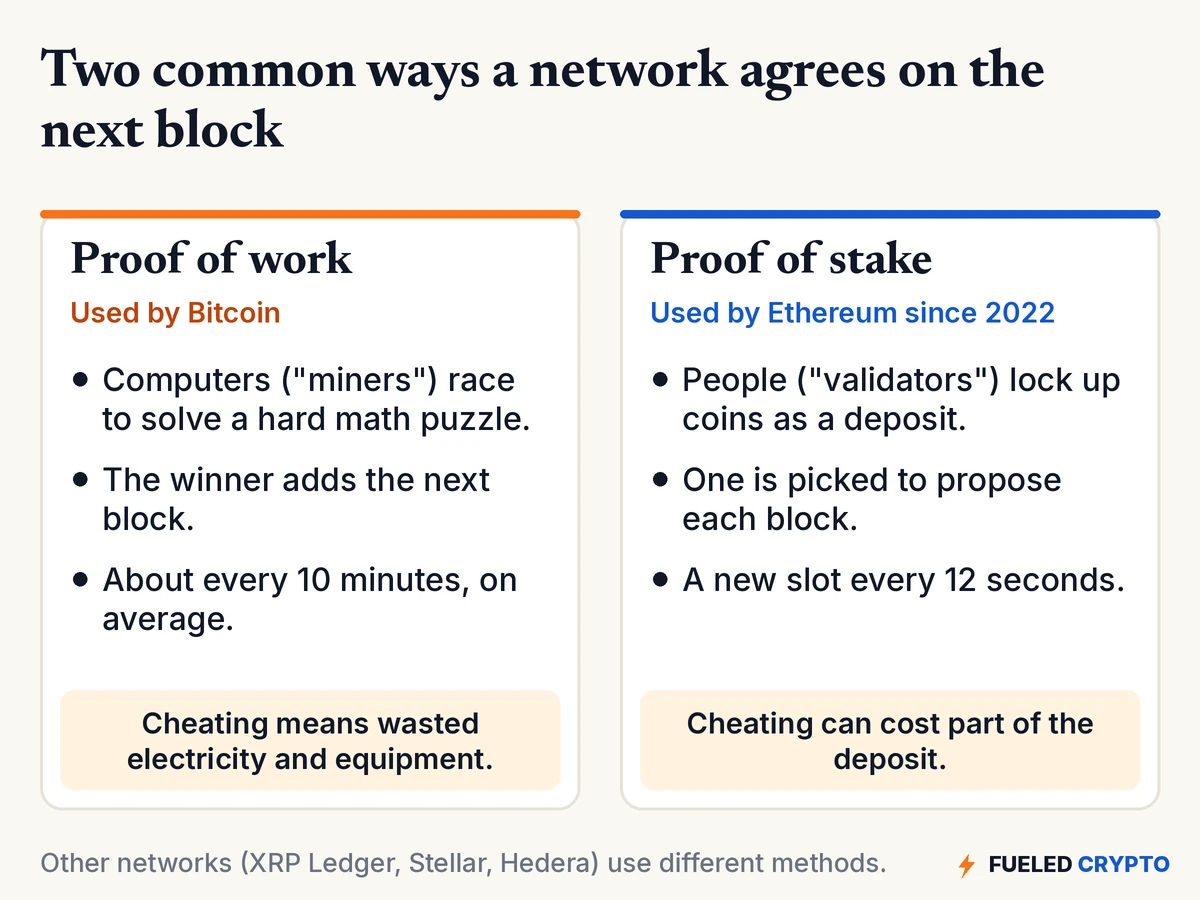
Proof of work (Bitcoin). Computers called miners compete to solve a puzzle that takes a huge amount of trial-and-error computing. The first to solve it gets to add the next block, and the other nodes check the answer, which is easy to verify. Bitcoin automatically adjusts the puzzle's difficulty every 2,016 blocks so that a new block arrives about every 10 minutes on average (Bitcoin developer guide). When two versions compete, nodes follow the chain with the most work behind it, often called the "longest chain" (Bitcoin whitepaper). Cheating would mean outspending the rest of the network on electricity and equipment.
Proof of stake (Ethereum). Instead of burning electricity, participants called validators put up a deposit, 32 ETH, as collateral. Time is divided into 12-second slots, and in each slot one validator is randomly picked to propose a block while others vote on whether it's valid. Validators who break the rules can lose some or all of their deposit (ethereum.org: proof of stake). Ethereum switched from proof of work to proof of stake in "The Merge" on September 15, 2022, which cut its energy use by about 99.95%, according to ethereum.org (ethereum.org: The Merge).
Other approaches. Not every network uses either one. The XRP Ledger has no mining. Its servers listen to a list of trusted validators, run by different parties, and agree on a new ledger version every few seconds (xrpl.org: consensus, xrpl.org: what is the XRP Ledger). Stellar uses the Stellar Consensus Protocol (Stellar docs), and Hedera uses a different data structure called a hashgraph rather than a traditional chain of blocks (Hedera docs). The details differ, but the goal is the same: lots of independent computers agreeing on one shared history without a boss.
So where are "my coins," exactly?
This is the part that trips up almost everyone at first, so it's worth saying plainly: your coins don't sit inside your wallet app or hardware wallet. They're entries on the blockchain, tied to an address.
What your wallet holds is a private key, the secret that lets you sign a transaction proving you're allowed to move what's at that address. The network checks the signature, and if it's valid, your transaction can go into a block. That's why your seed phrase (the backup of your keys) matters so much: whoever has it controls the coins. Our Seed Phrase Basics guide walks through keeping it safe.
It's also why anyone can look up any address's history. The ledger is public. Our How to Read a Blockchain Explorer guide shows you how to check a transaction yourself.
What a blockchain does well, and what it doesn't
Good at:
- Keeping a shared record that no single company controls.
- Making the past very hard to rewrite once enough blocks are stacked on top.
- Transparency. Anyone can verify the ledger for themselves.
- Running all day, every day, with no business hours or holidays.
Not magic:
- "Unhackable" applies to the ledger, not to you. Most thefts happen through stolen seed phrases, phishing sites, or hacked exchange accounts, not by breaking the chain itself. See How to Avoid Crypto Scams.
- Mistakes are usually permanent. Send to the wrong address and there's typically no "undo" button and no bank to call.
- Public isn't the same as anonymous. Addresses aren't printed with names, but every transaction tied to them is visible forever.
- The security depends on the network. A small network with few participants is easier to overpower than a large one. Both the Bitcoin whitepaper and ethereum.org discuss the risk of an attacker controlling most of a network's mining power or stake (ethereum.org: consensus mechanisms).
- A blockchain isn't an investment. It's plumbing. Whether any coin built on one is worth anything is a separate question, and one we don't answer for you.
Words you'll keep hearing
- Block: a batch of transactions added to the ledger together.
- Hash: a fingerprint of some data. Change the data, the fingerprint changes.
- Node: a computer that keeps a copy of the ledger and checks the rules.
- Miner: a node that competes to add blocks in a proof-of-work network.
- Validator: a participant that proposes or approves blocks in proof of stake and similar systems.
- Consensus: the process a network uses to agree on the next block.
- Confirmation: each block added after the one holding your transaction. More confirmations, more settled.
- Genesis block: the very first block in a chain.
- Private key / seed phrase: the secret that proves you control an address, and its human-readable backup.
Frequently asked questions
What is a blockchain in simple terms? A shared record book of transactions, kept in sync by many independent computers. Transactions are grouped into blocks, and each block carries a fingerprint of the one before it, which makes old entries very hard to change without everyone noticing.
Why is it called a blockchain? Because each block includes the fingerprint (hash) of the previous block, linking them in order like a chain, all the way back to the first block.
Can a blockchain be hacked? Changing a large, established blockchain's history would require overpowering most of the network, which is extremely expensive. Most crypto losses come from stolen keys, scams, and hacked accounts or apps, not from breaking the chain itself. Smaller networks with fewer participants can be more vulnerable.
Who controls a blockchain? On public blockchains like Bitcoin, no single company does. Independent node operators each enforce the rules on their own copy. How much power any group has varies from network to network.
What's the difference between proof of work and proof of stake? Proof of work (Bitcoin) has miners spend computing power to win the right to add a block. Proof of stake (Ethereum) has validators lock up coins as a deposit and get picked to propose blocks, and they can lose part of that deposit for cheating.
Can a blockchain transaction be reversed? Generally, no. Once a transaction is confirmed and buried under more blocks, there's no central party who can undo it. That's why double-checking addresses matters.
Is a blockchain the same as Bitcoin? No. Bitcoin is one cryptocurrency that runs on its own blockchain, the first one built for a cryptocurrency. Many other networks, such as Ethereum, use their own blockchains or similar shared ledgers.
Where to go next
- How to Read a Blockchain Explorer: look up a real transaction yourself.
- Seed Phrase Basics: protect the key that controls your coins.
- How to Avoid Crypto Scams: where the real risks usually are.
Sources
- Satoshi Nakamoto, Bitcoin: A Peer-to-Peer Electronic Cash System (2008), sections 1, 3, 4, 5 and 11.
- Bitcoin Developer Guide, Block Chain (difficulty adjustment every 2,016 blocks, genesis block).
- NIST, FIPS 180-4 Secure Hash Standard (SHA-256).
- ethereum.org, Blocks, Proof-of-stake, The Merge, Consensus mechanisms, Nodes and clients.
- XRP Ledger docs, Consensus and What is the XRP Ledger?
- Stellar docs, Stellar Consensus Protocol.
- Hedera docs, Hashgraph consensus algorithm.
All diagrams and animations are original Fueled Crypto graphics. Example fingerprints were computed with SHA-256 and shortened for display.
Fueled Crypto publishes news and education, not investment, tax, or legal advice. Crypto assets are volatile and can lose value. Do your own research and consider a licensed professional before making financial decisions. See our full disclaimer.
Want plain-English crypto news once a week? Subscribe to Fueled Crypto.