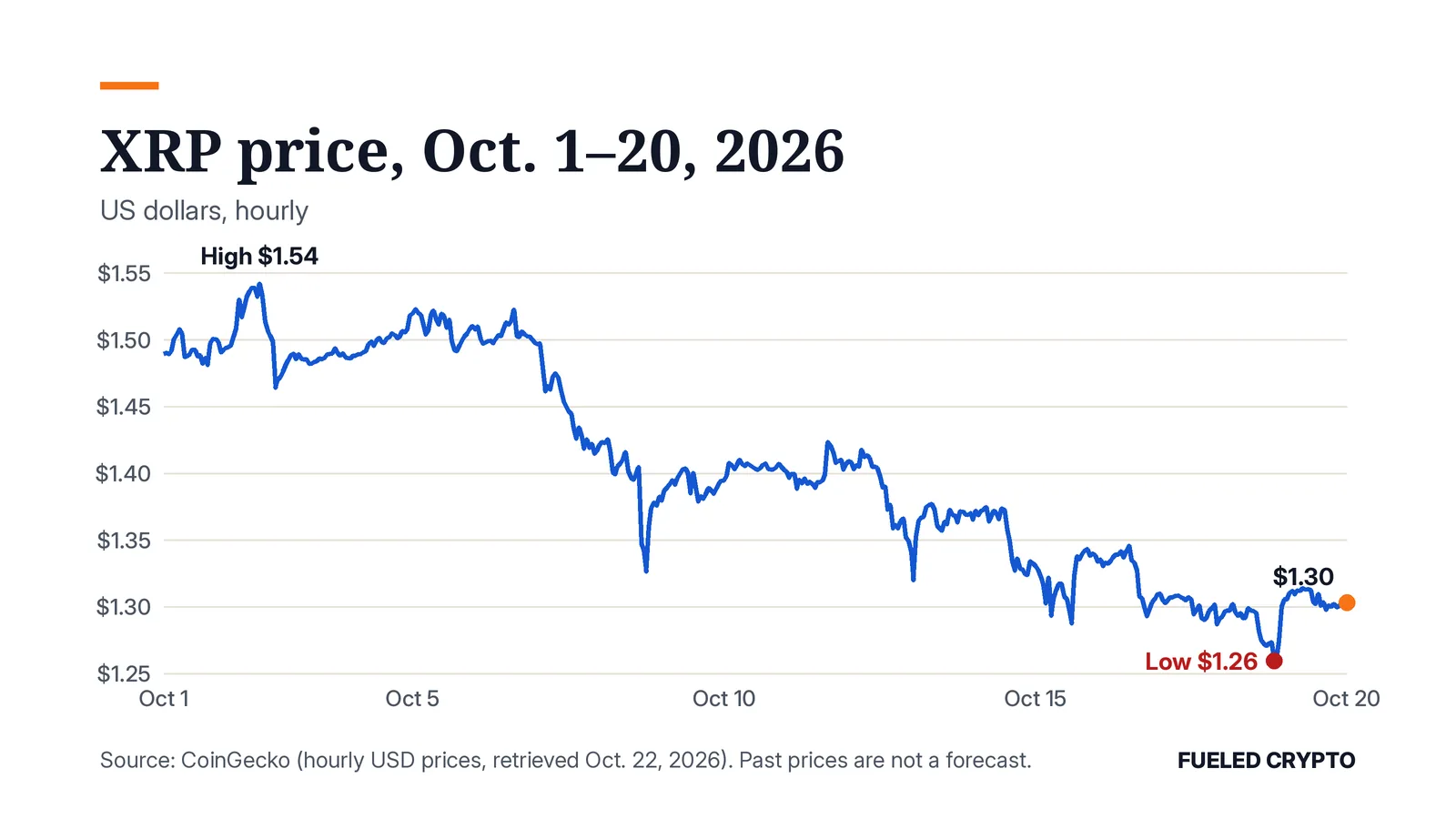
XRP participated in crypto’s latest rebound, but the character of the move matters more than the color of the chart.
CoinDesk reported XRP at roughly $1.31 on October 19, with gains ranging from 0.49% to 1.14% across two market snapshots. Bitcoin traded above $82,000 as stocks recovered, while DeFi tokens led the broader altcoin advance. That is a fairly ordinary risk-market bounce, not evidence that banks suddenly began routing payments through XRP or that tokenized settlement reached a new stage of adoption.
The distinction sounds obvious. Crypto markets routinely ignore it.
Payment-focused assets including XRP, XLM, XDC, HBAR, ALGO and VeChain are frequently grouped under the loose banner of “financial infrastructure.” Their communities point to fast settlement, low transaction costs, enterprise-oriented networks and compatibility with institutional workflows. Those may be useful technical characteristics. They do not mean every price increase reflects demand from payment companies, banks or tokenized-asset platforms.
On October 19, the cleaner explanation was the simpler one: risk appetite improved, Bitcoin bounced with equities and altcoins followed. XRP joined the trade. It did not produce a separate bank-adoption signal.
The market move did not distinguish payment rails from everything else
The available market data shows broad participation rather than a payment-specific catalyst.
In one CoinDesk snapshot, Bitcoin was up 0.42%, Ether gained 0.27%, XRP rose 0.49% and Solana advanced 0.98%. A later snapshot showed Bitcoin up 0.96%, Ether up 0.77%, XRP up 1.14% and Solana up 1.55%. The figures moved as the market moved, which is exactly what intraday snapshots tend to do.
More importantly, CoinDesk characterized DeFi tokens as the leaders of the altcoin gains. That makes it difficult to present XRP’s move as a vote on cross-border settlement. The session was rewarding crypto exposure broadly, with higher-beta areas doing better.
This matters because investors often work backward from price. A token rises, then every available narrative gets recruited to explain the move. For XRP, the familiar explanations involve bank adoption, payment messaging standards and an eventual migration away from legacy correspondent banking. For other infrastructure tokens, the labels change slightly, but the reasoning is similar.
Price alone cannot tell us whether any of that is happening.
A bank can experiment with a blockchain without purchasing its public token. A payment processor can use distributed-ledger software while settling obligations in conventional money. A tokenization platform can issue assets on a network while relying on stablecoins, bank deposits or off-chain cash accounts for payment. Even successful network adoption may leave the native asset with a narrow operational role.
That is the uncomfortable but necessary question for payment-token investors: who must buy the token, and why?
Bank adoption and token adoption are different events
Banks do not adopt technology in the same way retail users adopt an app. They integrate systems around compliance controls, liquidity management, accounting, operational resilience and legal responsibility.
A blockchain may improve one piece of that machinery without becoming the settlement asset at its center.
Consider a hypothetical cross-border payment. A US business sends dollars to a supplier in another country. The payment provider must identify both parties, screen the transaction, quote an exchange rate, move value between jurisdictions and ensure the recipient can withdraw usable local currency. A blockchain can potentially improve the transfer or reconciliation layer. Yet the native token captures meaningful demand only if it is required somewhere in that process.
If the provider can use tokenized bank deposits or dollar stablecoins instead, the network may gain activity without producing durable demand for a volatile bridge asset. If market makers hold the token for only a few seconds, transaction volume may look impressive while the amount of capital committed remains modest. If transfers occur between related entities, headline volume may reveal little about outside customer adoption.
This does not make payment tokens useless. It makes their investment cases more specific than the slogans suggest.
For XRP, XLM, XDC, HBAR, ALGO and VeChain, the relevant issue is not whether the underlying network can transfer an asset. Most modern blockchains can do that. The question is whether regulated institutions choose that network for production activity and whether the native token performs an economically necessary function within the resulting workflow.
Those are two separate hurdles.
ISO 20022 still does not choose a settlement asset
Payment-token discussions often circle back to ISO 20022, the financial messaging standard used to structure richer payment information. The standard can help institutions exchange consistent data about transactions. It does not dictate that a bank use XRP, XLM or any other crypto asset to settle them.
Messaging and settlement are connected, but they are not interchangeable.
A bank can send standardized payment instructions while settling through correspondent accounts. It can use the same data format alongside a tokenized deposit system. It could also connect that messaging layer to a blockchain-based payment network. Compatibility may make integration easier, but it does not confer exclusivity or create automatic token demand.
For investors, the practical lesson is to treat ISO 20022 claims as the beginning of due diligence rather than the conclusion. The useful questions are concrete:
Does the institution describe a production deployment or a pilot? Are real customer payments moving, or is the project testing technical connectivity? Is the public token required for settlement? Who supplies liquidity between currencies? What happens when a transaction is delayed, reversed or disputed? Which entity bears the loss if the conversion price moves?
Without answers, “bank-ready” remains a technical description, not an adoption metric.
Tokenized finance may favor cash-like settlement assets
The expansion of tokenized securities creates a genuine opening for blockchain infrastructure. Assets that trade outside conventional market hours need payment systems capable of keeping up. A tokenized bond is not especially useful at midnight if the cash leg must wait for a bank to open the next morning.
But that opportunity does not automatically favor every native token marketed as a settlement asset.
Financial institutions generally prefer to match the asset being paid with a settlement instrument whose value and legal treatment they can understand. For dollar-denominated securities, that may favor tokenized dollars, regulated stablecoins or bank-issued deposit tokens. A volatile intermediary adds price risk and another conversion step unless it delivers enough liquidity or efficiency to justify the complication.
Native tokens could still serve as network resources, collateral or temporary bridge assets. The burden is to demonstrate that those roles create sustained demand rather than momentary throughput.
That is why production details matter more than partnership counts. A named relationship may cover software evaluation, membership in an industry group or limited testing. None of those outcomes is meaningless, but neither is equivalent to a bank holding the token or using it to settle customer obligations at scale.
What investors should take from the rebound
XRP’s October 19 gain showed that it remains connected to the wider crypto market. When Bitcoin and equities recover, capital can rotate into large, liquid altcoins. That liquidity has value for traders and may eventually matter to payment providers seeking efficient conversion. It is not, by itself, proof of payment adoption.
Readers evaluating XRP or its infrastructure-focused peers should separate three claims that are often bundled together: the network works, institutions are testing it and the token benefits economically. Evidence for one does not establish the other two.
The next meaningful signal will not be another broad-market bounce or another compatibility label. It will be a documented production flow that identifies what is being settled, which institutions are involved, how liquidity is provided and why the native asset is necessary.
Until then, XRP’s move above and around $1.31 belongs in the market column, not the bank-adoption ledger.
Educational only. Not financial, investment, tax, or legal advice. Do your own research. Read the full disclaimer.