Arf and Ripple Plan RLUSD Settlement Loans for Payment Firms on the XRP Ledger
Swiss-regulated Arf will lend Ripple's RLUSD stablecoin to licensed cross-border payment companies. Its later on-chain lending phase still needs XRPL validator votes.
By Fueled Crypto Newsroom · AI-assisted · 3 min read
Payment firms often have to pay out in one country before funds from another country arrive. Arf fills that gap with short-term credit. In the first phase, Arf will provide RLUSD liquidity directly, typically repaid in one to five days, and the same capital can be lent again as payments clear.
"Payment companies need capital to keep money moving while they wait for funds to settle," said Arf co-founder and CEO Ali Erhat Nalbant. "Through this partnership with Ripple, we're bringing stablecoin working capital to the XRP Ledger." Jasmine Cooper, head of product at RippleX, said settlement liquidity "is exactly the kind of use case XRPL and RLUSD are built to support."
Settlement liquidity is exactly the kind of use case @XRP Ledger and RLUSD are built to support.@Arf_One is bringing its approach to settlement liquidity to the XRP Ledger, using RLUSD to support short-term working capital for licensed payment companies as cross-border payments… https://t.co/h4XdEzA3IF
Since launching in November 2022, Arf says it has scaled to about $10 billion a year in global settlement volume, with capital turning over four times a month. It is headquartered in Zug and is a member of VQF, a Swiss self-regulatory organization. Crypto Briefing notes that Arf previously operated on the Stellar network and merged with Huma Finance in 2024, and that Arf reports a 0% default rate over more than 1,400 days. Those are Arf's own figures.
Fueled Crypto Daily
Get the news, explained, by email.
Borrowers don't have to touch a blockchain. Arf says payment companies can benefit without operating on-chain, and underwriting decisions stay with Arf, off-chain.
Arf is bringing settlement liquidity to the @XRP Ledger.
Cross-border payments move trillions of dollars every year, but the capital needed to move that money often remains tied up across markets.
EconoTimes points out that the announcement gave no start date, no RLUSD amount, no participating payment firms and no pricing. Arf also didn't say how much of its $10 billion volume would move to this program.
In this setup, RLUSD is the money being lent. XRP's role is narrower: Arf says XRPL transactions need fees paid in XRP, and accounts and some ledger objects carry XRP reserve requirements. More lending activity means more of those small, recurring uses of the network's token.
The second phase depends on a vote
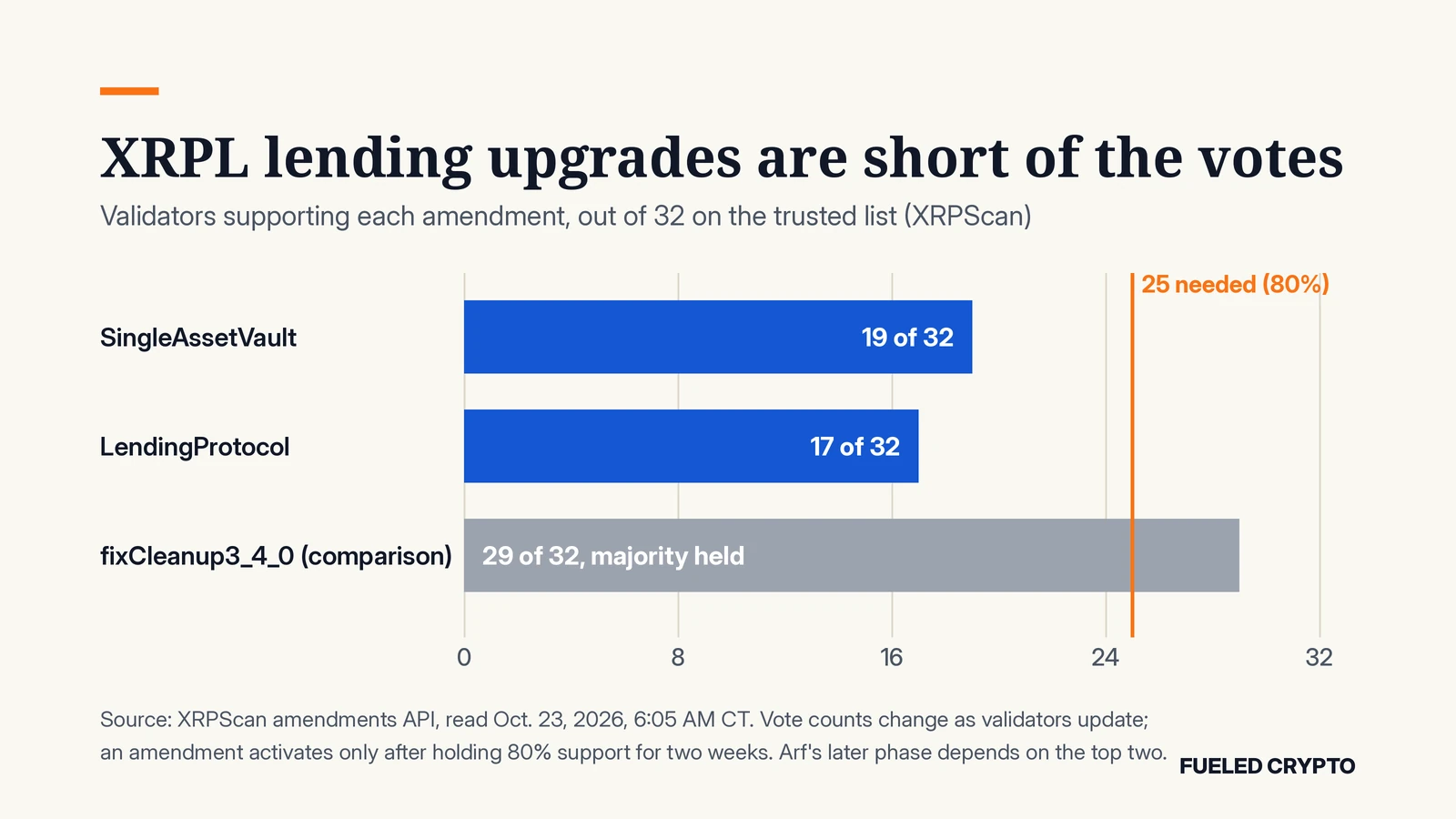
Arf's later phase would run the loans through two native XRPL features: Single Asset Vaults, which pool capital on-chain, and the Lending Protocol, which extends it as structured loans. Bitcoin.com News reports those are amendments XLS-65 and XLS-66, and that a related update, LendingProtocolV1_1, is also required.
Amendments take effect only after more than 80% of trusted validators support them for two weeks. As of early Friday, neither had the votes:
The XRPL known amendments page tracks status, and EconoTimes notes the ledger's website lists native lending as "Coming Soon." For more on the token itself, see our XRP hub.
MAS says the three central banks will work with firms including Ripple, Visa and Mastercard on how stablecoins and tokenized deposits settle across borders. No XRP role was announced.
Rising crypto vault deposits and a broad market rebound show capital returning on-chain, but US payment adoption depends on whether dollar liquidity remains available for ordinary settlement.
XRP rose alongside a broader market recovery, but payment-focused tokens still need evidence that financial institutions require the assets themselves.