Solana Switches On Alpenglow, Cutting Finality to About 150 Milliseconds
Solana swapped out its consensus protocol on Wednesday. Wallet users don't need to do anything, but validators, indexers and exchanges have real work to do.
By Fueled Crypto Newsroom · AI-assisted · 4 min read
Solana replaced its consensus protocol on Wednesday morning. According to the network's official upgrade page, Alpenglow activated at the start of epoch 1064, around 13:36 UTC (8:36 a.m. CT). It took over from TowerBFT, the voting system Solana had used until now, after a 5,000-slot handoff window.
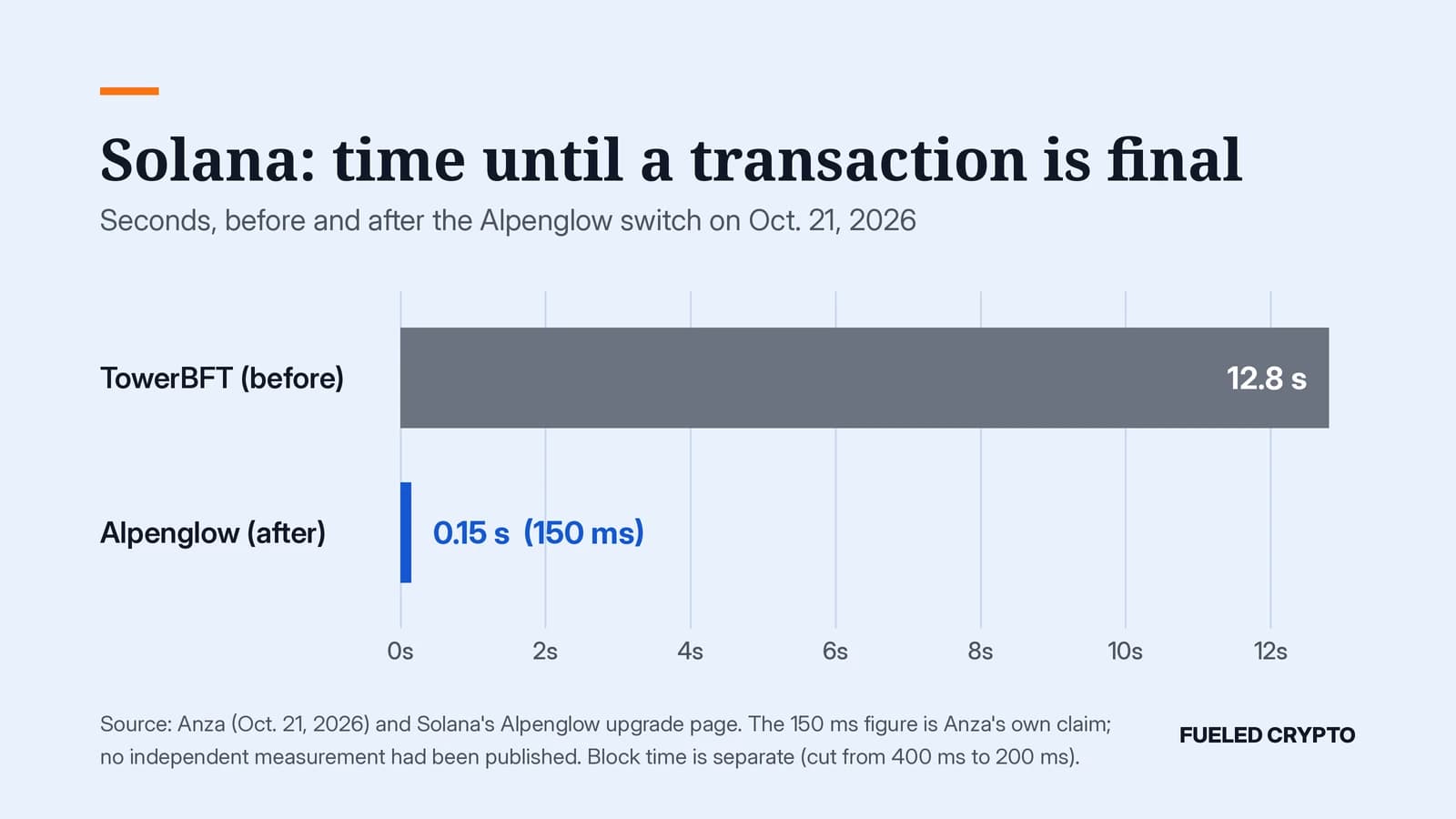
Anza, the engineering firm that built the upgrade, posted the result at 8:54 a.m. CT. It says finality fell from 12.8 seconds to 150 milliseconds. Finality is the point at which a transaction can't be reversed.
Alpenglow is live on mainnet-beta ⛰️ 🎉
Solana’s new consensus protocol: finality reduced from 12.8 seconds to 150 milliseconds, built by Anza.
The feature turned on at the epoch boundary. The network kept running TowerBFT for the first 5,000 slots, which took about 18 minutes, and the last block of that window, slot 459,652,999, became the Alpenglow "genesis" block. Solana's page says 446 of the network's 654 validators signed the certificate for it. Alpenglow consensus began at slot 459,653,000, and Anza put the handoff at about 900 milliseconds.
Under TowerBFT, validators voted by sending transactions, and a block became final once enough votes stacked up over 32 slots. Under Alpenglow's voting protocol, Votor, validators send votes directly to each other and bundle them into certificates, so a block is final after one or two rounds of voting. Vote transactions no longer appear in blocks at all.
Fueled Crypto Daily
Get the news, explained, by email.
What didn't change matters too. The upgrade page says execution "is untouched: the SVM, transactions, programs, and fees stay the same."
What it means if you just hold SOL
For regular users, Solana's own checklist is short: "No action needed." Signing, sending and approving transactions work the same, and wallets and apps behave as before.
Anza told The Block the faster finality is aimed at exchanges crediting deposits and merchants processing payments. Whether any given exchange will shorten its confirmation wait is up to that exchange. None had announced a change in the sources we reviewed.
Solana co-founder toly (@toly) played down the hype the same afternoon:
Two numbers get mixed up here, so it helps to separate them. The 150 ms figure is how long a transaction takes to become final. It is not how often blocks are produced. Solana's page says block time was cut separately, from 400 ms to 200 ms, in four stages that finished this month.
The work falls on operators
Most of the breaking changes hit the infrastructure layer:
Validators had to run version 4.3.2 of an Agave-based client (Agave, Jito-Solana or Harmonic Salsa). Firedancer and Frankendancer "were not supported for the migration," the upgrade page says. Validators also need at least 0.8 SOL above the rent-exempt minimum in their vote account to pay a new per-epoch "Validator Admission Ticket" fee, or they stop voting and producing blocks the next epoch.
Indexers, explorers and trading systems that stream block data must handle more than one candidate block per slot and stop counting vote transactions. The "confirmed" and "finalized" commitment levels now describe the same state.
What's next
Solana's upgrade page says Rotor, a second phase that changes how block data spreads across the network, is planned for a later release but not yet scheduled. The Block reports that Anza also described Quantumglow, a research design that would swap Alpenglow's elliptic-curve cryptography for hash-based signatures. Neither has a release date.
One caution from Solana Compass: the 150 ms figure is Anza's own, and no independent post-switch measurement had been published when that outlet reported on Wednesday.
A visible AI credit on a crypto market story is useful, but readers still need to know what the system produced, what a human checked, and when the underlying data was captured.