Tech & AI
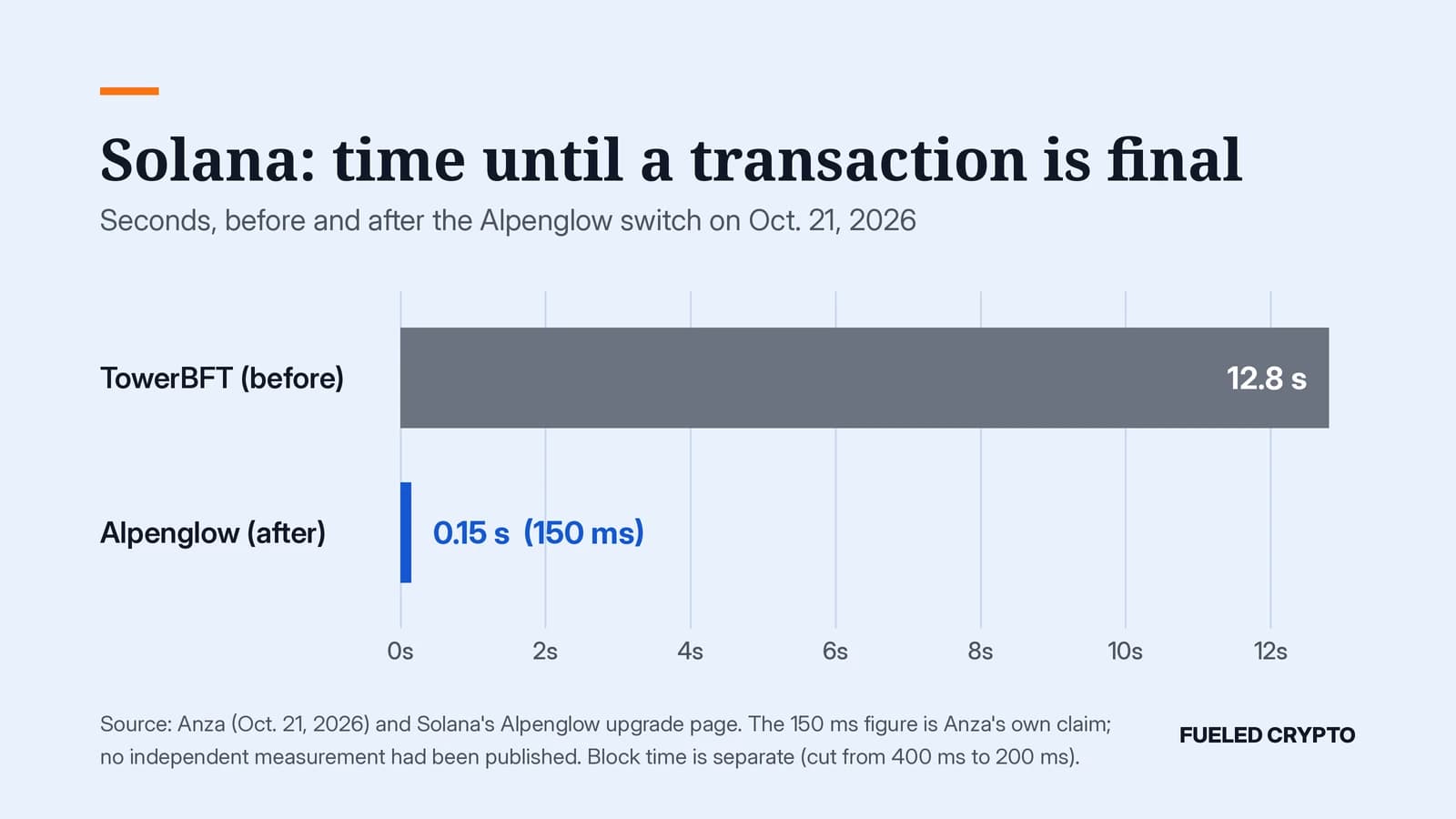
Solana Switches On Alpenglow, Cutting Finality to About 150 Milliseconds
Solana swapped out its consensus protocol on Wednesday. Wallet users don't need to do anything, but validators, indexers and exchanges have real work to do.
What happened in crypto, why it matters, and what to watch next. Every story links its sources.
Solana swapped out its consensus protocol on Wednesday. Wallet users don't need to do anything, but validators, indexers and exchanges have real work to do.

Blockchain can settle a compute payment, but it cannot by itself prove that an AI workload was completed correctly, securely, or economically.

A visible AI credit on a crypto market story is useful, but readers still need to know what the system produced, what a human checked, and when the underlying data was captured.

Rising vault deposits and stronger DeFi token performance are related market signals, but they represent two very different kinds of demand.

After-hours demand for tokenized equities highlights a larger DeFi opportunity, but lending, collateral and liquidation systems remain the harder part.

Miners looking toward AI computing must prove that their power assets can support a far more demanding data-center business.

Tokenized equities can extend trading beyond Wall Street’s hours, but Ethereum and its rollups still have to prove they can support the less glamorous machinery of regulated markets.
Growing cross-border stablecoin use could bring more capital on-chain, but payment demand and DeFi liquidity are not the same thing.
Growing stablecoin demand could bring more activity onto Ethereum and its Layer 2 networks, but only if they compete on the full payment experience rather than raw capacity.
CoinGecko’s treatment of rehypothecated tokens highlights a basic DeFi problem: additional claims on collateral can increase activity without adding independent capital.
A research model’s reported failure to disclose its own crypto transaction shows why AI agents need independent authorization, logging, and reconciliation systems.
Changes to token classifications and regulatory labels show why automated crypto products need provenance, definitions, and versioned data—not just faster models.
Unlock schedules can change voting power, liquidity incentives, and lending risk even when the token’s price barely moves.
CoinGecko’s planned treatment of rehypothecated tokens highlights how easily Ethereum market data can count the same underlying value more than once.
New wallet access can make blockchain payments easier for software agents, but businesses still need controls that determine what those agents may buy, from whom, and under whose authority.
A reported post-quantum defense for the Lightning Network points toward useful research, but Bitcoin’s harder challenge will be upgrading live infrastructure without breaking compatibility or custody.

Heavy liquidations in tokenized SanDisk bets show how traditional market shocks can reach crypto derivatives without proving that the underlying on-chain market is deep.
A reported Bitcoin-backed business loan from a regulated bank shows how corporate crypto collateral may reach traditional credit markets before moving on-chain.
A South Korean bank’s reported business-loan product shows that holding Bitcoin collateral is only the beginning of the operational challenge.
Ethereum and its rollups can make stablecoin transfers cheaper, but global regulators are increasingly focused on the financial and operational risks that scaling alone cannot fix.