Deck: Tapping "Send" kicks off a short journey: your wallet signs, the network passes it around, it waits its turn, and it lands in a block. Here's each step in plain English, plus why fees go up and down and what "confirmations" actually mean.
Last reviewed: October 24, 2026
The first time you send crypto, the waiting can feel strange. The app says "pending," the coins have left your balance, and nothing seems to happen for a while. Then it says "confirmed," maybe with a number next to it.
Let's dig into what's going on in that gap, one step at a time. This guide builds on two others. How a Blockchain Works covers blocks, nodes and consensus, and Keys, Addresses and Wallets covers what your wallet holds and how it signs. We'll lean on both rather than repeat them.
The short version
- You sign. Your wallet writes the transaction and signs it with your private key.
- It's broadcast. The signed transaction goes out to nodes, which pass it along.
- It waits. It sits with other pending transactions until a block has room for it.
- It lands in a block. A miner or validator includes it in a new block.
- It gets confirmed. Each block added after that makes it harder to undo. How long until it's final depends on the network.
- You pay a fee for the block space. Fees rise when lots of people want in at once.
- There's no undo. Once it's confirmed, only the person you paid can send it back.
The journey, step by step
1. Your wallet builds and signs it
When you fill in an address and an amount, your wallet writes a transaction that says, in effect, "move this much from my address to that one, and here's the fee I'll pay." Then it signs it with your private key, proving the request came from you without revealing the key. ethereum.org describes the signature as what "confirms the sender has authorized this transaction" (ethereum.org: transactions). We cover signing in more depth in Keys, Addresses and Wallets.
2. It's broadcast to the network
Your wallet hands the signed transaction to one or more nodes. Each node checks that it's valid and passes it on to others, so within moments much of the network has a copy (Bitcoin developer guide: P2P network).
3. It waits its turn
Valid transactions that aren't in a block yet sit in what's basically a waiting room. Bitcoin software calls it the memory pool, or mempool (Bitcoin developer guide: P2P network). ethereum.org calls it a "transaction pool consisting of all other pending network transactions" (ethereum.org: transactions). This is the "pending" stage you see in your wallet.
4. It lands in a block
A miner (on proof-of-work networks like Bitcoin) or a validator (on proof-of-stake networks like Ethereum) picks transactions from the waiting room and packs them into a new block. Blocks have limited room, which is the whole reason fees exist. More on that below. The XRP Ledger works a little differently: its validators agree on a new ledger version every few seconds, which includes the waiting transactions that are ready (xrpl.org).
5. It collects confirmations
Once your transaction is in a block, it has one confirmation. Every new block added on top adds another. Because each block points back to the one before it (the chain from the blockchain guide), undoing your transaction would mean redoing every block that came after it, and that gets harder with each one. bitcoin.org puts it this way: transactions "accumulate confirmations, each making them increasingly difficult to reverse" (bitcoin.org: some things you need to know).
How long until it's final?
This is where networks really differ.
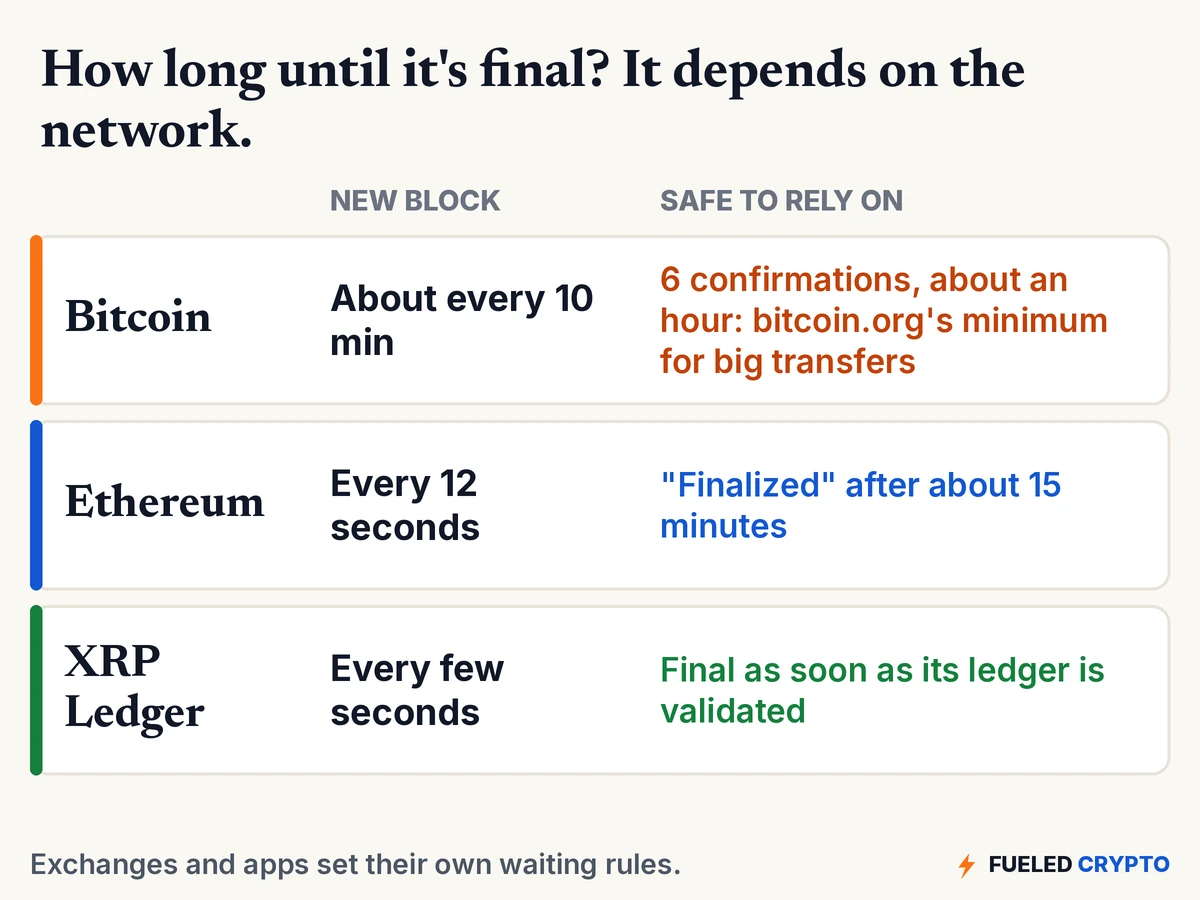
- Bitcoin adds a block about every 10 minutes. bitcoin.org's table rates a single confirmation as only "somewhat" or "mostly" reliable, depending on the wallet, and lists 6 confirmations as the "minimum recommendation for high-value bitcoin transfers" (bitcoin.org). Six blocks at roughly 10 minutes each is about an hour, though block times vary.
- Ethereum adds a block every 12 seconds, and a transaction is "finalized" once its block is locked in by validators. ethereum.org says that currently "takes about 15 minutes" (ethereum.org: single slot finality, ethereum.org: proof-of-stake).
- The XRP Ledger agrees on a new ledger version every few seconds (xrpl.org). Once a ledger version is validated, "its contents can never change" (xrpl.org: ledger structure).
That's also why an exchange might show your deposit as "pending" for a while after your wallet says it's sent. Each exchange decides how many confirmations it waits for on each network.
Fees: what you're paying for
Every block has limited space, and a fee is what you offer to get your transaction into it. It's also what stops someone from flooding the network with junk for free.
Who gets the fee?
It depends on the network:
| Network | Where the fee goes | Source |
|---|---|---|
| Bitcoin | To the miner who includes your transaction | Bitcoin developer guide |
| Ethereum | A base fee that is burned (destroyed), plus an optional tip to the validator | ethereum.org: gas |
| XRP Ledger | A small amount of XRP that is destroyed, not paid to anyone | xrpl.org: transaction cost |
Either way, the fee never goes to the person you're paying. If you send 1 coin, they get 1 coin, and the fee comes out on top of it.
What sets the size of the fee?
Usually it's how much work or space your transaction takes, not how much money you're sending. Sending a large amount can cost the same fee as sending a small one.
- Bitcoin fees are "based on the total byte size of the signed transaction," and the price per byte rises "as demand increases" (Bitcoin developer guide: transactions).
- Ethereum measures work in "gas." A plain ETH transfer uses 21,000 gas, and you pay that times the base fee plus your tip. Gas prices are quoted in gwei, a billionth of an ETH (ethereum.org: gas).
- The XRP Ledger has a minimum cost of 10 drops for a standard transaction, which is 0.00001 XRP. It can rise when the network is under unusual load (xrpl.org: transaction cost).
Why fees go up when the network is busy
Think of it like a few seats on a bus with a crowd at the stop. When it's quiet, everyone gets on. When it's busy, the transactions offering more get picked first, and the rest wait for the next block or the one after. On Ethereum, the tip is literally there "to make your transaction attractive to validators," and ethereum.org notes that when "there is a lot of demand then you might have to set your priority fee higher" (ethereum.org: gas).
Most wallets estimate a fee for you, and many let you choose slower and cheaper or faster and pricier. If you're not in a hurry and the network is busy, waiting for a quieter time is a perfectly reasonable choice.
One more thing worth knowing: if you're withdrawing from an exchange, the exchange may charge its own withdrawal fee on top of, or instead of, showing you the network fee. Check its fee page before you send.
When a transaction is stuck
If you offer a fee that's too low during a busy stretch, your transaction can sit in the waiting room for a long time. On Bitcoin, unconfirmed transactions aren't stored forever: they can "slowly disappear from the network" as nodes restart or clear space (Bitcoin developer guide: P2P network). If that happens, the coins were never actually moved, and your wallet will show them as spendable again.
Some wallets offer a "speed up" or "cancel" button for pending transactions. How that works, and whether it's available, depends on the wallet and the network, so check your wallet's own help pages. To see exactly where a transaction stands, look it up by its transaction ID on a block explorer. Our explorer guide walks you through it.
There's no undo button
Once a transaction is confirmed, nobody can reverse it: not your wallet, not the network, and not a support team. bitcoin.org says "a Bitcoin transaction cannot be reversed, it can only be refunded by the person receiving the funds" (bitcoin.org), and ethereum.org gives the same warning for Ethereum (ethereum.org: wallets).
That's why scammers push people to send quickly, and why anyone promising to "recover" sent crypto for an upfront fee deserves a lot of suspicion. See How to Avoid Crypto Scams, and if something has already gone wrong, What to Do If Your Crypto Is Stolen.
Before you hit Send
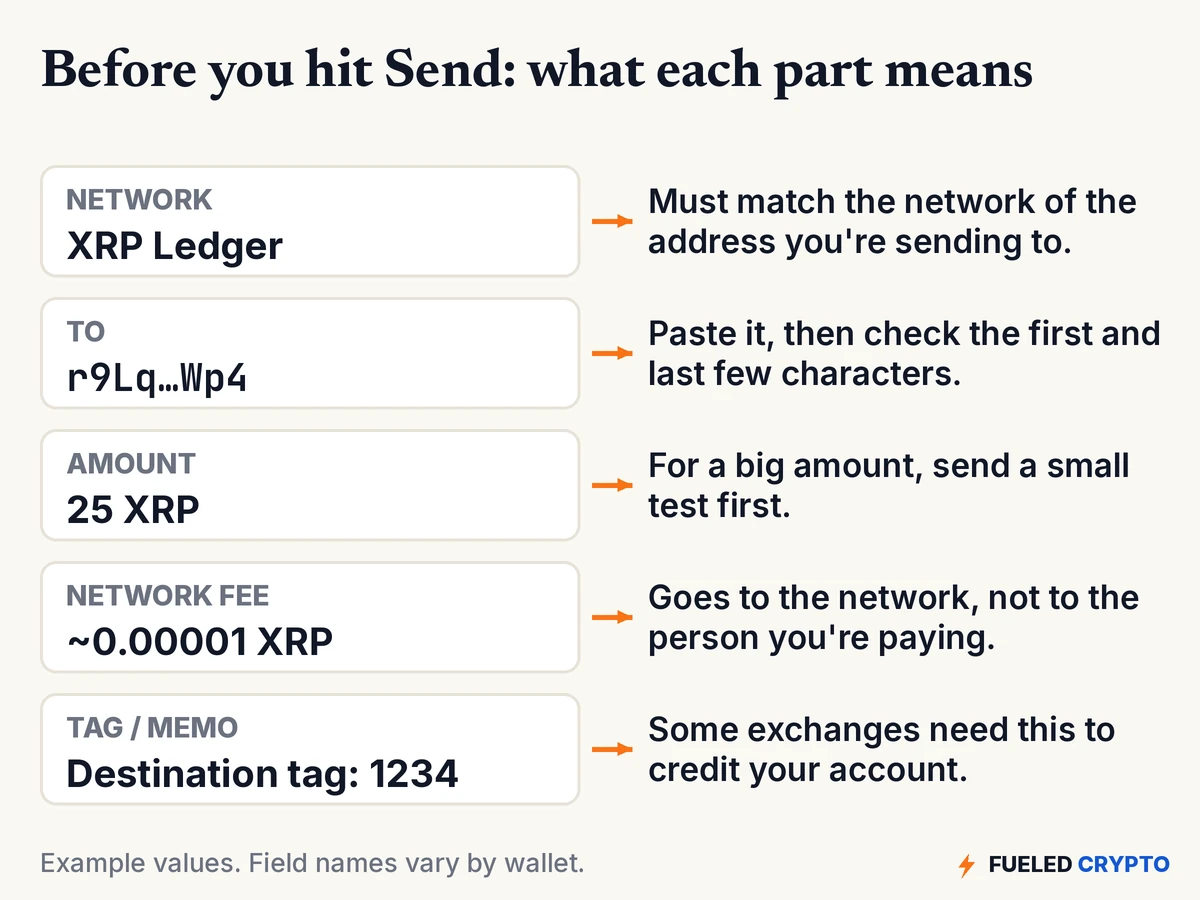
A short checklist that covers most of the expensive mistakes people make:
- Match the network. Sending a coin on the wrong network can mean losing it. Address formats differ by network, which Keys, Addresses and Wallets explains.
- Paste, don't type, then check. Compare the first and last few characters with the address you meant to use. A wrong address can't be fixed after the fact.
- Include the tag or memo if asked. Some exchanges need an XRP destination tag to know which customer to credit (xrpl.org: destination tags).
- Send a small test first for anything you'd hate to lose, and wait until it arrives. How to Move Crypto to Cold Storage shows this step in practice.
- Look at the fee before you confirm, and decide whether now is a good time.
Words you'll keep hearing
- Transaction: a signed instruction to move crypto from one address to another.
- Broadcast: sending a signed transaction out to the network's nodes.
- Mempool (memory pool): the waiting room of valid transactions not yet in a block.
- Pending / unconfirmed: sent, but not yet in a block.
- Confirmation: each block that includes or builds on your transaction. Its own block is the first.
- Finality: the point at which a transaction can't realistically be reversed.
- Network fee: what you pay to get your transaction into a block.
- Gas / gwei: Ethereum's unit of work, and the tiny ETH unit (a billionth) used to price it.
- Transaction ID (hash): the unique code you can search on a block explorer to track a transaction.
- Destination tag / memo: an extra number or note some exchanges need to credit your deposit.
Frequently asked questions
How do crypto transactions work? Your wallet signs a transaction with your private key and broadcasts it to the network. It waits with other pending transactions until a miner or validator puts it in a block, and then it gains confirmations as more blocks are added.
What is a crypto network fee? It's what you pay to get your transaction into a block. Depending on the network, it goes to a miner or validator or is burned. It never goes to the person you're paying.
Why are crypto fees sometimes so high? Block space is limited. When lots of people want to send at the same time, transactions offering higher fees usually get picked first, so the going rate rises until things calm down.
What is a confirmation? When your transaction is included in a block, it has one confirmation. Each block added after that adds another, making the transaction harder to reverse.
How many confirmations does Bitcoin need? There's no single rule. bitcoin.org lists 6 confirmations as the minimum recommendation for high-value transfers, and exchanges set their own requirements.
Why is my crypto transaction still pending? It's probably waiting in the mempool, often because the network is busy or the fee offered was low. Look it up by transaction ID on a block explorer to see its status.
Can you reverse a crypto transaction? No. Once it's confirmed, it can't be undone. The only way to get it back is for the person who received it to send it back.
Where to go next
- How to Read a Blockchain Explorer: track your own transaction and see its confirmations.
- How to Move Crypto to Cold Storage: a real transfer, with a test send, step by step.
- How to Avoid Crypto Scams: since transactions can't be undone, this one's worth reading.
Sources
- Bitcoin Developer Guide, Transactions (fees by byte size, fees go to miners) and P2P network (relaying, memory pool).
- bitcoin.org, Some things you need to know (confirmations table, irreversibility, roughly 10-minute blocks).
- ethereum.org, Transactions, Gas and fees, Proof-of-stake, Single slot finality and Wallets.
- XRP Ledger, About, Ledger structure, Transaction cost and Source and destination tags.
All diagrams and animations are original Fueled Crypto graphics. Addresses, amounts and fees shown in them are made-up examples.
Fueled Crypto publishes news and education, not investment, tax, or legal advice. Crypto assets are volatile and can lose value. Do your own research and consider a licensed professional before making financial decisions. See our full disclaimer.
Want plain-English crypto news once a week? Subscribe to Fueled Crypto.