Deck: Cryptocurrency is money-like value that lives on a shared ledger instead of in a bank's records. Here's what that actually means, how it differs from the dollars in your account, and why "coin" and "token" aren't the same thing.
Last reviewed: October 24, 2026
If you've ever nodded along while someone talked about "crypto" and quietly wondered what it actually is, you're in good company. The FTC's own consumer page opens with: "Confused about cryptocurrencies, like bitcoin or Ether (associated with Ethereum)? You're not alone" (FTC).
This guide is the starting point for our beginner series. We'll keep it to the big picture and point you to the deeper guides as we go. No price talk and no predictions, just what the thing is.
The short version
- Cryptocurrency is a digital asset recorded on a blockchain, a shared ledger kept by many computers instead of one company.
- It's different from bank money. No bank keeps the record, payments generally can't be reversed, and it isn't FDIC-insured.
- A coin is the asset built into a blockchain itself, like BTC on Bitcoin, ETH on Ethereum or XRP on the XRP Ledger.
- A token is an asset someone creates on top of an existing blockchain, like a stablecoin or an NFT.
- Tokens still need the coin to pay the network's fees.
- It isn't anonymous. Most blockchains are public, and transactions can sometimes be traced to people.
So what is it?
The FTC's definition is a fine place to start: "Cryptocurrency is a type of digital currency that generally exists only electronically" (FTC). That's true but leaves out the part that makes it different from, say, the balance in your banking app, which is also just numbers on a screen.
The difference is who keeps the record. Your bank balance is an entry in your bank's private database. A cryptocurrency balance is an entry on a public, shared ledger that thousands of independent computers keep in sync, following rules everyone can check. That shared ledger is the blockchain, and we explain how it works, block by block, in How a Blockchain Works.
The idea goes back to 2008, when the Bitcoin white paper described "a purely peer-to-peer version of electronic cash" that "would allow online payments to be sent directly from one party to another without going through a financial institution" (Bitcoin white paper). Many more have come since, and new ones keep being created (FTC).
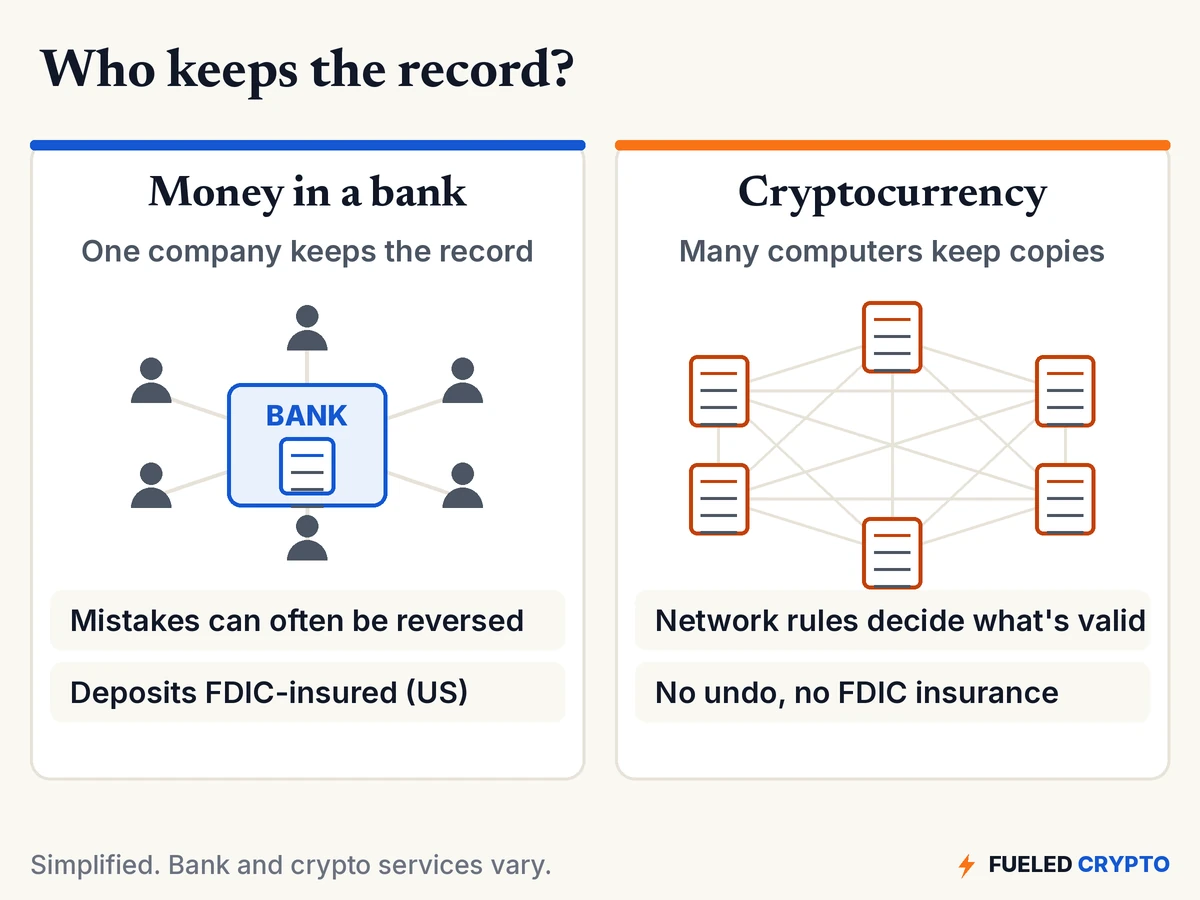
How crypto is different from dollars in the bank
None of these make crypto "better" or "worse." They're just differences worth understanding before you ever touch it.
- No bank in the middle. With crypto you can hold the keys yourself, which means nobody can freeze your account, but also nobody can reset your password. Keys, Addresses and Wallets explains what you actually hold.
- Payments usually can't be undone. The FTC notes that crypto payments "typically are not reversible" and "do not come with legal protections" like the dispute process on a credit card (FTC). Our transactions guide shows why.
- Not FDIC-insured. The FDIC lists crypto assets among the products it does not insure, even when bought through an insured bank (FDIC). The FTC adds that if the company holding your crypto "goes out of business or is hacked," the government "has no obligation to step in" (FTC).
- The supply follows code, not a central bank. Each network sets its own rules. Bitcoin's are the best-known: new bitcoin is created at a "decreasing and predictable rate," and only 21 million will ever exist (bitcoin.org FAQ). Other networks work differently.
- Prices move a lot. The FTC warns that crypto values "can change rapidly, even changing by the hour," and "if the value goes down, there's no guarantee it will go up again" (FTC).
- It's public, not anonymous. Most blockchains are open for anyone to read. bitcoin.org says plainly that "Bitcoin is not anonymous" and "leaves extensive public records" (bitcoin.org FAQ). You can see this for yourself with our blockchain explorer guide.
Coins vs. tokens
You'll hear "coin" and "token" used loosely, sometimes for the same thing. There is a real difference, though, and it's a useful one.
Coins: built into the blockchain
A coin is the native asset of its own blockchain. It's part of the network's rules from the start, and it's what you pay network fees with.
- BTC is the coin of the Bitcoin network.
- ETH is the coin of Ethereum. ethereum.org notes that fees "have to be paid in Ethereum's native currency, ether (ETH)" (ethereum.org: gas).
- XRP is the coin of the XRP Ledger, where a tiny amount is used up as the cost of each transaction (xrpl.org).
Tokens: built on top of a blockchain
A token is an asset that someone creates on a blockchain that already exists. On Ethereum this is done with a small program called a smart contract, and most tokens follow a shared standard called ERC-20, so wallets and apps know how to handle them (ethereum.org: ERC-20). The XRP Ledger has its own built-in token features, and xrpl.org notes that "anyone can issue" tokens there (xrpl.org: tokens).
That last point trips up a lot of beginners. If you hold a token on Ethereum but no ETH, you can't move the token, because the network fee has to be paid in ETH (ethereum.org: gas).
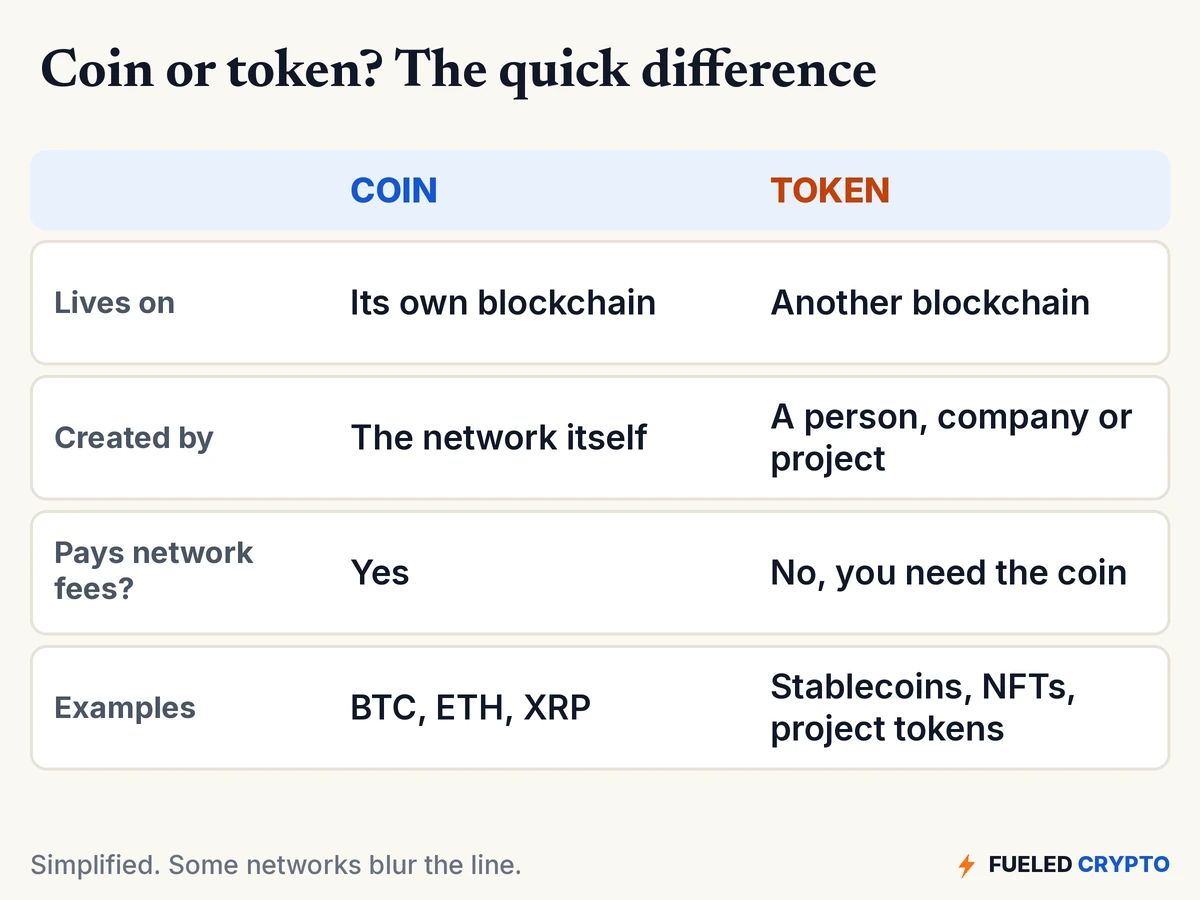
A few kinds of tokens you'll hear about
- Stablecoins are tokens "designed to stay at a fixed value," usually one US dollar (ethereum.org: stablecoins). They're issued by companies or protocols, so who stands behind them matters. In the US, payment stablecoins now have their own federal law, covered in our GENIUS Act explainer.
- NFTs (non-fungible tokens) represent something unique, like a piece of digital art or an in-game item (ethereum.org: NFTs, xrpl.org: tokens). Regular tokens are interchangeable, one for one. An NFT isn't.
- Tokenized real-world assets are tokens meant to represent something off-chain, like a bond or a fund share. See Tokenization of Real-World Assets.
- Project tokens are created by a specific app or project, for voting, rewards or access. Anyone can make one, which brings us to the next point.
Being on a big blockchain doesn't make a token safe
Because anyone can create a token, a token living on Ethereum or the XRP Ledger tells you nothing about whether the people behind it are trustworthy. The FTC specifically warns about scammers who "impersonate new or established businesses offering fraudulent crypto coins or tokens" (FTC). It suggests checking whether a company has really issued a coin or token, since "it will be widely reported in established media if it is true." More in How to Avoid Crypto Scams.
Common mix-ups (and the facts)
- "Crypto means Bitcoin." Bitcoin was the first, but there are many different cryptocurrencies, and they work in different ways.
- "Every crypto is its own blockchain." Only coins are. Many of the assets you'll see listed on exchanges are tokens running on someone else's chain.
- "A token on Ethereum is backed by Ethereum." No. It runs on Ethereum, but whoever created it is responsible for what it is and whether it's worth anything.
- "Crypto is anonymous." Mostly public, actually. The FTC notes it's "sometimes possible" to use transaction and wallet information to identify people (FTC).
- "My crypto is insured like my bank account." It isn't covered by FDIC insurance (FDIC).
Words you'll keep hearing
- Cryptocurrency (crypto): a digital asset recorded on a blockchain.
- Blockchain: a shared ledger kept in sync by many computers.
- Coin: the native asset of its own blockchain, used to pay that network's fees.
- Token: an asset created on top of an existing blockchain.
- Smart contract: a program that runs on a blockchain. On Ethereum, tokens are made with them.
- ERC-20: Ethereum's common standard for interchangeable tokens.
- Stablecoin: a token designed to hold a steady value, usually one US dollar.
- NFT: a non-fungible token, one that represents something unique.
- Fungible: interchangeable. Any one unit is the same as any other.
Frequently asked questions
What is cryptocurrency in simple terms? It's a digital asset whose ownership is recorded on a blockchain, a shared ledger kept by many independent computers instead of a single bank or company.
How is cryptocurrency different from regular money? No bank keeps the record, payments generally can't be reversed, it isn't FDIC-insured, and its supply follows each network's rules rather than a central bank. Its price can also change quickly.
What's the difference between a coin and a token? A coin is the native asset of its own blockchain, like BTC, ETH or XRP. A token is created on top of an existing blockchain, like a stablecoin or an NFT, and moving it still requires the chain's coin to pay fees.
What is a stablecoin? A token designed to hold a steady value, usually one US dollar. It's issued by a company or protocol, so it depends on whoever stands behind it.
Is cryptocurrency FDIC-insured? No. The FDIC lists crypto assets among the products it doesn't insure, even if you bought them through an insured bank.
Is cryptocurrency anonymous? Not really. Most blockchains are public, and transaction and wallet information can sometimes be used to identify the people involved.
Can anyone create a cryptocurrency? Creating a new blockchain takes real work, but creating a token on an existing blockchain is easy, which is why there are so many and why a token's mere existence says nothing about whether it's legitimate.
Where to go next
This is the first stop in our beginner series. Read the others in order:
- How a Blockchain Works: blocks, hashes, nodes and consensus.
- Keys, Addresses and Wallets: what your wallet actually holds.
- How Crypto Transactions Work: sending, fees and confirmations.
Curious why prices swing so much? Crypto Market Cycles explains the patterns without predictions.
Sources
- Federal Trade Commission, What To Know About Cryptocurrency and Scams (definition, differences from dollars, reversibility, privacy, token scams).
- FDIC, Deposit Insurance (crypto assets not insured).
- Satoshi Nakamoto, Bitcoin: A Peer-to-Peer Electronic Cash System (2008), and bitcoin.org, FAQ (21 million limit, not anonymous).
- ethereum.org, Gas and fees, ERC-20 token standard, Stablecoins and NFTs.
- XRP Ledger, Tokens and Transaction cost.
All diagrams and animations are original Fueled Crypto graphics. Token labels in them are generic examples, not specific products.
Fueled Crypto publishes news and education, not investment, tax, or legal advice. Crypto assets are volatile and can lose value. Do your own research and consider a licensed professional before making financial decisions. See our full disclaimer.
Want plain-English crypto news once a week? Subscribe to Fueled Crypto.