Deck: Crypto ATMs turn cash into crypto and send it to whatever address you scan. That makes them simple to use, and it's also why scammers love them. Here's how they work, what federal agencies say about fees, and the warning signs to share with the people you care about.
Last reviewed: October 24, 2026
I'd walked past crypto ATMs at gas stations for years without really knowing what they did. When I finally read what the FTC and FBI say about them, two things stood out: how simple they are, and how often that simplicity gets used against people, especially older adults.
This guide explains both sides. It doesn't name or rate any machine or company.
The short version
- A crypto ATM (or kiosk) turns cash into crypto and sends it to an address you scan or type. It doesn't hold your money like a bank ATM.
- Whoever owns that address gets the crypto. If someone else handed you the QR code, it's theirs.
- Fees can be high. FinCEN reports kiosk fees ranging from 7 to 20 percent.
- Scams are common. The FBI's IC3 received more than 13,400 complaints involving kiosks in 2025, with losses over $388 million.
- The rule of thumb: no real government agency, bank or company will tell you to pay at a crypto ATM.
What a crypto ATM is
FinCEN, the Treasury bureau that oversees money transmitters, calls them "ATM-like devices or electronic terminals that allow customers to exchange real (or fiat) currency for virtual currency and vice versa." The FTC notes they've "been popping up at convenience stores, gas stations, and other high-traffic areas for years."
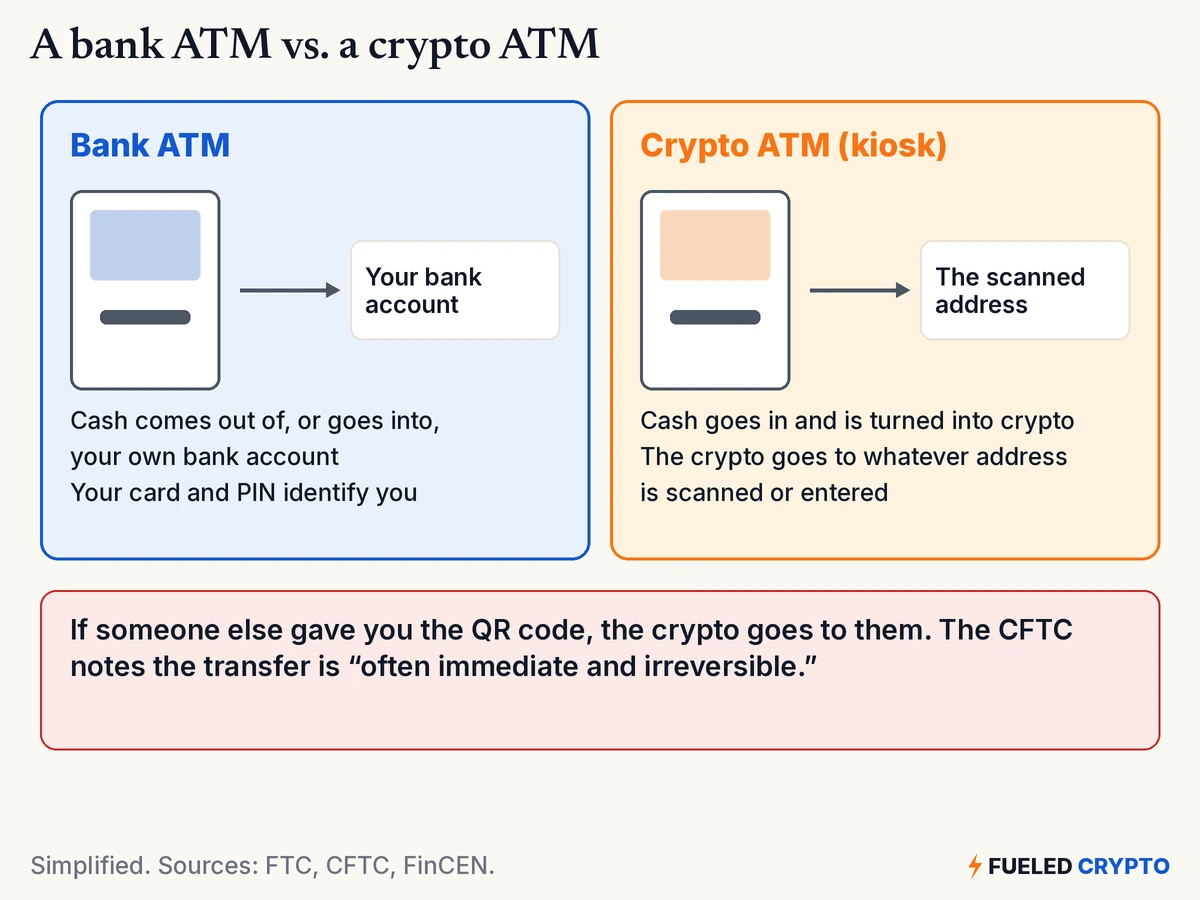
The CFTC explains the key difference: "Unlike a typical ATM, where cash can be deposited into or withdrawn from an account managed by the ATM's user, cash deposited into a crypto ATM is converted into various forms of cryptocurrency and deposited into a specified crypto address." FinCEN adds that some machines also let you sell crypto, not just buy it.
How a purchase works
FinCEN described the steps in a 2025 notice:
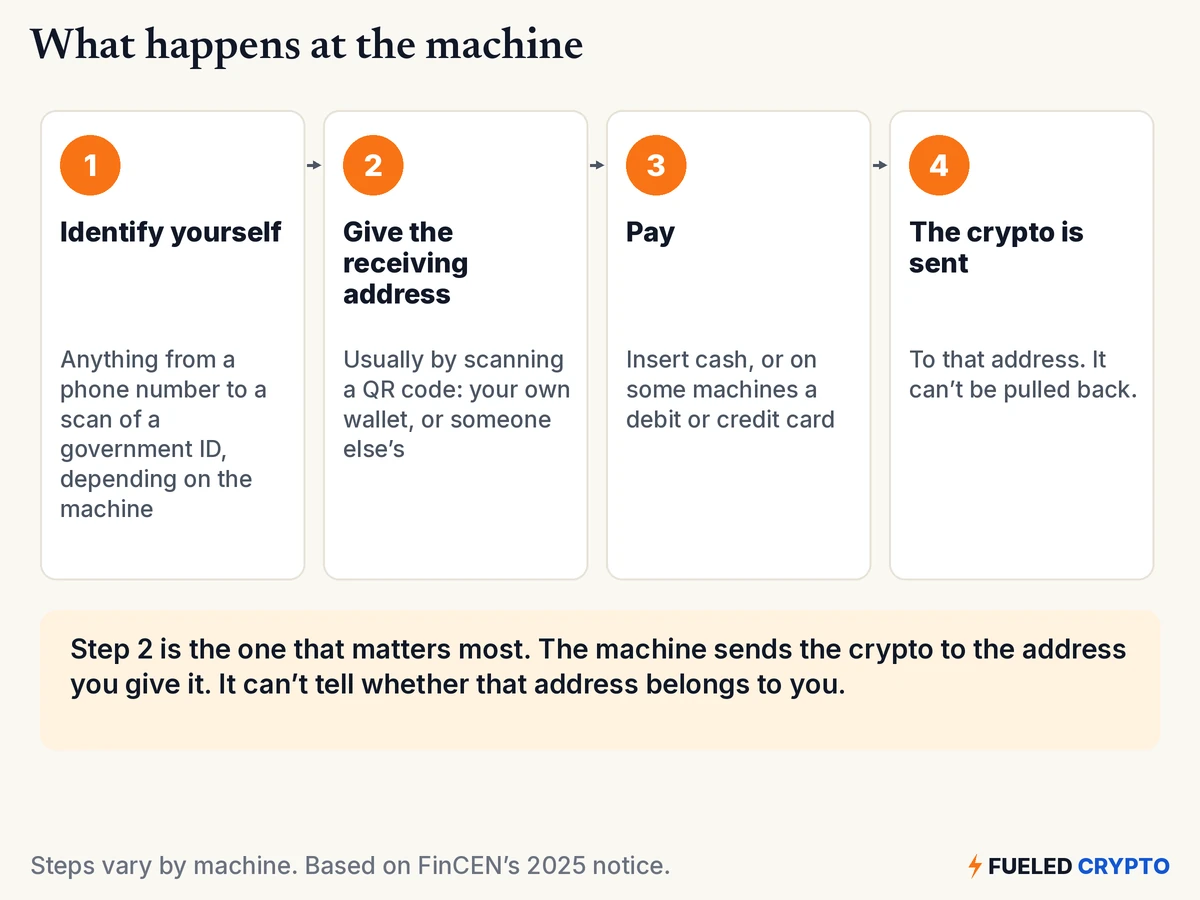
- Identify yourself. FinCEN says this "can range from a phone number to a scan of a government-issued ID."
- Enter the receiving address, which "could be the customer's own CVC wallet or that of a third party" and "is normally embedded in a quick response (QR) code." (CVC, or convertible virtual currency, is FinCEN's term for crypto.)
- Pay with cash, or on some machines a debit or credit card.
- The crypto is sent to that address.
If you use one for yourself, the address should come from your own wallet. Our wallets and keys guide explains where it comes from, and the before-you-send checklist covers matching the network.
What it costs
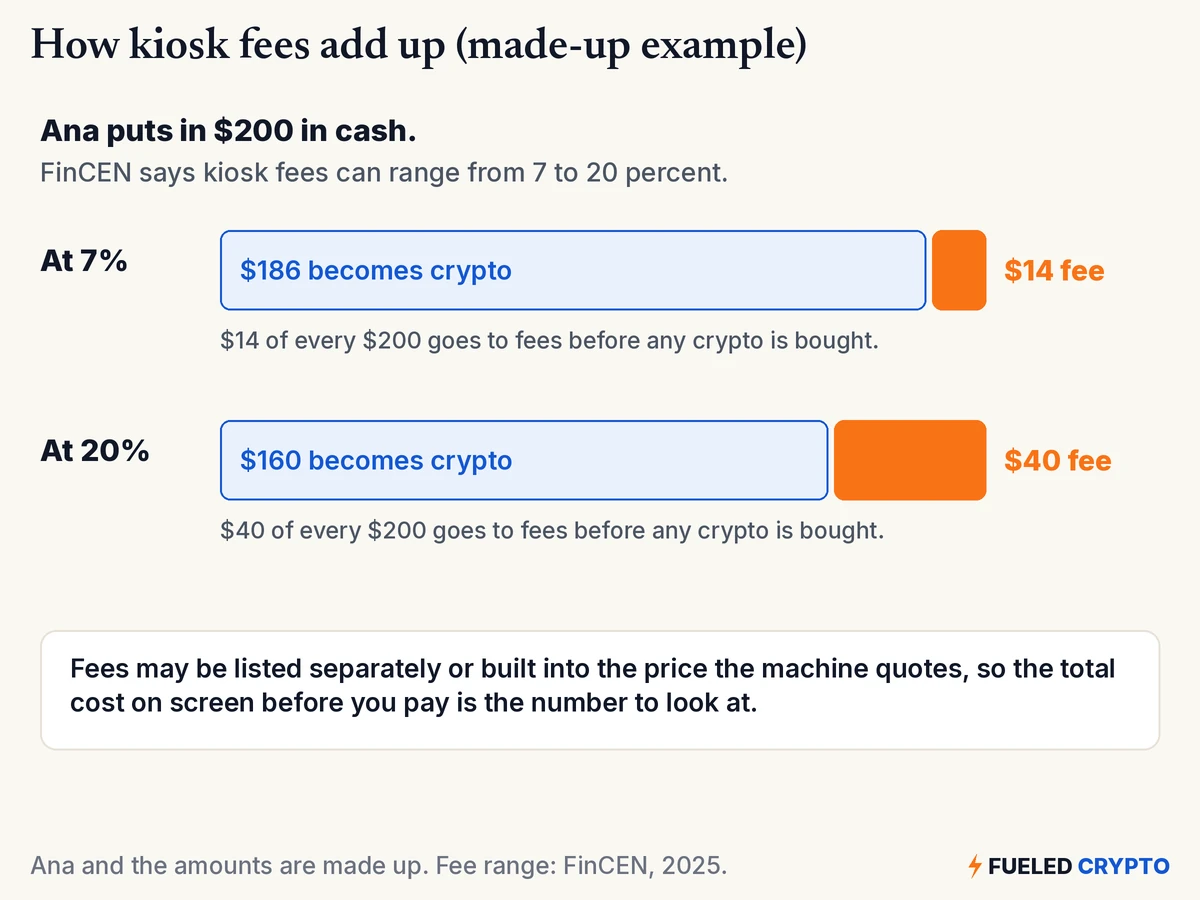
FinCEN says kiosks "generate revenue for their operator through the collection of fees," and that kiosks "can have high transaction fees relative to other means of transferring funds for senders and recipients, ranging from 7–20 percent."
Other ways of buying crypto have their own fees and spreads. Our guide to how crypto exchanges work explains those.
The rules, briefly
Kiosk operators that move money between customers and crypto are generally treated as money services businesses under federal law, and they must register with FinCEN. FinCEN is careful to add that registration "is not a recommendation, certification of legitimacy, or endorsement of the business," and that "FinCEN does not license MSBs." Some states add their own rules for kiosks, and those vary from state to state.
The scam pattern to know
The FTC, FBI and CFTC all describe almost the same script. It usually starts with an urgent problem and ends at a kiosk.
- It starts with a scare. The FTC says many scams "start with a call or message about supposed suspicious activity or unauthorized charges on an account," or a fake security pop-up. Then it escalates: your money is at risk, or you're "linked to money laundering or even drug smuggling."
- Then comes the cash. Scammers "direct you to go to your bank to take out cash," then "send you to a nearby BTM location – often a specific one."
- Then the QR code. "They text you a QR code to scan at the machine, and once you do, the cash you deposit goes right into the scammer's wallet," per the FTC.
- They stay with you. The FBI says the scammer "is in constant online communication with the victim and provides step-by-step instructions until the payment is completed." The CFTC adds coaching on what to say to others, and instructions to split up payments.
Scammers have even called these machines "safety lockers," the FTC says. There's no such thing.
The rule of thumb, from the FTC: "Don't believe anyone who says you need to use a Bitcoin ATM to protect your money or fix a problem. Real businesses and government agencies will never do that — anyone who does is a scammer." The CFTC says the same: "No government agency, legitimate financial institution, or reputable company will instruct you to move money using crypto ATMs."
If you get a call like this, the FTC's advice is to verify the story yourself: "use a phone number, website, or app you know is real to contact your bank, investment, or retirement company," not the contact details in the message.
How big the problem is
- FBI (2025 data): IC3 received more than 13,400 complaints involving cryptocurrency kiosks, with losses over $388 million. That's a 23% increase in complaints and a 58% increase in losses from 2024. More than half of the complaints involved people over 50, with losses over $302 million. IC3 notes these complaints can include other kinds of transactions too, so not all of the losses happened at kiosks.
- FTC (2024 data spotlight): Reported fraud losses at Bitcoin ATMs increased nearly tenfold from 2020 to 2023, and topped $65 million in just the first half of 2024. In those six months, the median reported loss was $10,000, and people 60 and over were "more than three times as likely as younger adults to report a loss using a BTM."
The FTC notes that "the vast majority of frauds are not reported," so these numbers likely reflect only part of the harm. If you have older parents or relatives, this is a conversation worth having before anyone calls them.
If you or a family member already paid
- Stop sending. FinCEN says scammers "often attempt to extract repeated payments from the same victim."
- Gather the details. IC3 asks for the transaction ID (TXID), the wallet address the funds went to, and the kiosk's location, plus any phone numbers, emails or names the scammer used. Keep your kiosk receipts.
- Report it to your local police, to the FBI at ic3.gov, and to the FTC at ReportFraud.ftc.gov. The FTC's reporting list also includes the CFTC (CFTC.gov/complaint) and the company you used to send the money. For a kiosk, that's its operator, reached through the contact details printed on the machine or its official website, not a number from the scammer.
- Watch for recovery scams. IC3 warns to "Be wary of cryptocurrency recovery services, especially those charging an up-front fee."
Our guide on what to do if crypto is stolen goes step by step, and How to Avoid Crypto Scams covers other common patterns.
Common mix-ups
- "It's like depositing money in an ATM." A crypto ATM doesn't put money into your account. It sends crypto to whatever address is entered.
- "The machine is official, so the request must be too." The machine just follows instructions. It can't tell who's on the other end of the address.
- "The government asked me to protect my money this way." Real agencies never do. The FTC calls anyone who does "a scammer."
- "A FinCEN registration means it's approved." FinCEN says registration is not an endorsement or a license.
- "I can cancel it later." The CFTC says the transfer is "often immediate and irreversible."
Words you'll keep hearing
- Crypto ATM / Bitcoin ATM (BTM) / crypto kiosk: a machine that exchanges cash and crypto.
- Operator: the company that runs a kiosk and collects its fees.
- QR code: a square barcode. At a kiosk, it usually holds the receiving address.
- Receiving address: where the crypto is sent. Whoever controls it controls the crypto.
- MSB (money services business): the federal category kiosk operators generally fall under.
- TXID: the transaction ID, which IC3 asks for when reporting.
More terms are in our crypto glossary.
Frequently asked questions
How does a crypto ATM work? You identify yourself, give a receiving address (usually by scanning a QR code), and insert cash or, on some machines, a card. The machine converts the money to crypto and sends it to that address.
How much do crypto ATMs charge? FinCEN reports kiosk fees ranging from 7 to 20 percent. Fees may be shown separately or built into the quoted price, so the total cost on screen is the number to check.
Can a crypto ATM transaction be reversed? Generally not. The CFTC says the transfer is "often immediate and irreversible," and the FBI notes it differs from bank transfers that can stay pending for a day or two.
Would the government or my bank ever tell me to use a crypto ATM? No. The FTC says real businesses and government agencies will never tell you to use a Bitcoin ATM to protect your money or fix a problem, and that anyone who does is a scammer. The FBI adds that no legitimate law enforcement or government official will call to demand payment via a cryptocurrency kiosk.
Why do scammers use crypto ATMs? The machines are easy to find, accept cash, and send crypto to any address. The FTC and FBI describe scammers sending a QR code that holds their own address and coaching the victim through the steps.
Are crypto ATMs regulated? Operators are generally money services businesses that must register with FinCEN, and some states add their own rules. FinCEN says registration is not an endorsement or a license.
What should I do if I sent money through a crypto ATM to a scammer? Stop sending more, gather the transaction ID, receiving address, kiosk location and receipts, and report it to local police, ic3.gov and ReportFraud.ftc.gov. Be wary of anyone offering to recover the money for a fee.
Where to go next
- How to Avoid Crypto Scams, for other common patterns.
- What to Do If Your Crypto Is Stolen, for step-by-step help.
- Before You Hit Send, for checking an address and network.
- Wallets, Keys and Addresses, for what an address is.
- How a Crypto Exchange Works, for fees and spreads elsewhere.
- Crypto Glossary, for any other term.
Sources
- Federal Trade Commission: Bitcoin ATMs: A payment portal for scammers (Data Spotlight, September 3, 2024).
- Federal Trade Commission: Scammers use Bitcoin ATMs to steal your money (consumer alert, September 3, 2024).
- Federal Trade Commission: What To Know About Cryptocurrency and Scams (where to report, May 2022).
- FinCEN: Notice on the Use of Convertible Virtual Currency Kiosks for Scam Payments and Other Illicit Activity (FIN-2025-NTC1, August 4, 2025).
- FBI Internet Crime Complaint Center: IC3 Cryptocurrency Kiosk Complaint Data By State (I-051526-PSA, May 15, 2026).
- FBI Internet Crime Complaint Center: The FBI Warns of Fraudulent Schemes Leveraging Cryptocurrency ATMs and QR Codes to Facilitate Payment (November 4, 2021).
- FBI Internet Crime Complaint Center: Cryptocurrency (recovery-service warning).
- CFTC: Pause Before You Pay: Unusual Money Transfer Instructions May Signal Fraud.
All diagrams and animations are original Fueled Crypto graphics. Ana and the fee amounts are made-up examples.
Fueled Crypto publishes news and education, not investment, tax, or legal advice. Crypto assets are volatile and can lose value. Do your own research and consider a licensed professional before making financial decisions. See our full disclaimer.
Want plain-English crypto news once a week? Subscribe to Fueled Crypto.