Deck: Behind the Buy button there's an order book: a list of people offering to buy and sell. Here's how that works in plain English, what market and limit orders do, why the price you get can differ from the price you saw, and what to look for in any platform.
Last reviewed: October 24, 2026
For a long time I just pressed Buy and hoped the number looked right. When I finally opened an "advanced" trading screen, it was a wall of red and green numbers. It turned out to be simpler than it looked: a list of offers, and a few rules for matching them.
This guide explains those rules. It doesn't name or compare platforms, and it isn't trading advice.
The short version
- A crypto "exchange" is usually a company that matches buyers and sellers, and often holds customers' crypto too.
- Trades usually happen on the platform's own books, not on the blockchain. Deposits and withdrawals are on-chain.
- The order book lists bids (offers to buy) and asks (offers to sell). The gap between the best of each is the spread.
- A market order fills right away at the best available prices, but the price isn't guaranteed.
- A limit order sets your price or better, but it may never fill.
- Slippage is the difference between the price you saw and the average you got.
- Costs can include trading fees, the spread and withdrawal fees. Each platform publishes its own.
What a crypto exchange actually does
FINRA, the U.S. broker-dealer regulator, describes crypto trading platforms as intermediaries that "enable trading, record ownership and facilitate the custody" of crypto, and notes they're "widely referred to as 'exchanges'."
That word can be misleading. A stock exchange mostly matches orders, and other firms handle the brokerage and custody. At an April 2025 SEC roundtable, Commissioner Caroline Crenshaw said crypto trading platforms "often perform multiple services under one roof, sometimes including brokerage, clearing, and custody," jobs that "In traditional finance, they are typically performed by separate registered entities." That's one commissioner's view, and U.S. rules for these platforms are still changing. Our CLARITY Act explainer tracks that.
One thing hasn't changed: the FTC notes that crypto held in accounts "is not insured by a government like U.S. dollars deposited into an FDIC insured bank account." Our guide to exchange vs. self-custody covers what holding crypto on a platform means.
On-chain vs. the platform's own books
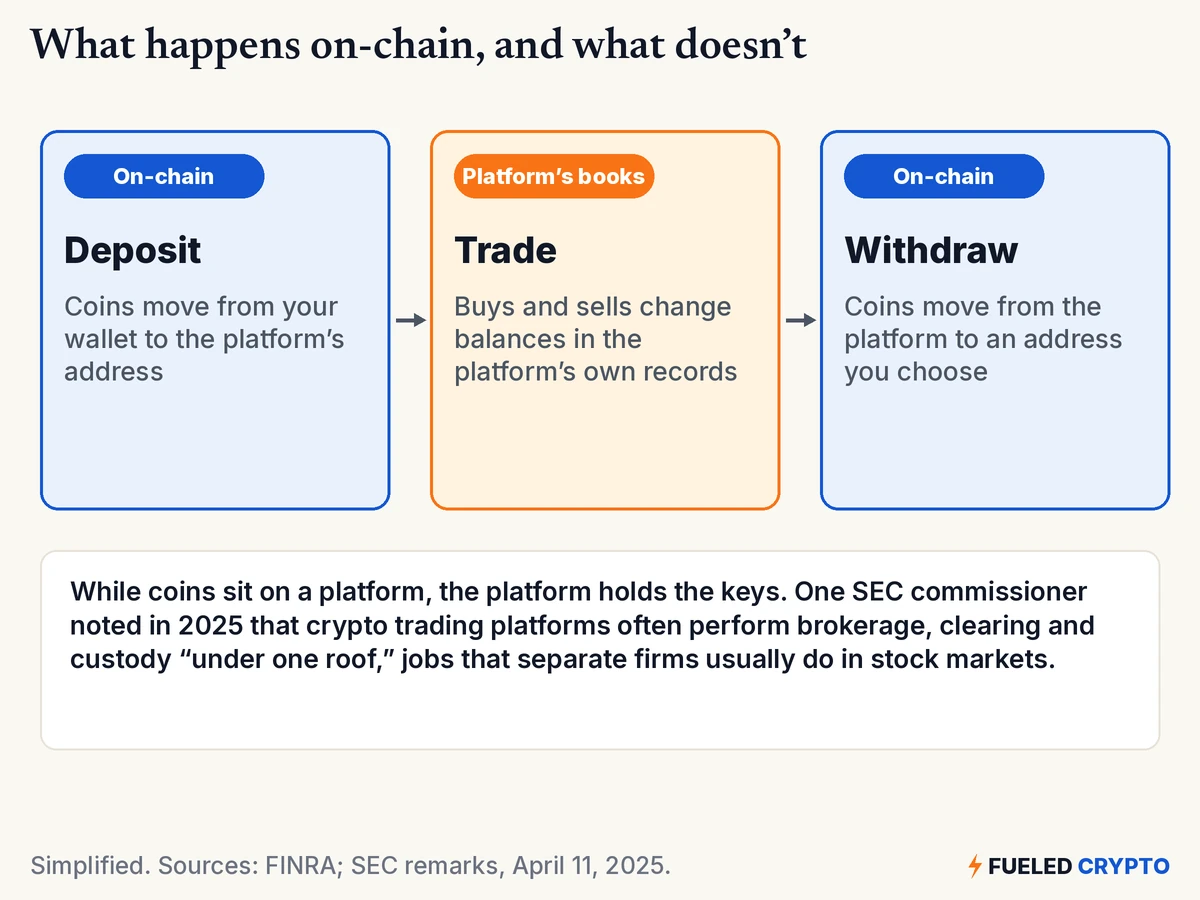
When you deposit, a real blockchain transaction moves coins to the platform. When you trade, the platform usually just updates its own records, which is why trades can be quick and don't pay a network fee. When you withdraw, the platform sends a new blockchain transaction to the address you give it, which is where our sending checklist comes in.
The order book: bids, asks and the spread
Most platforms match trades with an order book: a live list of offers.
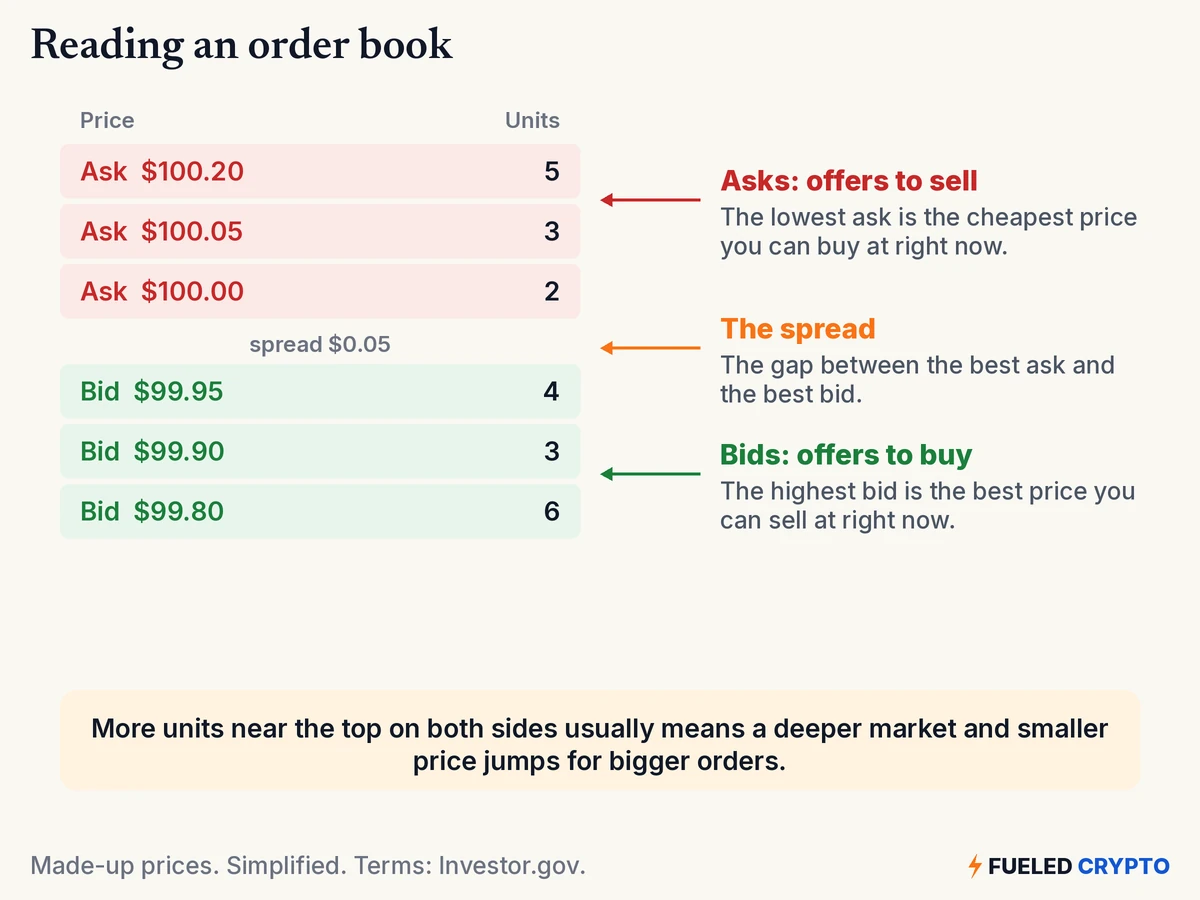
The SEC's Investor.gov defines the bid as "the highest price a buyer will pay" and the ask as "the lowest price at which a seller will sell." "The difference between the bid and ask prices is called the 'spread.'" A narrow spread and plenty of units near the top usually mean an active, "liquid" market. A wide spread or thin rows mean bigger price jumps for bigger orders.
Many platforms offer a simple Buy screen and a separate advanced screen that shows the order book. The simple screen may quote one all-in price, while the advanced screen lets you choose the order type. The details, and the fees on each, differ by platform.
Market orders and slippage
Investor.gov says a market order is filled "at the best available price. Generally, a market order will be executed immediately. However, the price at which a market order will be executed is not guaranteed." It adds that "the last-traded price is not necessarily the price at which a market order will be executed."
Here's why. A market order takes the best offer first. If that offer is too small, it moves to the next one up.
In this made-up example, Sam saw $100.00 but paid about $100.06 on average. That gap is slippage. It tends to be bigger for larger orders, for coins with thin order books, and when prices are moving quickly. Some platforms let you set a slippage limit; others don't.
Limit, stop and stop-limit orders
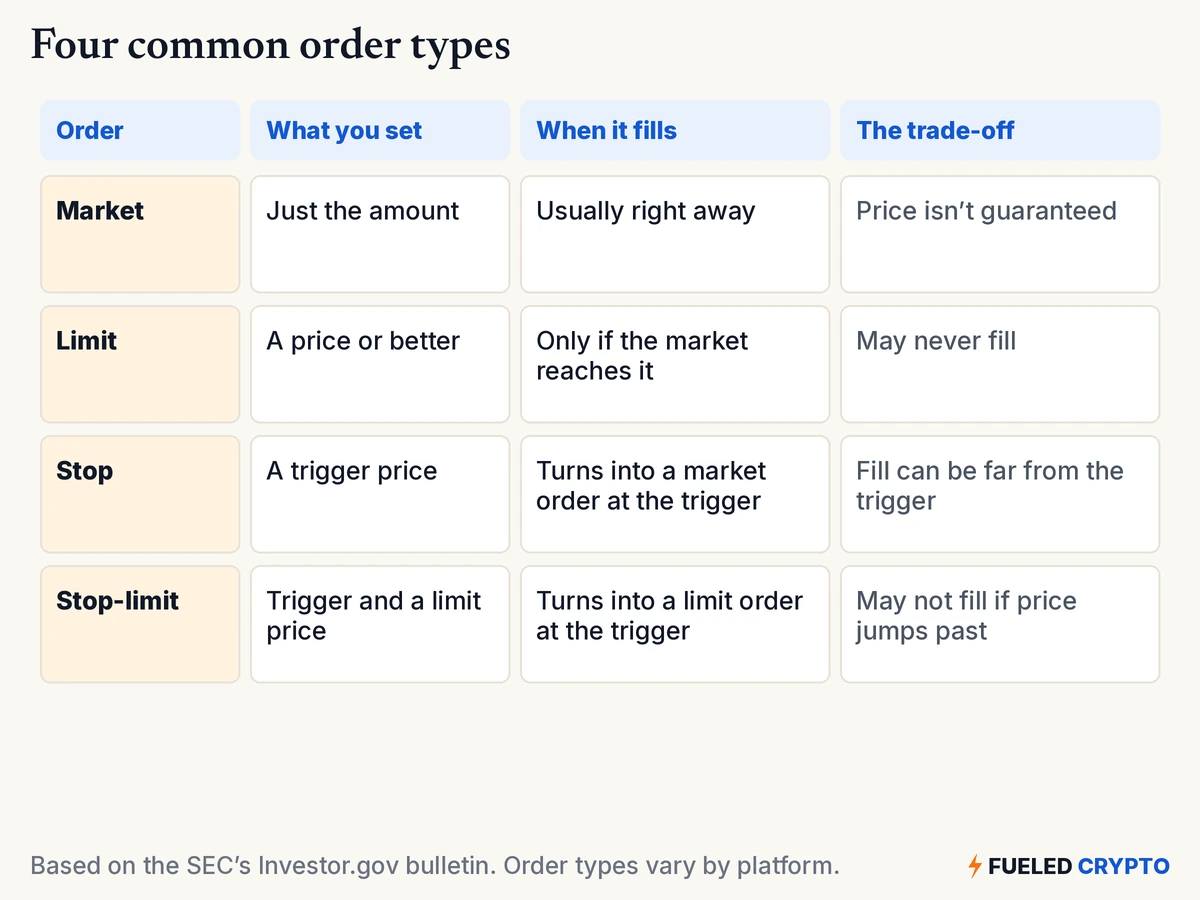
- Limit order: an order "to buy or sell a stock at a specific price or better," per Investor.gov. "A buy limit order can only be executed at the limit price or lower," and it "is not guaranteed to execute."
- Stop order: "When the stop price is reached, a stop order becomes a market order." Investor.gov notes the price you get "can deviate significantly from the stop price."
- Stop-limit order: once the stop price is reached, it "becomes a limit order," which avoids an unexpected price but may not fill at all.
Investor.gov wrote this about stocks, but crypto platforms use the same basic ideas. Which order types are offered, and how they behave, varies by platform, so the platform's own help pages are the place to check.
Where the costs show up
A trade can cost more than the price on screen:
- Trading fees. Many platforms charge a fee per trade, sometimes a percentage.
- Maker and taker fees. An order that waits on the book "makes" liquidity; one that fills right away against a waiting order "takes" it. The SEC uses these terms for stock exchanges, and many crypto platforms use the same labels with different rates for each.
- The spread. A simple Buy screen may build some of the cost into the quoted price.
- Withdrawal fees. Moving coins off the platform can carry the network fee plus the platform's own charge.
Every platform publishes its own fee schedule. Reading it before trading is the only way to know the real cost.
Questions to ask about any platform
None of these point to a particular company. They're the same questions for any platform:
- Who holds the crypto, and is it kept separate from the company's own funds?
- Where is it allowed to operate, and under which licenses or registrations? This varies by country and U.S. state.
- What's on the fee schedule for trades, spreads and withdrawals?
- Which order types are offered, and how do they work there?
- How do withdrawals work, including limits, delays and which networks are supported?
- How do you reach official support? The FBI has warned about scammers posing as exchange staff, so it's worth knowing the official channels in advance. Our account security guide covers locking an account down.
Common mix-ups
- "The price on the chart is the price I'll get." That's the last trade. A market order fills at whatever offers are on the book.
- "An exchange is like a bank." Crypto held in accounts isn't FDIC insured, per the FTC.
- "Every trade goes on the blockchain." Trades on a platform usually only change its internal records.
- "A limit order always fills." It only fills if the market reaches your price.
- "A stop order guarantees my price." Once triggered, it becomes a market order.
Words you'll keep hearing
- Order book: the live list of offers to buy and sell.
- Bid / ask: the best price buyers will pay, and the lowest price sellers will accept.
- Spread: the gap between the best bid and best ask.
- Liquidity: how much is on offer near the current price.
- Market order: fill now at the best available prices.
- Limit order: fill only at your price or better.
- Slippage: the difference between the expected price and the average fill.
- Maker / taker: adding a waiting order to the book vs. filling against one.
- Custody: who holds the keys to the crypto.
More terms are in our crypto glossary.
Frequently asked questions
How does a crypto exchange work? Most match buyers and sellers through an order book and record trades in their own systems. Many also hold customers' crypto. Deposits and withdrawals are blockchain transactions, but trades usually aren't.
What is an order book? It's a live list of offers: bids from buyers and asks from sellers. The best bid and best ask sit closest to the middle, and the gap between them is the spread.
What's the difference between a market order and a limit order? A market order usually fills right away at the best available prices, but the price isn't guaranteed. A limit order fills only at your price or better, but it may never fill.
What is slippage? It's the difference between the price you expected and the average price you got. It happens when an order is bigger than the best offer, so part of it fills at worse prices.
What is the bid-ask spread? Investor.gov defines it as the difference between the highest price a buyer will pay and the lowest price a seller will accept. A narrow spread usually means an active market.
What are maker and taker fees? A maker order waits on the order book and adds liquidity; a taker order fills right away against a waiting order. Many platforms charge different rates for each, listed on their fee schedules.
Is my crypto insured on an exchange? The FTC says crypto held in accounts is not insured by the government the way FDIC-insured bank deposits are. How a platform holds customer crypto is worth checking directly.
Where to go next
- Exchange vs. Self-Custody, for who holds the keys.
- Secure Your Exchange Account, for account safety.
- Before You Hit Send, for withdrawing safely.
- How to Read a Crypto Chart, for the price charts next to the order book.
- The CLARITY Act, for where U.S. rules stand.
- Crypto Glossary, for any other term.
Sources
- SEC, Investor.gov: Investor Bulletin: Understanding Order Types (written about stocks).
- SEC, Investor.gov: Bid price / Ask price glossary.
- SEC: Spread.
- SEC, Equity Market Structure Advisory Committee: Maker-Taker Fees on Equities Exchanges (definitions of making and taking liquidity).
- FINRA: Crypto Assets – Buying and Selling.
- SEC Commissioner Caroline A. Crenshaw: Remarks at the Crypto Roundtable: "Between a Block and a Hard Place: Tailoring Regulation for Crypto Trading" (April 11, 2025; one commissioner's views).
- Federal Trade Commission: What To Know About Cryptocurrency and Scams (May 2022).
- FBI Internet Crime Complaint Center: FBI Warns of Scammers Impersonating Cryptocurrency Exchanges (August 1, 2024).
All diagrams and animations are original Fueled Crypto graphics. Sam, the coin and every price are made-up examples.
Fueled Crypto publishes news and education, not investment, tax, or legal advice. Crypto assets are volatile and can lose value. Do your own research and consider a licensed professional before making financial decisions. See our full disclaimer.
Want plain-English crypto news once a week? Subscribe to Fueled Crypto.