Deck: When your crypto sits on an exchange, the exchange holds the keys and you hold a balance in its records. Here's what that means, what actually happened to customers when past platforms failed, and how self-custody is different.
Last reviewed: October 24, 2026
"Not your keys, not your coins" is one of the oldest sayings in crypto. It sounds like a slogan, but it describes something real about who controls what. This guide sticks to the plain facts: how custody works, and what courts, regulators and trustees have said about past failures. It isn't here to tell you where to keep your crypto. That's your call.
If private keys are new to you, Keys, Addresses and Wallets, Explained is the place to start.
The short version
- On an exchange, the company holds the keys. Your account shows a balance in its records, and the coins sit in wallets it controls.
- In self-custody, you hold the keys. No company can freeze your coins, but no company can recover them for you either.
- Crypto on an exchange isn't FDIC-insured. The FDIC says its insurance doesn't cover crypto or protect against a crypto company's bankruptcy.
- Past failures followed a pattern: withdrawals stopped, a bankruptcy followed, and repayment took years, sometimes only partly.
- The details matter. In one major case, a court ruled that customers' deposits belonged to the company because of the terms they'd agreed to.
What you own when your crypto is on an exchange
When you buy crypto on an exchange and leave it there, nothing moves to an address you control. The exchange records that you're owed a certain amount, and the coins themselves sit in wallets whose keys the exchange holds. ethereum.org puts it simply: with an exchange, "If the exchange has financial trouble, your funds would be at risk" (ethereum.org: wallets).
How the exchange holds those coins depends on the company and its regulator. New York's financial regulator, for example, expects licensed custodians to keep customer crypto separate from company assets, either in wallets for each customer or in "one or more omnibus on-chain wallets" holding only customer assets, with records showing "each individual customer's beneficial interest." It also expects the customer agreement to make clear the relationship is custodial, "rather than a debtor-creditor relationship" (NYDFS custody guidance, 2025).
That last phrase is the heart of it. If you're a custody customer, the coins are meant to be yours, held for you. If you're a creditor, you're owed something, and in a bankruptcy you may wait in line with everyone else the company owes. Which one you are can come down to the terms you clicked "accept" on, as the Celsius case below shows.
What about insurance? The FDIC is direct: deposit insurance "does not apply to financial products such as stocks, bonds, money market mutual funds, other types of securities, commodities, or crypto assets," and it "does not protect against the default, insolvency, or bankruptcy of any non-bank entity, including crypto custodians, exchanges, brokers, wallet providers, and neobanks" (FDIC fact sheet).
Three ways to hold crypto, and who holds the keys
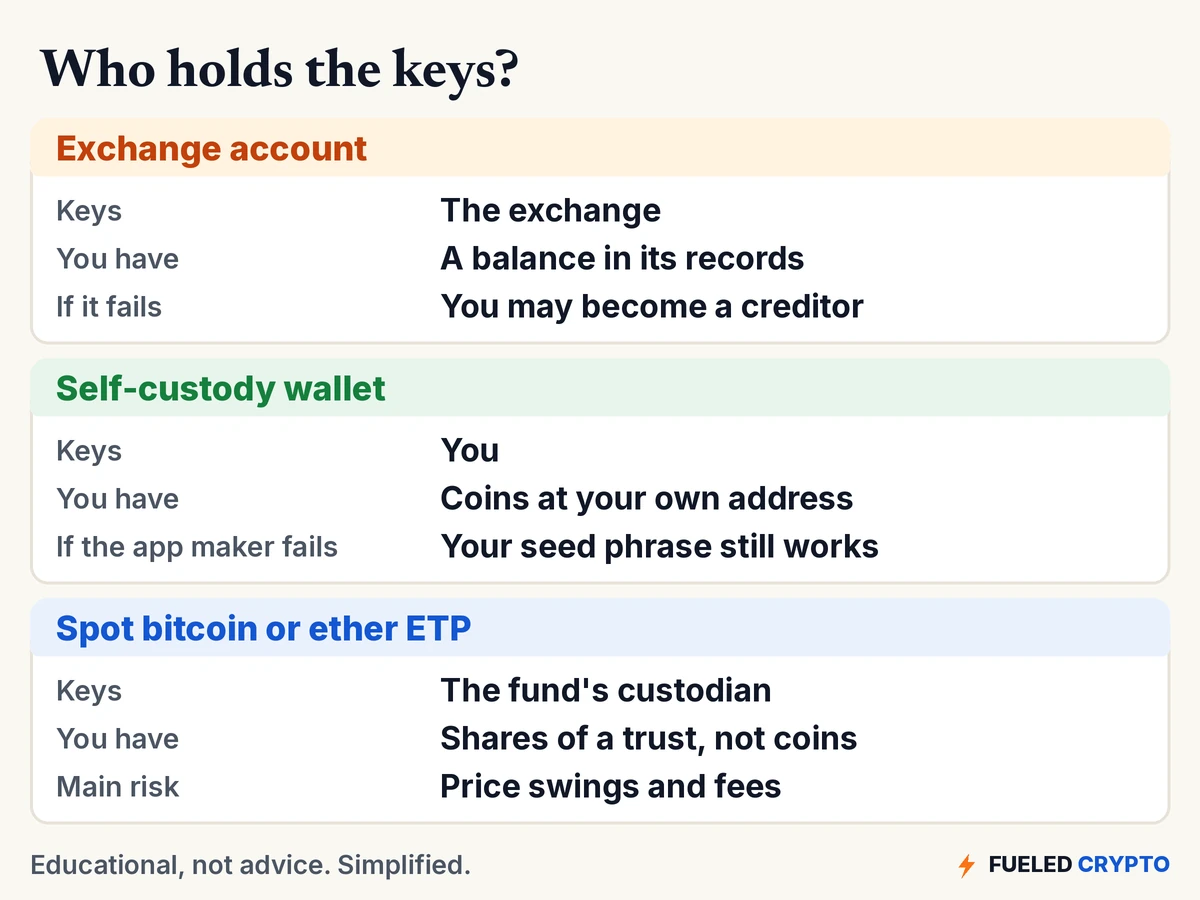
- Exchange account (custodial). Convenient for buying, selling and converting to dollars. The exchange controls the keys, and its health and terms matter.
- Self-custody wallet. You hold the keys, in a phone app or on a hardware wallet. ethereum.org notes that wallet providers "don't have custody of your funds," so if the app maker disappears, your seed phrase can restore access in another compatible wallet (ethereum.org: wallets). The flip side, also from ethereum.org: "there's no customer support in crypto. You are responsible for keeping your keys safe and secure" (same source). Our Hot Wallet vs. Cold Wallet guide covers the two kinds.
- Spot bitcoin or ether ETPs. These are exchange-traded trusts that hold the coins. The SEC's investor office says they may give exposure "without some of the direct risks to the investor of personally transacting on a crypto asset trading platform or using a crypto asset wallet," but notes "the spot bitcoin or ether ETP itself is subject to these risks." They're also not registered under the Investment Company Act of 1940, so they aren't subject to its custody and valuation rules, and they charge a sponsor fee (Investor.gov bulletin).
What happened in past failures
These four cases are long over as businesses, and each is documented by courts, regulators or trustees. They're the clearest record we have of what "your funds would be at risk" looks like in practice.
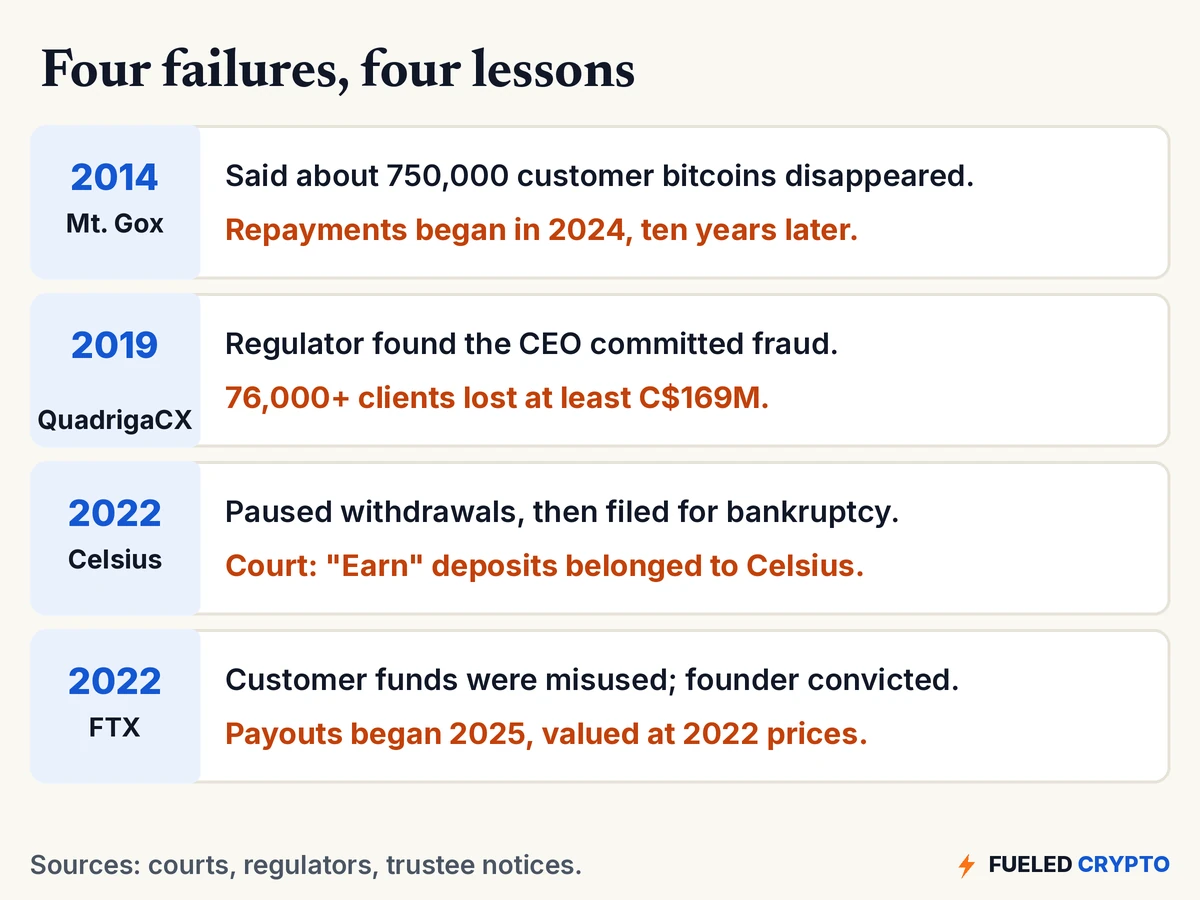
Mt. Gox (2014)
On February 28, 2014, the Tokyo-based exchange applied for civil rehabilitation and said "approximately 750,000 bitcoins deposited by users and approximately 100,000 bitcoins belonging to us had disappeared" (Mt. Gox announcement, 2014). The court-appointed trustee began repaying creditors in bitcoin and bitcoin cash on July 5, 2024, more than ten years later (trustee notice, July 2024). In October 2026 the trustee extended the repayment deadline again, to October 31, 2027, because many creditors still hadn't completed the steps to get paid (trustee notice, Oct. 2026).
QuadrigaCX (2019)
The Canadian platform stopped operating and sought creditor protection in early 2019, after announcing its CEO had died. The Ontario Securities Commission's review found that "Over 76,000 clients were owed a combined $215 million," only $46 million was recovered or identified, and clients "collectively lost at least $169 million" (Canadian dollars). Its conclusion: the collapse "resulted from a fraud committed by Quadriga's co-founder and CEO," who used client assets "at will" (OSC QuadrigaCX report).
Celsius (2022)
Celsius was a crypto lending platform rather than a trading exchange, but its case is the clearest lesson on terms of service. It halted withdrawals on June 12, 2022, leaving "hundreds of thousands of Celsius customers" with "$4.7 billion in inaccessible assets," and filed for bankruptcy on July 13, 2022 (U.S. Attorney, SDNY). In January 2023, the bankruptcy judge ruled that Celsius's terms of use "unambiguously transfer title and ownership" of assets in its interest-paying Earn accounts to the company (court opinion, quoted in Arnold & Porter's summary). That made Earn customers unsecured creditors rather than owners. Its founder was later sentenced to 12 years for fraud (SDNY, same source).
FTX (2022)
FTX filed for bankruptcy on November 11, 2022, days after customers rushed to withdraw (U.S. Bankruptcy Court, D. Del.). According to the Justice Department, its founder, who was convicted by a jury, told customers their deposits "were kept safe and were held in custody for the customers," while in fact he "channeled billions of dollars in customer deposits from FTX to Alameda" (U.S. Department of Justice). He was sentenced to 25 years in March 2024 (same source). FTX began paying its first customer claims on February 18, 2025 (FTX press release). One detail surprised many customers: U.S. bankruptcy law generally values claims "in lawful currency of the United States as of the date of the filing of the petition" (11 U.S.C. § 502(b)). In the FTX case, the judge wrote that "the value of the claims must be determined as of the petition date," and the court approved a conversion table that turns each customer's crypto into U.S. dollars using petition-date market prices (U.S. Bankruptcy Court, D. Del., June 2024 opinion). So crypto held on FTX was counted at its November 2022 dollar value, not at later prices.
The pattern: what usually happens when a platform fails
Every case is different, and laws vary by country. But the public record shows a familiar sequence.
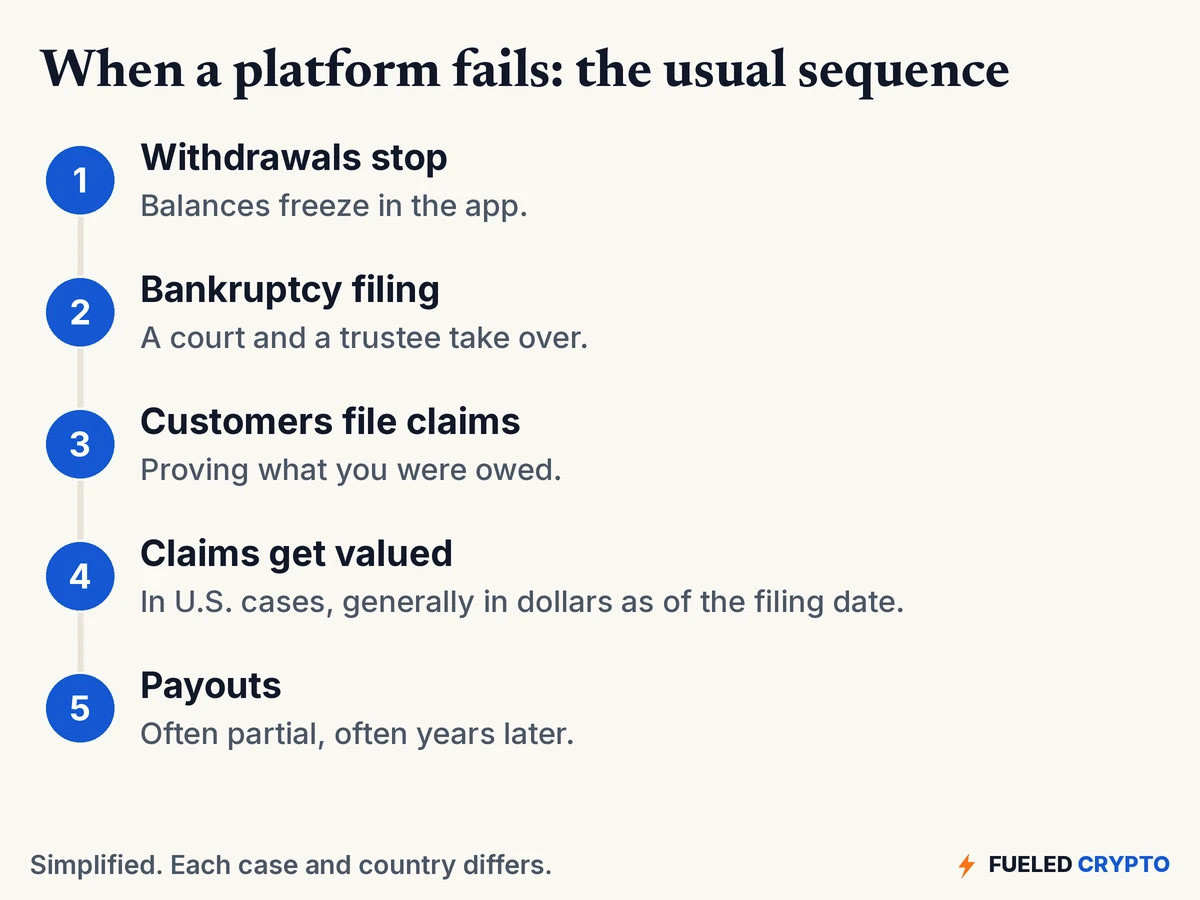
A few facts stand out across the four cases above:
- Withdrawals stopped first. By the time a bankruptcy was filed, customers already couldn't move their coins.
- The terms decided a lot. Whether you're an owner or a creditor can depend on the agreement you accepted (Celsius ruling).
- Time was measured in years. Mt. Gox repayments started a decade after its collapse; FTX's started more than two years after.
- Fraud, not just bad luck, was found in three of the four. Regulators or courts found fraud by leaders at QuadrigaCX, Celsius and FTX.
None of this means any exchange running today will fail. Many people use exchanges every day, and regulators like New York's set custody rules aimed at exactly these problems. It means custody is a real trade-off worth understanding.
What self-custody changes, and what it doesn't
Self-custody removes the company from the middle. Nobody can pause your withdrawals or treat your coins as theirs in a bankruptcy. But the responsibilities move to you:
- You are the backup. Lose your seed phrase and there's no reset. See Seed Phrase Best Practices.
- Mistakes are final. Blockchain transactions generally can't be reversed (how transactions work).
- Scams target you directly. No support desk will step in. See How to Avoid Crypto Scams.
- Your family needs a plan. See our crypto estate planning guide.
If you decide to move crypto off an exchange, our step-by-step guides cover setting up a hardware wallet and making the transfer. For coins you keep on an exchange, How to Avoid Exchange Outages covers a different problem: being locked out during busy markets.
Common mix-ups
- "My exchange balance is in my wallet." It's in the exchange's records. The coins sit in wallets the exchange controls.
- "It's insured like a bank account." The FDIC says its insurance doesn't cover crypto assets or a crypto company's bankruptcy (FDIC).
- "If an exchange fails, I'll get my coins back." Past cases paid back partly, late, or in dollar value fixed at the filing date.
- "An ETF means I own bitcoin." You own shares of a trust that holds it, and the trust's custodian holds the keys (Investor.gov).
- "Self-custody is risk-free." It swaps company risk for personal responsibility.
Words you'll keep hearing
- Custody: holding assets on someone else's behalf.
- Custodial / non-custodial: whether a company holds your keys or you do.
- Omnibus wallet: one wallet holding many customers' crypto, tracked in the company's records.
- Creditor: someone owed money by a company. In bankruptcy, creditors share what's left.
- Petition date: the day a bankruptcy is filed. U.S. claims are generally valued as of this date.
- Trustee: the person or firm appointed to run a bankrupt company's affairs and repay creditors.
- Spot ETP: an exchange-traded product that holds the actual crypto, not futures.
Frequently asked questions
What happens to my crypto if an exchange goes bankrupt? Withdrawals usually stop and a court process decides what customers get back. In past cases, repayment took years and was often partial. Whether you're treated as an owner or a creditor can depend on the exchange's terms.
Is crypto on an exchange FDIC-insured? No. The FDIC says deposit insurance doesn't cover crypto assets and doesn't protect against the bankruptcy of crypto exchanges, custodians or wallet providers.
What does "not your keys, not your coins" mean? If someone else holds the private keys, they control the coins. You have a claim on them, not direct control.
Did FTX customers get their money back? FTX began paying customer claims in February 2025. Claims were valued in dollars as of the November 2022 bankruptcy filing, rather than at later prices.
Did Mt. Gox customers get their bitcoin back? Repayments began in July 2024, more than ten years after the collapse, and the trustee has extended the deadline to October 31, 2027.
Is a spot bitcoin ETF the same as owning bitcoin? No. You own shares of a trust that holds bitcoin through a custodian. That avoids handling keys yourself, but the trust carries its own risks and fees.
Should I keep my crypto on an exchange or in my own wallet? That's a personal decision, and we don't give financial advice. This guide explains how each works so you can weigh it for yourself.
Where to go next
- Keys, Addresses and Wallets, Explained and Hot Wallet vs. Cold Wallet.
- How Crypto Transactions Work and What Is Cryptocurrency, Really?
- How to Move Crypto Off an Exchange to Cold Storage and Hardware Wallet Setup Guide.
- How to Avoid Exchange Outages During Peak Volatility.
Sources
- FDIC, Fact Sheet: What the Public Needs to Know About FDIC Deposit Insurance and Crypto Companies (July 2022).
- New York DFS, Updated Guidance on Custodial Structures for Customer Protection in the Event of Insolvency (Sept. 2025).
- SEC Investor.gov, Exchange-Traded Products Providing Exposure to Bitcoin and Ether (Sept. 2024).
- ethereum.org, Wallets.
- Mt. Gox: 2014 announcement, July 2024 repayment notice, October 2026 deadline notice.
- Ontario Securities Commission, QuadrigaCX: A Review by Staff (June 2020).
- Celsius: U.S. Bankruptcy Court SDNY opinion, Jan. 4, 2023; Arnold & Porter summary; U.S. Attorney SDNY, May 2025.
- FTX: U.S. Department of Justice, March 2024; U.S. Bankruptcy Court, D. Del. opinion, June 26, 2024; FTX distributions press release, Feb. 2025.
- 11 U.S.C. § 502 (claims valued as of the petition date).
All diagrams and animations are original Fueled Crypto graphics. Names and amounts in the animation are made up.
Fueled Crypto publishes news and education, not investment, tax, or legal advice. Crypto assets are volatile and can lose value. Do your own research and consider a licensed professional before making financial decisions. See our full disclaimer.
Want plain-English crypto news once a week? Subscribe to Fueled Crypto.