Deck: Crypto payments usually can't be pulled back, so a few seconds of checking before you press Send matters. Here's a plain checklist: the right network, the full address, any memo or tag, the fee, and when a small test send helps.
Last reviewed: October 24, 2026
The first time I sent crypto to someone, I checked the address about six times and still held my breath. It turns out there's a short list of things that actually cause problems, and once you know them, sending gets a lot less nerve-wracking.
This guide is that list. It covers what to check before you press Send. Our transactions guide covers what happens after.
The short version
- There's usually no undo. Once a transaction is confirmed, it can't be canceled. Getting it back depends on the receiver.
- Match the network, not just the coin. Many tokens exist on more than one network.
- Check the whole address, including the middle. Lookalike addresses are a known scam.
- Include the memo or tag if the receiver asks for one. Shared exchange addresses often need it.
- Keep enough of the fee coin. Some networks need their own coin to pay fees.
- A small test send is a common way to check a new address, at the cost of an extra fee.
Why a quick check matters
The Federal Trade Commission puts it plainly: "Cryptocurrency payments typically are not reversible. Once you pay with cryptocurrency, you can usually only get your money back if the person you paid sends it back." ethereum.org says the same about Ethereum: "once a transaction is confirmed, you cannot cancel the transaction."
That's the whole reason for a checklist. A bank might reverse a mistaken transfer. A blockchain doesn't have anyone whose job that is.
Check 1: the right asset on the right network
Many tokens, including well-known stablecoins, exist on several networks at once. ethereum.org advises: "make sure that the recipient is using the same network as you are, since these are not interchangeable."
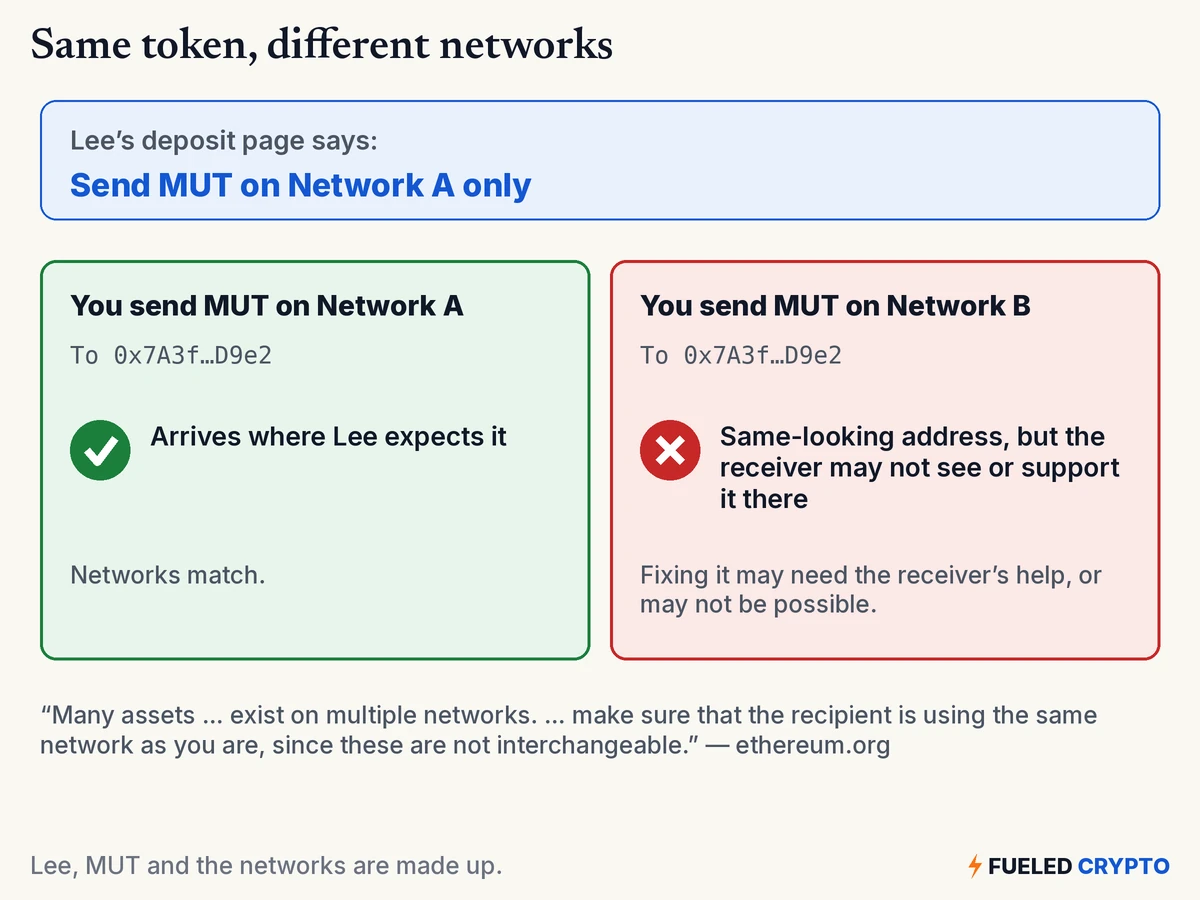
This is easy to get wrong because the address can look identical. ethereum.org explains that a wallet with a recovery phrase uses the same address on every Ethereum-compatible (EVM) network. So the same "0x…" address might exist on Ethereum and on several layer 2 networks, and coins sent on the wrong one land in a place the receiver may not be watching. Other blockchains, like Bitcoin, use a completely different address format.
What to look at:
- The receiver's instructions. Exchanges and apps usually list which networks they accept for each coin.
- The network selector in your wallet or the withdrawal screen. Make sure it matches.
- Wrapped or bridged versions of a coin, which are separate tokens. Our bridges guide explains the difference.
Check 2: the full address, not just the ends
ethereum.org says to "Avoid typing any Ethereum address manually," since that "can easily lead to clerical errors and lost funds." Copy and paste or a QR code is the usual approach. Then it's worth comparing what you pasted with where it came from.
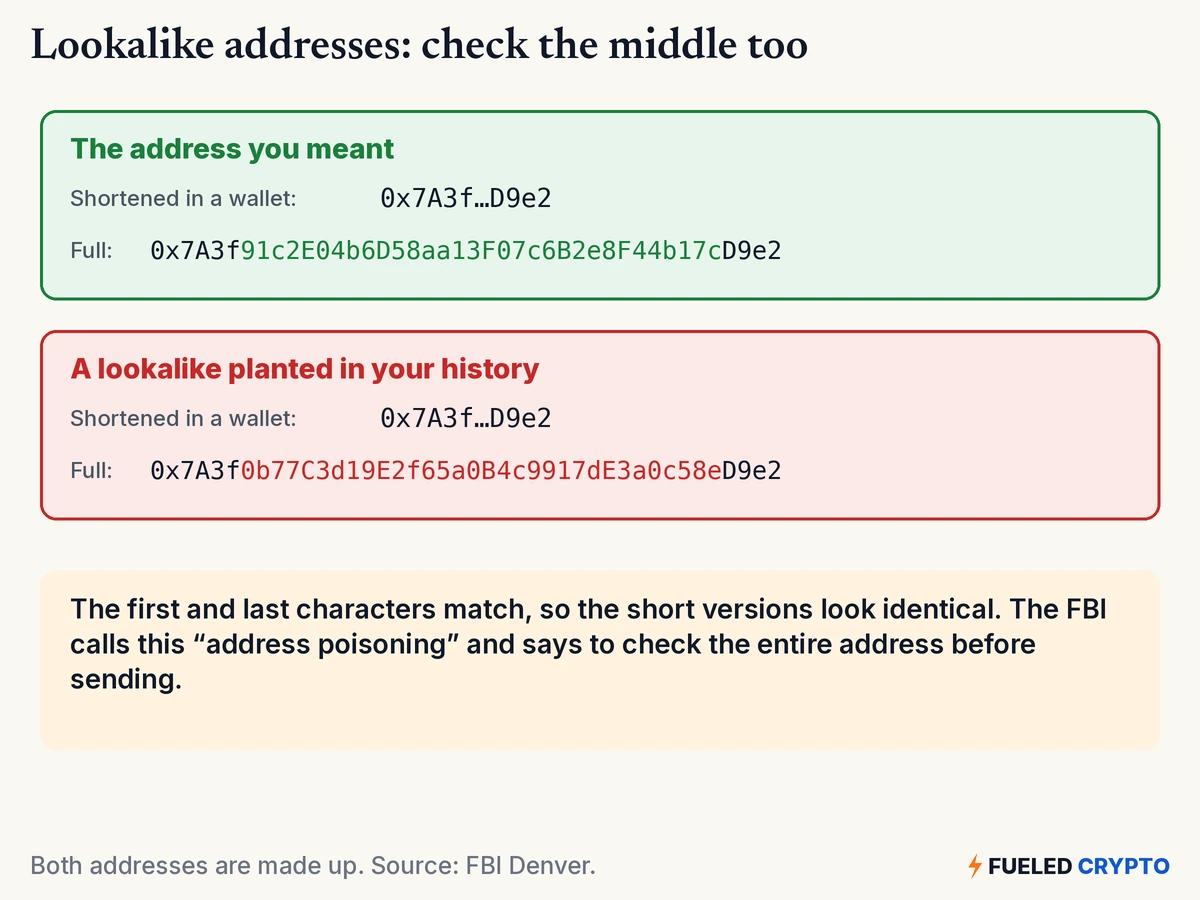
There's a scam built around this. The FBI's Denver field office describes "address-poisoning" attacks: scammers send fake, lookalike tokens from an address that closely resembles one you've dealt with before. Because wallet software shortens addresses, the first and last characters can match while the middle is different, so the fake looks familiar in your history. The FBI's advice is to "check the entire cryptocurrency address to ensure it fully matches the address where you want to send funds."
A few habits that help:
- Get the address from the source each time (the receiver, or your own exchange's deposit page) rather than copying it from your transaction history.
- Check the middle, not just the first and last few characters.
- Save known addresses in your wallet's address book, if it has one, after you've confirmed them once.
Check 3: a memo or destination tag, if asked
Some services, especially exchanges, use one shared address for many customers. To know whose deposit is whose, they ask for an extra number or note. On the XRP Ledger it's called a destination tag. Some other networks have a similar field, often called a memo.
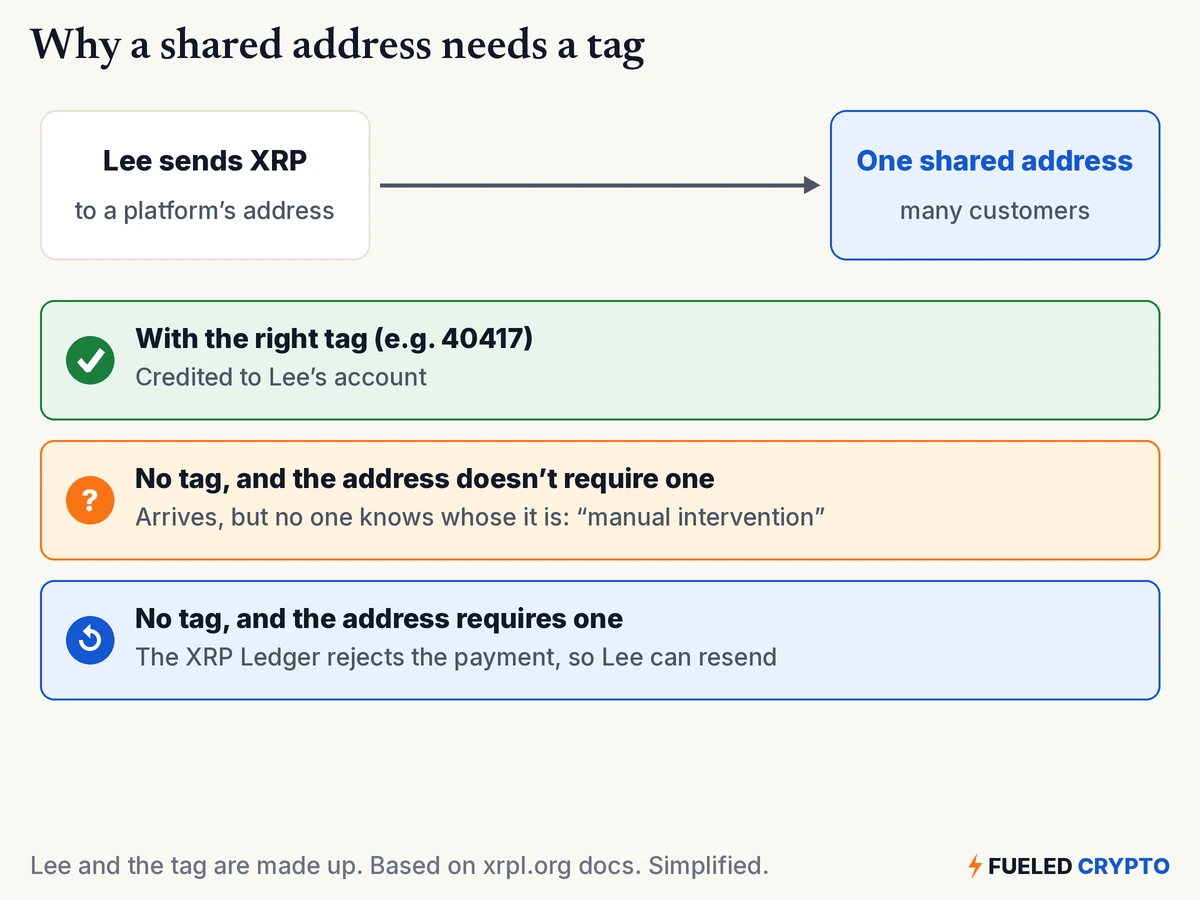
xrpl.org explains that a destination tag can "indicate which customer to credit" at an exchange. Without one, "it is not immediately obvious which customer to credit, which can require a manual intervention." Some addresses turn on a setting that makes the ledger reject payments without a tag, so the sender can simply try again.
If a deposit page shows a tag or memo, it belongs in the send. If you're sending to a personal wallet that doesn't use one, you usually leave it blank. When unsure, the receiver's instructions are the place to check.
Check 4: enough of the right coin for the fee
Every transaction pays a network fee, and on many networks that fee is paid in the network's own coin. ethereum.org reminds senders to "Ensure that your wallet has sufficient ETH to cover the transaction fee," even when the thing being sent is a different token. Our network fees guide explains why fees change and what a stuck transaction looks like.
If you're withdrawing from an exchange, it may also charge its own withdrawal fee. That's usually shown on the withdrawal screen or the platform's fee page.
Check 5: a small test send, when it helps
Many people send a small amount first when using a new address, then send the rest once it arrives. It's a common practice, not a requirement.
What I do: I send the minimum required first, make sure it actually lands on the other side, and then repeat the send with the larger amount. On networks where fees are pennies, that feels like cheap insurance to me. When fees are higher, paying twice is the cost of that peace of mind. That's just my habit, not a rule, and you may weigh it differently.
A test only checks something if it matches the real send exactly: the same address (copied fresh from the source, not from your history), the same network, and the same memo or tag if one is needed. If anything changes between the test and the real send, the test didn't check it.
Some trade-offs:
- It costs a second fee. On a busy, expensive network, that can add up.
- A brand-new address may need a minimum balance. On the XRP Ledger, for example, a new address must receive at least the base reserve (1 XRP on Mainnet, per xrpl.org) before it exists, so a tiny test can fail.
- It confirms the address and network, not who's on the other end. A test send to a scammer still goes to a scammer.
You can follow either send on a block explorer using its transaction ID.
Check who's asking
The checks above protect against mistakes. This one protects against people. The FTC is direct: "No legitimate business is going to demand you send cryptocurrency in advance – not to buy something, and not to protect your money. That's always a scam."
The FBI has also warned about scammers posing as exchange staff who say an account is at risk. Its advice is to hang up, call the exchange's official phone number to check, and not use any number the caller provides. A QR code someone sends you is just an address in picture form, so the same caution applies. Our scam guide covers more patterns.
If something went wrong
- Contact the receiving platform if you sent to an exchange or app with a missing tag or the wrong network. Some can help, and some can't.
- Write down the details: addresses, amounts, the transaction ID (hash), and dates and times. The FBI's IC3 asks for exactly these when you report a scam.
- Report scams to the FBI at ic3.gov and to the FTC at ReportFraud.ftc.gov.
- Be careful with "recovery" offers. IC3 warns to "Be wary of cryptocurrency recovery services, especially those charging an up-front fee."
Our guide on what to do if crypto is stolen goes step by step.
Common mix-ups
- "Same coin name means same network." Many tokens exist on several networks, and they're not interchangeable.
- "If the first and last characters match, it's the right address." That's exactly what address poisoning relies on.
- "The memo is optional, so I'll skip it." For a shared exchange address, it's often how your deposit gets credited.
- "Support can reverse it." Confirmed transactions can't be canceled. Getting funds back depends on the receiver.
- "A test send proves the person is legitimate." It only proves the address and network work.
Words you'll keep hearing
- Address: where crypto is sent, like an account number. Formats differ between blockchains.
- Network: the blockchain a transaction travels on. The same token can exist on several.
- Destination tag / memo: an extra number or note that tells a shared address whose deposit it is.
- Address poisoning: a scam that plants a lookalike address in your transaction history.
- Test send: a small first transfer to check an address and network.
- Transaction ID (hash): the unique ID you can look up on a block explorer.
- Reserve: a minimum balance some networks require for an address to exist.
More terms are in our crypto glossary.
Frequently asked questions
Can a crypto transaction be reversed? Usually not. The FTC says crypto payments "typically are not reversible," and you can usually only get money back if the person you paid sends it back. ethereum.org says a confirmed transaction can't be canceled.
What happens if I send crypto on the wrong network? It depends on the networks and the receiver. On Ethereum-compatible networks the same address can exist on several chains, so the coins may land somewhere the receiver isn't watching. Some platforms can help and others can't, so contacting the receiver is the first step.
What is a destination tag or memo? It's an extra number or note that tells a shared address, often an exchange's, which customer a deposit belongs to. If a deposit page shows one, it belongs in the send.
What is address poisoning? It's a scam where someone sends fake tokens from an address that looks like one you've used, hoping you'll copy it from your history later. The FBI says the first and last characters may match while the middle differs, and advises checking the entire address.
Should I do a test transaction first? Many people send a small amount first to a new address, using the same address, network and memo or tag as the real send. It costs an extra fee, it can fail on networks with a minimum balance for new addresses, and it doesn't prove who's on the other end.
Why do I need a different coin to send a token? On many networks, fees are paid in the network's own coin. ethereum.org reminds senders to keep enough ETH for fees, even when sending another token.
Where do I report a crypto scam? The FTC lists ReportFraud.ftc.gov and the FBI's ic3.gov, among others. IC3 asks for addresses, amounts, transaction IDs, and dates and times.
Where to go next
- How Crypto Transactions Work, for what happens after you press Send.
- Crypto Network Fees, Explained, for fees and stuck transactions.
- Wallets, Keys and Addresses, for what an address is.
- How to Read a Blockchain Explorer, for tracking a send.
- Move Crypto to Cold Storage, for sending to your own hardware wallet.
- How to Avoid Crypto Scams, for more scam patterns.
- Crypto Glossary, for any other term.
Sources
- Federal Trade Commission: What To Know About Cryptocurrency and Scams (May 2022).
- ethereum.org: How to use a wallet (last updated June 6, 2026; networks, typing addresses, fees, same address on EVM chains, no cancel).
- FBI Denver: FBI Warns of Cryptocurrency Token Impersonation Scam (address poisoning).
- FBI Internet Crime Complaint Center: FBI Warns of Scammers Impersonating Cryptocurrency Exchanges (August 1, 2024).
- FBI Internet Crime Complaint Center: Cryptocurrency (what to report; recovery-service warning).
- xrpl.org: Source and Destination Tags.
- xrpl.org: Reserves (1 XRP base reserve on Mainnet, checked October 24, 2026).
All diagrams and animations are original Fueled Crypto graphics. Lee, the token, the networks, the addresses and the tag are made-up examples.
Fueled Crypto publishes news and education, not investment, tax, or legal advice. Crypto assets are volatile and can lose value. Do your own research and consider a licensed professional before making financial decisions. See our full disclaimer.
Want plain-English crypto news once a week? Subscribe to Fueled Crypto.