Deck: Crypto comes with a lot of new words. Here are 64 of the most common, each explained in a sentence or two, with a link to the guide that goes deeper.
Last reviewed: October 24, 2026
When I started learning about crypto, half the battle was the vocabulary. People said "seed phrase," "gas" and "layer 2" like everyone already knew what they meant.
This page is a quick reference. Each term gets a short, plain-English definition and a link to a Fueled Crypto guide that explains it properly. Use your browser's find feature (Ctrl+F or Cmd+F) to jump to a word.
Where to start
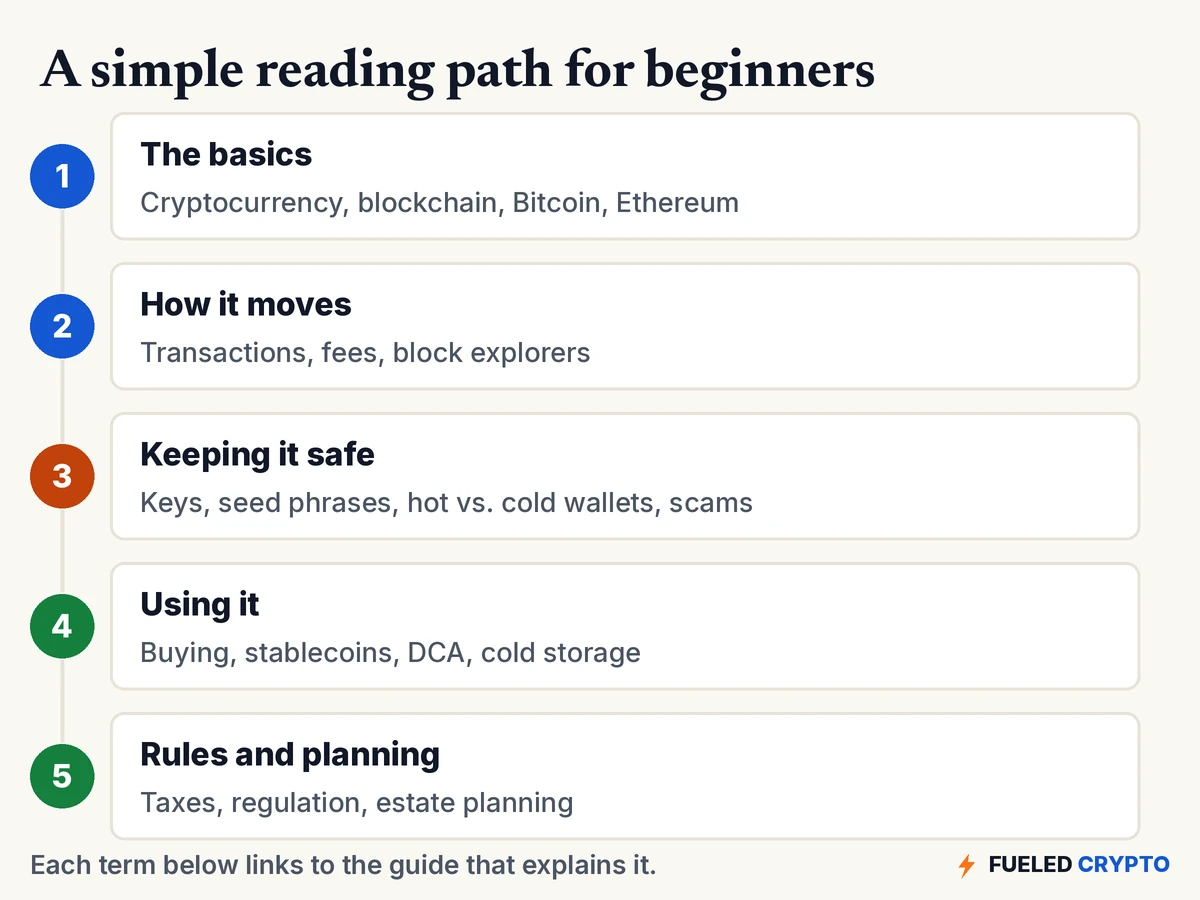
If you're brand new, start with What Is Cryptocurrency? and How Blockchain Works. Then come back here whenever a word trips you up.
Same idea, different names
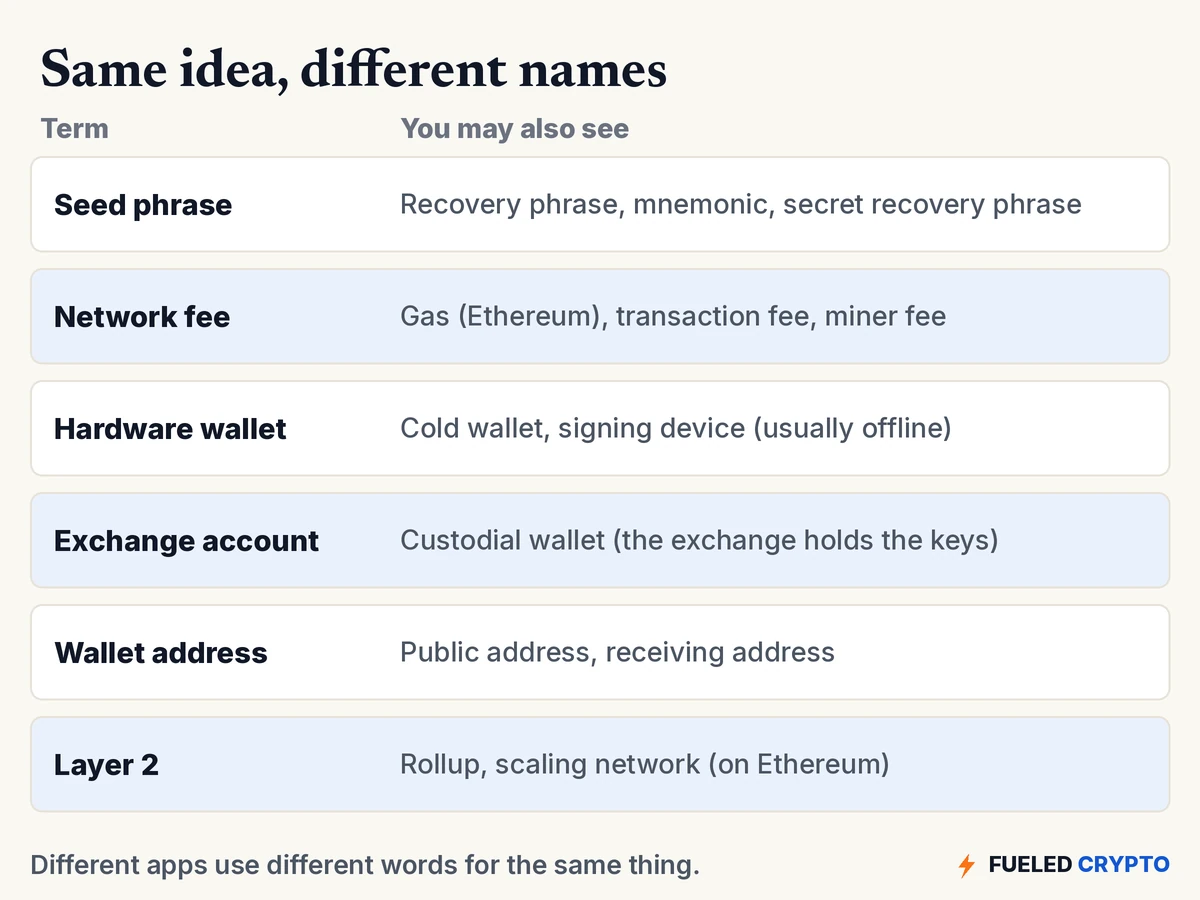
A lot of confusion comes from one idea having several names. A "recovery phrase" in one app is a "seed phrase" in another. Ethereum calls its network fee "gas." If a word looks unfamiliar, it may be something you already know.
The glossary, A to Z
A
Address: A string of characters that identifies where crypto can be sent, a bit like an account number. Sharing it is generally fine; it can't be used to spend. Learn more
Airdrop: Free tokens sent to many wallets, often for promotion. Unexpected airdrops are a common scam lure. Learn more
Altcoin: Any cryptocurrency other than bitcoin. Learn more
B
Bitcoin (BTC): The first cryptocurrency, launched in 2009 and run by a global network of computers with no central company. Learn more
Bitcoin ETF: An exchange-traded fund that holds bitcoin, bought and sold in a brokerage account. You own fund shares, not the coins. Learn more
Block: A batch of confirmed transactions added to a blockchain. Learn more
Block explorer: A website that lets anyone look up addresses, transactions and blocks on a public blockchain. Learn more
Blockchain: A shared record of transactions, kept by many computers and linked in a chain of blocks so past entries are very hard to change. Learn more
Bridge: A tool that moves assets between blockchains, usually by locking them on one and issuing a stand-in on the other. Bridges have been frequent hacking targets. Learn more
C
Cold storage: Keeping crypto keys on a device or medium that stays offline. Learn more
Cold wallet: A wallet whose keys stay offline, often a hardware wallet. Learn more
Confirmation: A transaction is "confirmed" once it's included in a block; each later block adds another confirmation. Learn more
Consensus: The way a blockchain's computers agree on which transactions are valid and in what order. Learn more
Cost basis: What you paid for an asset, including certain fees. It's used to work out a gain or loss for taxes. Learn more
Crypto IRA: A self-directed individual retirement account that can hold crypto, usually through a specialized custodian. Learn more
Custody / custodial: Who holds the keys. With a custodial account, a company holds them for you. Learn more
D
DAO: A decentralized autonomous organization: a group whose rules and treasury are run by smart contracts, often with token-holder voting. Learn more
DeFi: Decentralized finance: lending, trading and other financial apps run by smart contracts instead of a company. Learn more
Dollar-cost averaging (DCA): Buying a fixed dollar amount on a regular schedule instead of all at once. Learn more
E
Estate plan (crypto): Instructions and documents that let your heirs find and access your crypto. Learn more
Ether (ETH): The native currency of Ethereum, used to pay network fees. Learn more
Ethereum: A blockchain that runs programs called smart contracts, which power tokens, DeFi and NFTs. Learn more
Exchange: A company or app where you buy, sell and trade crypto, usually holding it for you. Learn more
Exit strategy: A plan, made in advance, for when and how you'd sell or rebalance. Learn more
F
Fiat: Government-issued money such as US dollars. Learn more
G
Gas: The fee paid to process a transaction or run a smart contract on Ethereum. Learn more
GENIUS Act: The 2025 US federal law that set rules for payment stablecoins and their issuers. Learn more
H
Halving: Bitcoin's built-in event, about every four years, that cuts the new-coin reward for miners in half. Learn more
Hardware wallet: A small device that keeps your private keys offline and signs transactions on the device itself. Learn more
Hash: A short digital fingerprint of data. Change the data even slightly and the hash changes completely. Learn more
Hot wallet: A wallet whose keys are on an internet-connected device, like a phone app or browser extension. Learn more
I
ISO 20022: A global messaging standard for financial data used by banks and payment systems. It's a message format, not a cryptocurrency. Learn more
K
KYC: "Know your customer": the identity checks regulated exchanges and banks run when you open an account. Learn more
L
Layer 1 / Layer 2: Layer 1 is the main blockchain (like Bitcoin or Ethereum). Layer 2 is a network built on top to make transactions faster or cheaper. Learn more
M
Market cycle: The tendency of crypto prices to move through long rising and falling phases. Past patterns don't guarantee future ones. Learn more
Mining: Using computing power to add new blocks to a proof-of-work blockchain like Bitcoin, in exchange for new coins and fees. Learn more
Multisig: A wallet that needs more than one key to approve a payment, such as any 2 of 3. Learn more
N
NFT: A non-fungible token: a unique token that records ownership of a specific item, such as artwork or a ticket. Learn more
Node: A computer that keeps a copy of a blockchain and checks the rules. Learn more
P
Passphrase: An optional extra word or phrase added to a seed phrase that creates a separate hidden wallet. Lose it and the funds are unreachable. Learn more
Phishing: Fake emails, texts, sites or ads that try to trick you into handing over logins or seed phrases. Learn more
Pig butchering: A long-con scam where a fake friend or romance builds trust, then steers you into a fake investment platform. Learn more
Position sizing: Deciding how much of your money goes into any one holding. Learn more
Private key: The secret number that controls crypto at an address. Whoever has it can move the funds. Learn more
Proof of stake: A way to secure a blockchain where validators lock up coins for the right to add blocks. Learn more
Proof of work: A way to secure a blockchain where miners spend computing power to add blocks. Learn more
Public key: The shareable counterpart to a private key, used to create addresses and check signatures. Learn more
R
Rug pull: When a project's creators drain its funds or dump their tokens and disappear, leaving buyers with worthless tokens. Learn more
S
Satoshi: The smallest unit of bitcoin, 0.00000001 BTC, named after Bitcoin's pseudonymous creator. Learn more
Seed phrase: A list of words (usually 12 or 24) that backs up a wallet's keys. Anyone who sees it can take the funds. Learn more
Self-custody: Holding your own keys instead of leaving crypto with a company. Learn more
Shamir backup: A way of splitting a wallet backup into several shares, where only some are needed to recover it. Learn more
Smart contract: A program stored on a blockchain that runs automatically when its conditions are met. Learn more
Stablecoin: A token designed to hold a steady value, usually one US dollar, with major dollar stablecoins typically backed by cash and short-term government debt. Learn more
Staking: Locking up coins to help secure a proof-of-stake network, usually in return for rewards. It carries risks. Learn more
T
Taxable event: An action that can create a tax gain or loss, such as selling crypto or spending it. In the US, the IRS treats digital assets as property. Learn more
Token: A digital asset created on an existing blockchain, often by a smart contract. Learn more
Token approval: Permission you give a smart contract to move a token from your wallet. Old or unlimited approvals can be abused. Learn more
Tokenization (RWA): Representing real-world assets, like Treasury bills or real estate, as tokens on a blockchain. Learn more
Transaction ID (TXID): The unique code for a transaction, used to look it up on a block explorer. Learn more
V
Volatility: How sharply a price moves up and down. Crypto prices are often very volatile. Learn more
W
Wallet: An app or device that holds your keys and lets you send and receive crypto. The coins themselves live on the blockchain. Learn more
Whitepaper: A document that describes a crypto project's design. Bitcoin's 2008 whitepaper is a well-known example. Learn more
X
XRP Ledger: A blockchain built for payments; XRP is its native currency. Learn more
Frequently asked questions
What is the difference between a coin and a token? A coin is usually the native currency of its own blockchain, like bitcoin on Bitcoin or ether on Ethereum. A token is created on top of an existing blockchain, often by a smart contract. People don't always use the words consistently.
What is the difference between a wallet and an exchange? An exchange is a company where you buy and sell crypto, and it usually holds the keys for you. A wallet is an app or device that holds your own keys. Our exchange vs. self-custody guide compares the two.
Is a seed phrase the same as a private key? Not exactly. A seed phrase is a set of words that can recreate all of a wallet's private keys. Either one gives full control of the funds, so neither should ever be shared.
What does "not your keys, not your coins" mean? It's a common saying that if a company holds the keys, you're relying on that company to give you access to your crypto. It's a reminder of the trade-off between custodial and self-custody options.
What is gas in crypto? Gas is the fee paid to process a transaction or run a smart contract on Ethereum. Other networks have network fees too, but may call them something else.
Is crypto taxed? In the US, the IRS treats digital assets as property, so selling, trading or spending them can create a taxable gain or loss. Our tax guide explains the basics. A tax professional can advise on your situation.
What is a stablecoin? A token designed to hold a steady value, usually one US dollar. In the US, the GENIUS Act of 2025 set federal rules for payment stablecoin issuers. Our stablecoin guide explains how they work.
Where to go next
- What Is Cryptocurrency?, for the big picture.
- Keys, Addresses and Wallets, for the words that matter most for safety.
- How to Avoid Crypto Scams, for the terms scammers count on you not knowing.
Sources
- Ethereum.org: Glossary.
- Bitcoin developer documentation: Glossary (satoshis, blocks, confirmations).
- Satoshi Nakamoto: Bitcoin: A Peer-to-Peer Electronic Cash System (2008 whitepaper).
- IRS: Digital assets ("digital assets are considered property, not currency").
- GovInfo: Public Law 119-27, the GENIUS Act.
- Investor.gov: Investor bulletin on crypto asset exchange-traded products.
- Fueled Crypto guides linked in each entry.
All diagrams are original Fueled Crypto graphics.
Fueled Crypto publishes news and education, not investment, tax, or legal advice. Crypto assets are volatile and can lose value. Do your own research and consider a licensed professional before making financial decisions. See our full disclaimer.
Want plain-English crypto news once a week? Subscribe to Fueled Crypto.