Deck: A stablecoin is a crypto token built to hold a steady price, usually one U.S. dollar. Here's how one gets created, why its price tends to snap back to $1, and what happened the times it didn't.
Last reviewed: October 24, 2026
Most crypto prices bounce around all day. Stablecoins are the exception by design. They move on blockchains like other crypto, often as tokens on networks like Ethereum (see What Is Ethereum?), but they aim to stay worth a fixed amount, most often $1. That makes them the closest thing crypto has to cash, and you'll run into them almost as soon as you start looking around.
The Federal Reserve describes them as "a category of crypto-assets designed to maintain a stable value against a non-crypto reference asset." This guide explains how that's supposed to work, in plain English. If crypto tokens are new to you, start with What Is Cryptocurrency, Really?
The short version
- A stablecoin is a token that tries to stay worth a fixed amount, usually $1.
- The most common kind is backed by a reserve of dollars and similar assets held by a company, the issuer.
- New tokens are minted when dollars come in, and burned when someone hands tokens back for dollars.
- If the market price drifts from $1, traders who can mint or redeem have a reason to push it back.
- "Stable" is a goal, not a guarantee. Some stablecoins have broken their peg, and one collapsed completely.
- A stablecoin is not a bank deposit, and it isn't covered by FDIC insurance.
How a stablecoin gets made and unmade
Take the most common design, a reserve-backed stablecoin. A company issues the token and holds money in reserve to back it. The Fed note describes these reserves as "cash and cash-equivalent reserves such as deposits, Treasuries, and commercial paper," with a single company issuing the coins at 1:1.
Here's the basic cycle:
- Dollars go in. A customer sends $1,000 to the issuer. The money goes into the reserve.
- Tokens are minted. The issuer creates 1,000 new tokens and sends them to the customer's wallet.
- Tokens move around. Those tokens can now be sent, traded or held like any other crypto (see How Crypto Transactions Work).
- Tokens come back. Someone returns 1,000 tokens to the issuer and asks to redeem them.
- Tokens are burned, dollars go out. The issuer destroys the tokens and pays $1,000 from the reserve.
If it works as designed, the number of tokens out in the world matches the money in the reserve. That match is the whole promise.
One detail surprises many beginners. With reserve-backed stablecoins, you usually can't mint or redeem directly yourself. According to the Fed note, issuers "tend to only mint and burn new stablecoins with institutional customers, meaning that retail traders rely on secondary markets." In other words, most people buy and sell stablecoins on exchanges or from other people, not from the issuer.
Why the price snaps back to $1
Since most people trade stablecoins on the open market, the price there can drift a little above or below $1. What pulls it back is a simple profit opportunity for the customers who can deal with the issuer directly. The Fed note calls this arbitrage.
- If the price dips to $0.99, an approved customer can buy tokens on the market for $0.99 and redeem each with the issuer for $1. All that buying pushes the market price back up.
- If the price rises to $1.01, they can send $1 to the issuer, get a new token, and sell it on the market for $1.01. All that selling pushes the price back down.
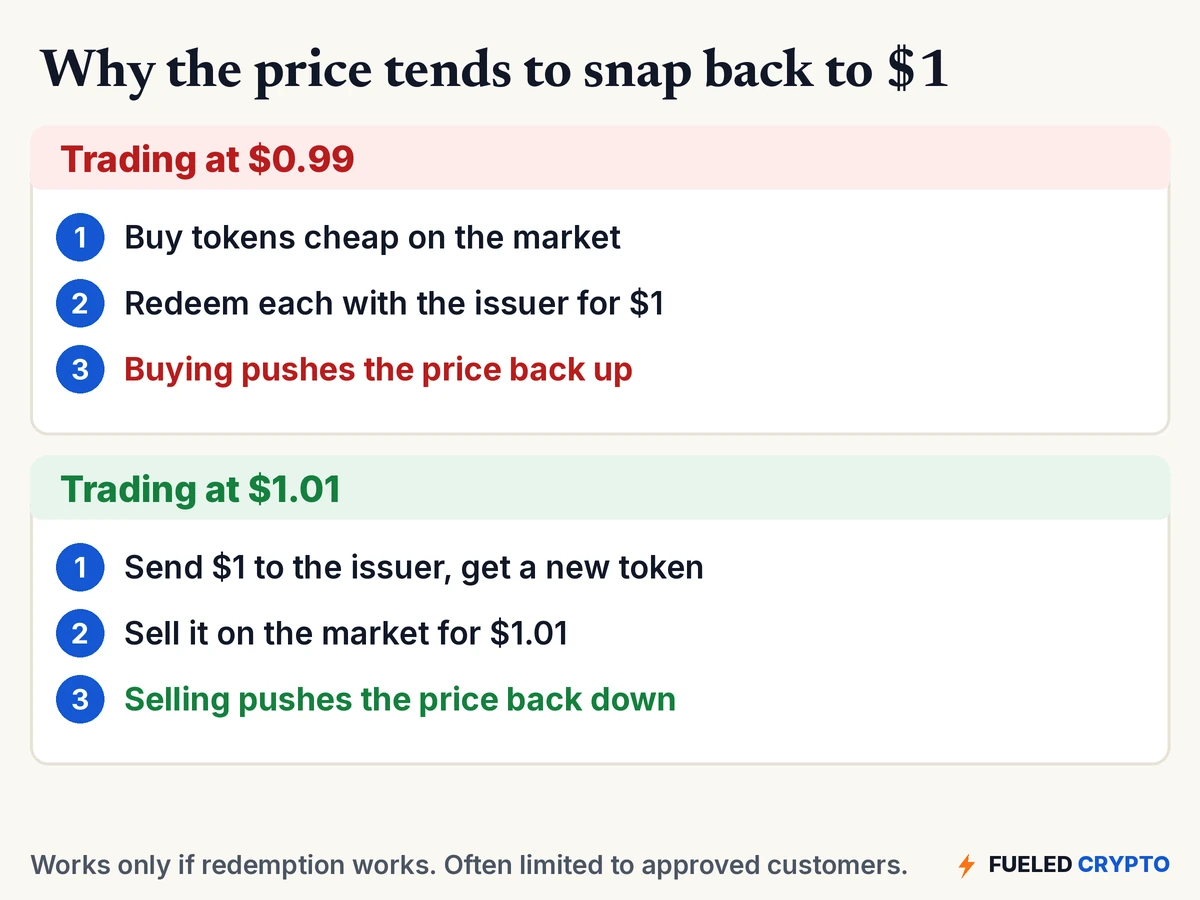
Notice what this depends on. The loop only works if redemption actually works, meaning the reserve is really there and the issuer can pay it out quickly. If people start to doubt that, the snap-back can weaken right when it's needed most.
Four ways to try to stay stable
Not every stablecoin uses a dollar reserve. Ethereum.org groups them into four broad types.
- Fiat-backed. Backed by traditional money and similar assets held in reserve. Ethereum.org notes you can buy them 1:1 and "later redeem them with the issuer." The tradeoff is that you're trusting a central company to hold and manage the reserve.
- Crypto-backed. Backed by other crypto locked in smart contracts. Because crypto prices swing, these are overcollateralized. Ethereum.org's example: a $1 stablecoin may have crypto "worth at least $2" behind it. The Fed note explains that if the collateral's value falls below a set level, the code sells (liquidates) it.
- Commodity-backed. Backed by something physical like gold. These track the value of that asset, so they aren't meant to stay at $1.
- Algorithmic. Not backed by a reserve. Ethereum.org describes them as relying on an algorithm that sells or supplies tokens to steer the price. They depend on people continuing to want the token.
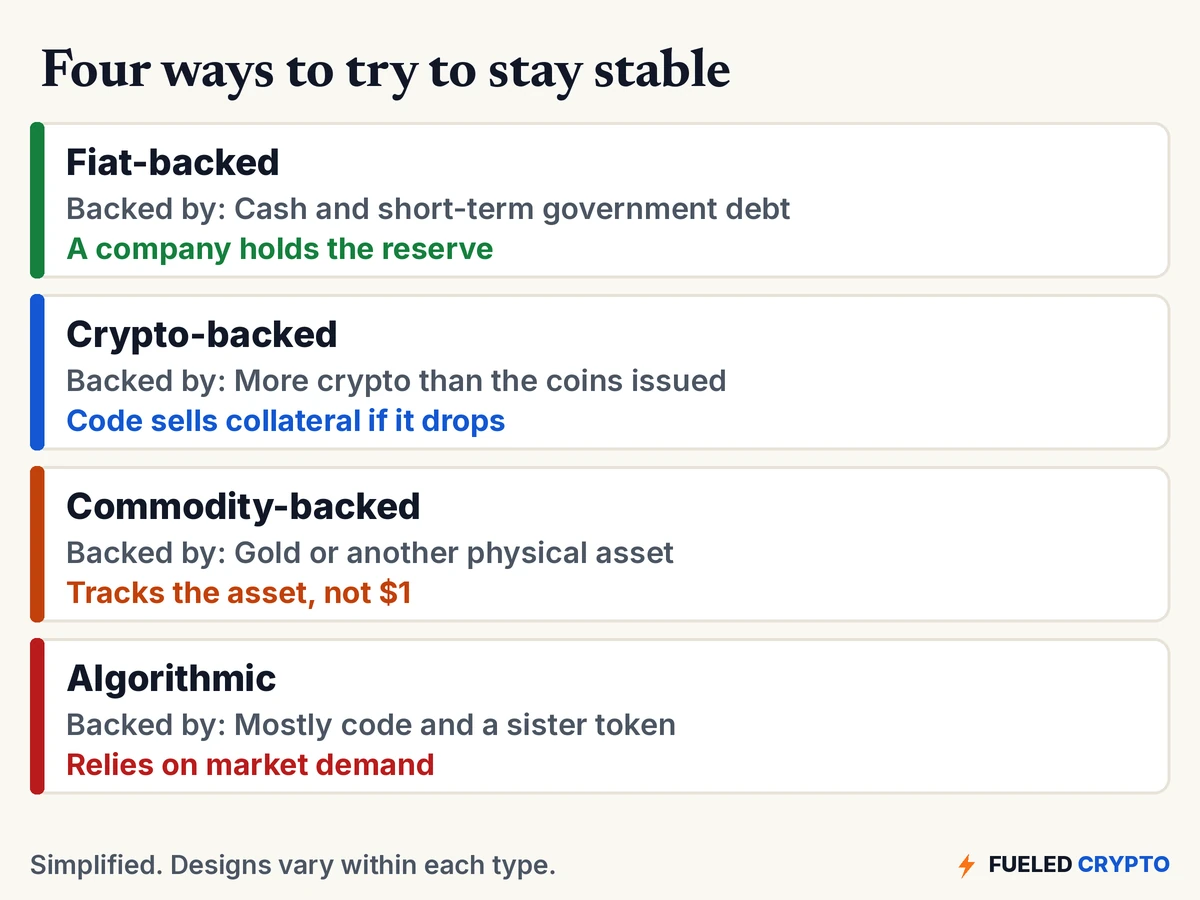
The question to ask about any stablecoin is the same: what's actually behind it, and can holders get that value back?
When "stable" wasn't
Pegs have broken. Two well-documented cases show two different ways it can happen.
TerraUSD, May 2022 (algorithmic). TerraUSD, known as UST, was meant to hold its dollar peg by being exchangeable for a sister token, LUNA, according to the SEC. In May 2022, the SEC says, "after UST de-pegged from the U.S. dollar, the price of UST and Terraform's other tokens plummeted to close to zero." The SEC put the loss at $40 billion in market value. In 2024 a jury in the SEC's case found Terraform Labs and Do Kwon liable for fraud, and they agreed to pay more than $4.5 billion.
USDC, March 2023 (fiat-backed). When Silicon Valley Bank failed, the issuer of USDC reported it couldn't withdraw $3.3 billion of its roughly $40 billion in reserves held there, according to the Fed note. USDC fell below 90 cents on the market, and a crypto-backed stablecoin that held USDC as collateral also slipped. Both recovered over about three days.
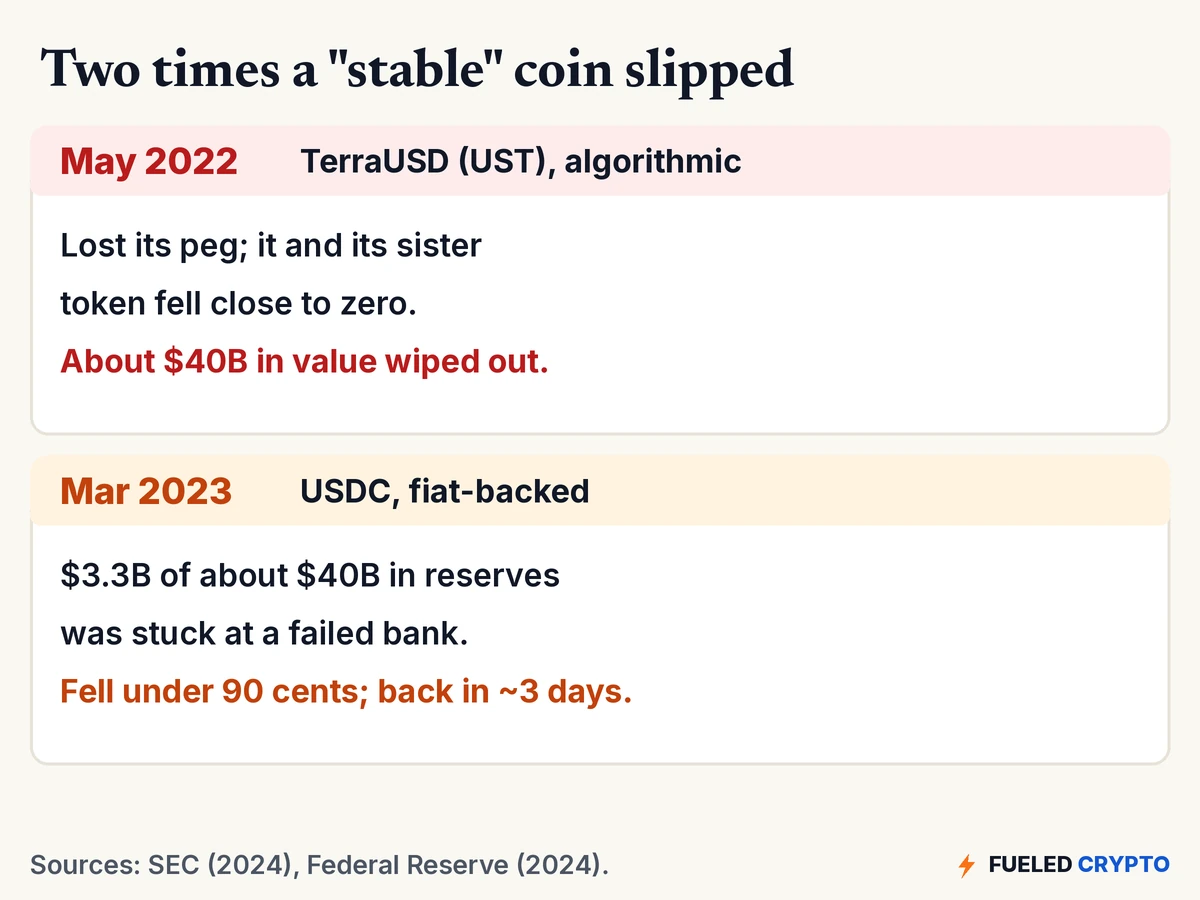
The lesson isn't that one type is good and another is bad. It's that a stablecoin is only as steady as whatever stands behind it, and markets can move fast when people start to doubt that.
Stablecoins and the law
In the U.S., the GENIUS Act, signed July 18, 2025, created a federal framework for "payment stablecoins," including reserve and disclosure rules for issuers. We keep the details in one place so they stay current: see our GENIUS Act explainer. Rules differ in other countries.
Separately from that law, the FDIC has said that its deposit insurance does not cover crypto assets, and that it only insures deposits held in insured banks, and only if the bank fails. Holding a stablecoin is not the same as holding dollars in an insured bank account.
Common mix-ups
- "Stable" means it can't lose value. It's a design goal. Pegs have slipped and, in one case, collapsed.
- "Backed" means I can get a dollar back. It depends on what's in the reserve and who is allowed to redeem. Many reserve-backed issuers only redeem for approved customers.
- The exchange price is the redemption price. On the market, the price can drift a little from $1. The issuer's 1:1 promise applies to redemptions.
- A stablecoin is a bank deposit. It isn't, and FDIC insurance doesn't cover it.
- Where you keep it doesn't matter. Stablecoins on an exchange carry the same custody questions as any crypto on an exchange. See Exchanges vs. Self-Custody.
Words you'll keep hearing
- Peg: the fixed value a stablecoin aims for, such as $1.
- Depeg: when the market price moves meaningfully away from the peg.
- Issuer: the company or protocol that creates the stablecoin.
- Reserve: the money and assets held to back the tokens.
- Mint / burn: create new tokens / permanently destroy tokens.
- Redeem: hand tokens back to the issuer for the underlying money.
- Collateral: assets locked up to back something, common with crypto-backed designs.
- Overcollateralized: backed by more value than the tokens issued.
- Arbitrage: buying in one place and selling in another to profit from a price gap, which is what pulls a peg back into line.
Frequently asked questions
Is a stablecoin always worth exactly $1? No. On the market it usually trades very close to $1, but it can drift, and it has dropped well below $1 in stressful moments. The 1:1 value is what the issuer promises on redemption.
Is a stablecoin the same as dollars in a bank? No. It's a crypto token, not a bank deposit. The FDIC says its deposit insurance does not cover crypto assets.
Can I redeem a stablecoin for dollars myself? For reserve-backed stablecoins, often not directly. The Federal Reserve notes that those issuers tend to mint and redeem only with institutional customers, so most people sell stablecoins on an exchange or to another person instead.
What keeps a stablecoin's price near $1? For reserve-backed stablecoins, arbitrage. If the price dips, approved customers buy cheap and redeem for $1. If it rises, they mint at $1 and sell. Both push the price back toward the peg.
What happened to TerraUSD? TerraUSD (UST) was an algorithmic stablecoin. In May 2022 it lost its dollar peg and fell close to zero, along with its sister token, wiping out about $40 billion in market value, according to the SEC.
Are stablecoins regulated in the U.S.? Yes. The GENIUS Act, signed July 18, 2025, set up federal rules for payment stablecoins. Our GENIUS Act explainer covers the details.
Why do people use stablecoins? The Federal Reserve notes they're widely used in decentralized finance, to make trades on crypto exchanges, and as a way into crypto markets. They let people move a dollar-like value on a blockchain without the price swings of most other crypto.
Where to go next
- What Is Cryptocurrency, Really? and How Crypto Transactions Work.
- What Is Ethereum?, which explains the smart contracts that crypto-backed stablecoins run on, and What Is Bitcoin?
- Exchanges vs. Self-Custody.
- The GENIUS Act, explained for the U.S. rules.
- Tokenization of Real-World Assets, which uses the same idea for other assets.
Sources
- Federal Reserve, FEDS Notes, Primary and Secondary Markets for Stablecoins (Feb. 23, 2024).
- ethereum.org, Stablecoins.
- U.S. Securities and Exchange Commission, press release 2023-32 (Feb. 16, 2023) and press release 2024-73 (June 13, 2024).
- FDIC, Fact sheet: What the public should know about FDIC deposit insurance and crypto companies (July 2022).
- Congress.gov, S.1582, GENIUS Act (became Public Law 119-27 on July 18, 2025).
All diagrams and animations are original Fueled Crypto graphics. Names and amounts in the animation are made up.
Fueled Crypto publishes news and education, not investment, tax, or legal advice. Crypto assets are volatile and can lose value. Do your own research and consider a licensed professional before making financial decisions. See our full disclaimer.
Want plain-English crypto news once a week? Subscribe to Fueled Crypto.