Deck: Ethereum is a blockchain that runs programs, not just payments. Here's what a smart contract actually is, what ETH and "gas" pay for, and how the network stays secure without mining.
Last reviewed: October 24, 2026
If Bitcoin is a shared ledger for sending money, Ethereum is a shared ledger that can also run code. That one difference is why so much of crypto lives on Ethereum: stablecoins, other tokens, collectibles and whole apps for trading and lending.
This guide sticks to how it works. If blockchains are new to you, start with How a Blockchain Works, in Plain English, and if you've read What Is Bitcoin?, you already have half the picture.
The short version
- Ethereum is a public blockchain that launched in July 2015. Anyone can use it, and no single company runs it.
- Its big idea is smart contracts: small programs stored on the blockchain that follow their rules automatically.
- ETH (ether) is its built-in currency. It pays the network fees, called gas, that every action costs.
- Since September 15, 2022, Ethereum is secured by staking, not mining. That switch was called the Merge.
- There's no fixed cap on ETH. New ETH is issued to validators, and part of every fee is destroyed.
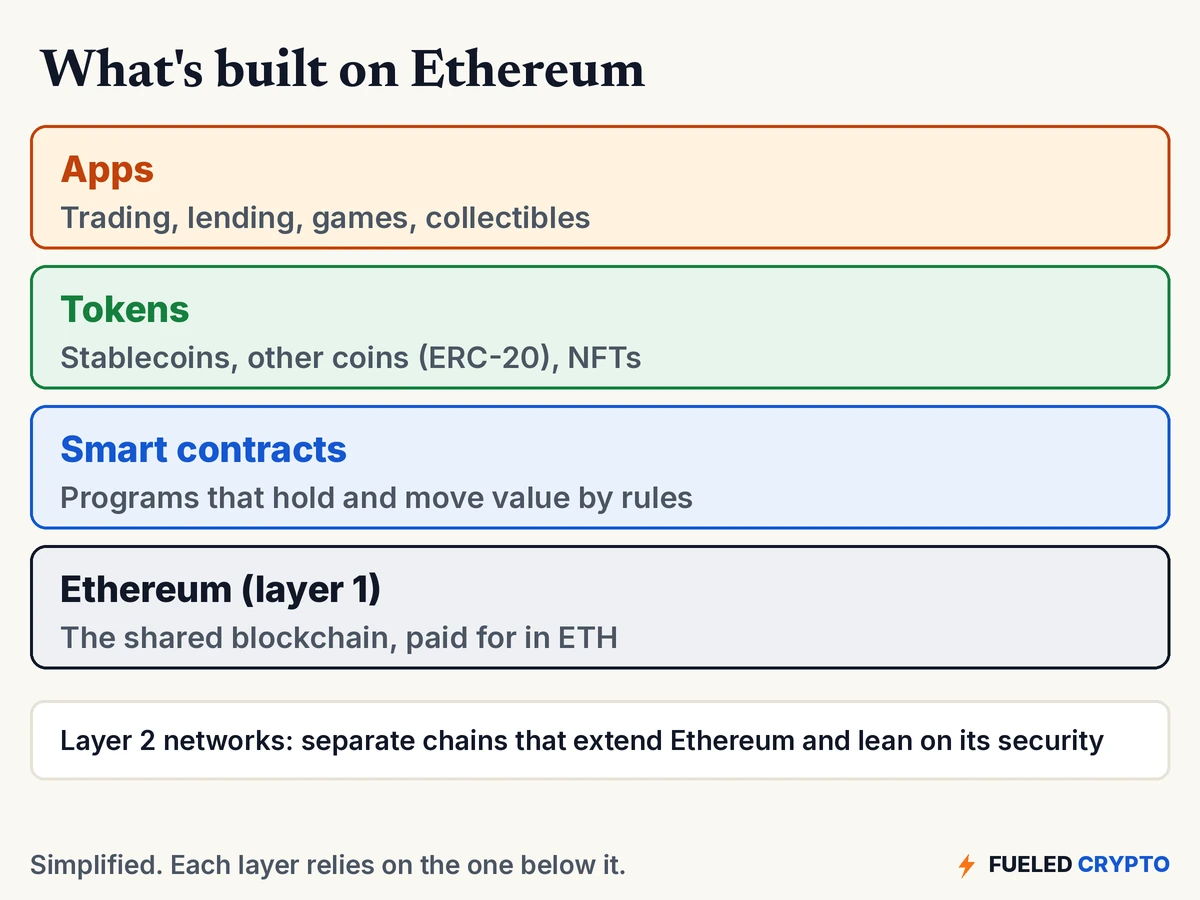
- Lots of other things are built on top of it: tokens, stablecoins, NFTs, apps, and faster "layer 2" networks.
What a smart contract is
The phrase sounds legal, but a smart contract isn't a contract in the lawyer sense. Ethereum.org puts it simply: "a 'smart contract' is simply a program that runs on the Ethereum blockchain."
The classic comparison, used on ethereum.org, is a vending machine. You pick an item, pay the right amount, and the machine hands it over. Nobody behind the counter decides whether you get it. The rules are built in.
A smart contract works the same way, with money and data instead of snacks. Say Sam, Ana and Lee want to chip in for a gift for Kim. They could use a contract whose rule is: "when three people have each sent 0.1 ETH, send all of it to Kim."
A few things make this different from asking a friend to hold the money:
- The rules are public. The contract's code sits on the blockchain where anyone can read it.
- It runs by itself. Once the condition is true, the payout happens. No one has to approve it.
- It's hard to change. Ethereum.org notes contract code "cannot be changed once created." Developers can design a contract to be upgradable, but by default the code is fixed.
- It does exactly what the code says. That includes mistakes. If the code has a bug, the bug runs too.
The term itself is older than Ethereum. Ethereum.org credits Nick Szabo with coining "smart contract" and says he wrote an introduction to the concept in 1994. Ethereum made the idea practical on a public blockchain.
ETH and gas: what you pay for
Every action on Ethereum, from sending ETH to using a contract, takes computing work by the network. You pay for that work with a fee measured in gas. Ethereum.org defines gas as "the unit that measures the amount of computational effort required to execute specific operations."
A fee has two parts:
- The base fee is set by the network and rises when it's busy. It's burned, meaning destroyed for good.
- The tip (priority fee) goes to the validator who adds your transaction to a block.
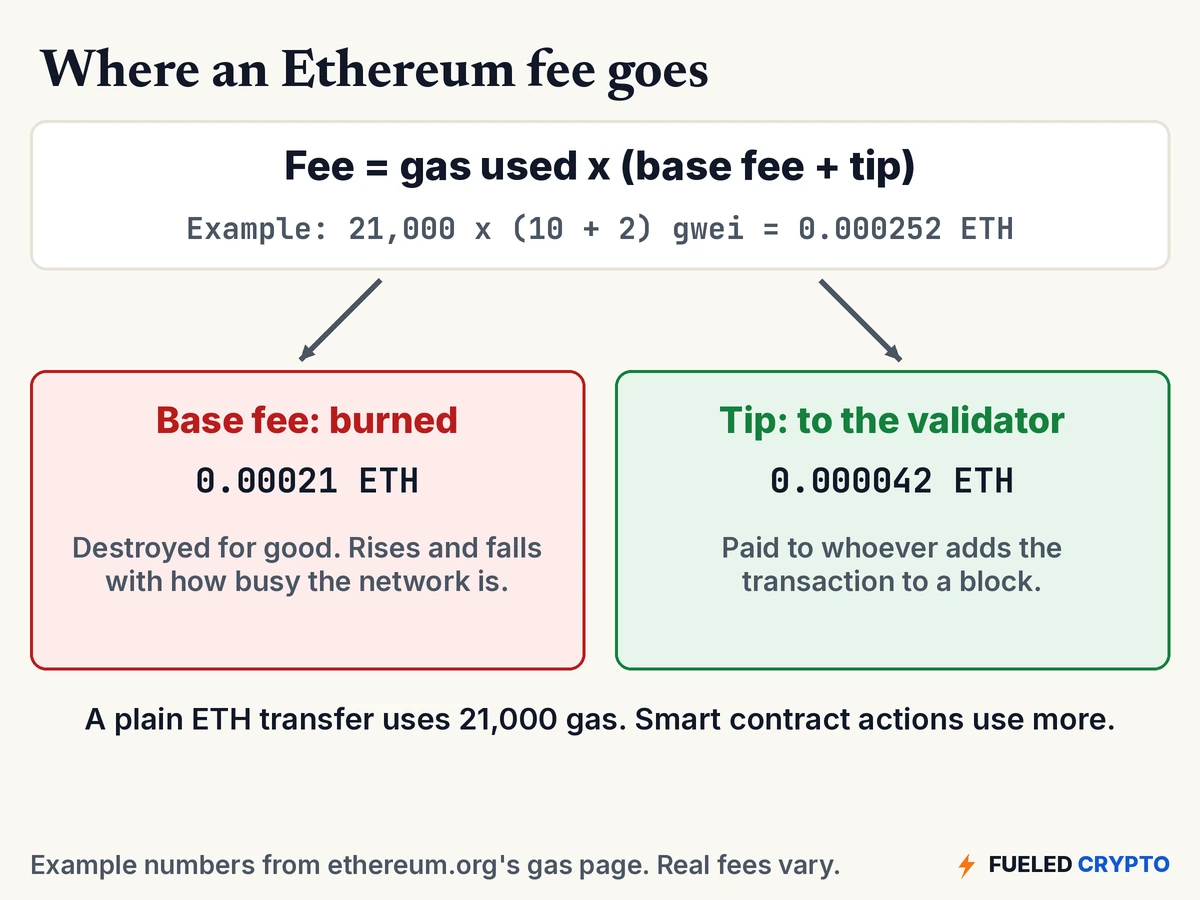
A simple ETH transfer uses 21,000 gas. A smart contract action usually needs more, because the network has more work to do. "Gwei" is just a small slice of ETH (one billionth), used so fee numbers aren't full of zeros. Real fees change with demand, so the example above is only an illustration.
How Ethereum stays secure: staking
Bitcoin uses mining, where computers race to solve a puzzle (see What Is Bitcoin?). Ethereum started out that way too, then switched.
On September 15, 2022, in an upgrade called the Merge, Ethereum moved to proof of stake. Instead of miners, it uses validators. Here's how it works, per ethereum.org:
- To run a validator, someone deposits 32 ETH as a stake and runs the network software.
- Time is split into 12-second slots. In each slot, one validator is picked at random to propose a block, and others check it and vote.
- Validators earn ETH for doing the job honestly. If one tries to cheat, some or all of its stake can be destroyed.
Ethereum.org says the Merge cut Ethereum's energy use by about 99.95%, because the computing race of mining was no longer needed.
Does ETH have a supply cap?
No. Unlike Bitcoin's 21 million cap, ETH has no fixed maximum. Ethereum.org describes two forces pulling in opposite directions:
- New ETH is issued to validators as rewards.
- The base fee on every transaction is burned.
When the network is busy, more ETH gets burned. When it's quiet, less does. So the total supply can grow or shrink over time, depending on how much the network is used. This guide doesn't try to predict which way it goes.
What's built on Ethereum
Because anyone can deploy a smart contract, people have built a lot on top of Ethereum:
- Tokens. Many coins created on Ethereum follow a shared standard for interchangeable tokens called ERC-20, so wallets and apps can handle them the same way. Stablecoins on Ethereum are tokens like this, run by smart contracts (see Stablecoins Explained).
- NFTs. Unique tokens that stand for one specific item, like a piece of digital art or a ticket.
- Apps. Smart contracts that let people trade, lend, borrow or play without a company in the middle, often called decentralized finance, or DeFi.
- Layer 2 networks. Ethereum.org describes a layer 2 as "a separate blockchain that extends Ethereum." They handle activity off the main chain to make it cheaper and faster, while leaning on Ethereum for security.
When the code was the problem
"It does exactly what the code says" cuts both ways. Ethereum's own history shows it.
In 2016, a project called The DAO was attacked, and, according to ethereum.org, "an insecure contract was drained of over 3.6 million ETH." On July 20, 2016, the Ethereum network adopted a change, called the DAO fork, that moved the funds to a new contract so people could withdraw them. Not everyone agreed with that fix. Ethereum.org notes the disagreement led to a permanent split, and the original chain continued as Ethereum Classic.
The broader lesson is that a smart contract is only as good as its code. A badly written contract can be exploited, and a malicious one will do exactly what its author intended. Our guide on what to do if your crypto is stolen covers the scams beginners run into most.
Common mix-ups
- Ethereum and ETH are the same thing. Ethereum is the network. ETH (ether) is the currency used on it.
- Smart contracts are legal contracts. They're programs. Whether one has any legal weight is a separate question this guide doesn't answer.
- Smart means safe. Contracts run exactly as written, bugs and all.
- Ethereum still uses mining. It switched to staking on September 15, 2022.
- Every token on Ethereum is ETH. No. Many other tokens run on Ethereum, but ETH is what pays the network's fees.
- Gas is a separate coin. Gas is a unit of work. You pay for it in ETH.
Words you'll keep hearing
- Smart contract: a program stored on the blockchain that runs by its rules automatically.
- ETH (ether): Ethereum's built-in currency.
- Gas: the unit for how much work an action takes. Fees are paid in ETH.
- Gwei: one billionth of an ETH, used to quote fees.
- Validator: a participant who stakes ETH and helps propose and check blocks.
- Staking: locking up ETH to help secure the network.
- The Merge: the September 2022 switch from mining to staking.
- ERC-20: the common standard most Ethereum tokens follow.
- Layer 2: a separate network that extends Ethereum to make activity cheaper and faster.
- DeFi: financial apps built from smart contracts.
Frequently asked questions
What is Ethereum in simple terms? Ethereum is a public blockchain that can run programs called smart contracts. It launched in July 2015, and its built-in currency is ETH.
What is a smart contract? A program stored on the Ethereum blockchain that follows its rules automatically, like a vending machine: the right input produces a set output, with no one in the middle deciding.
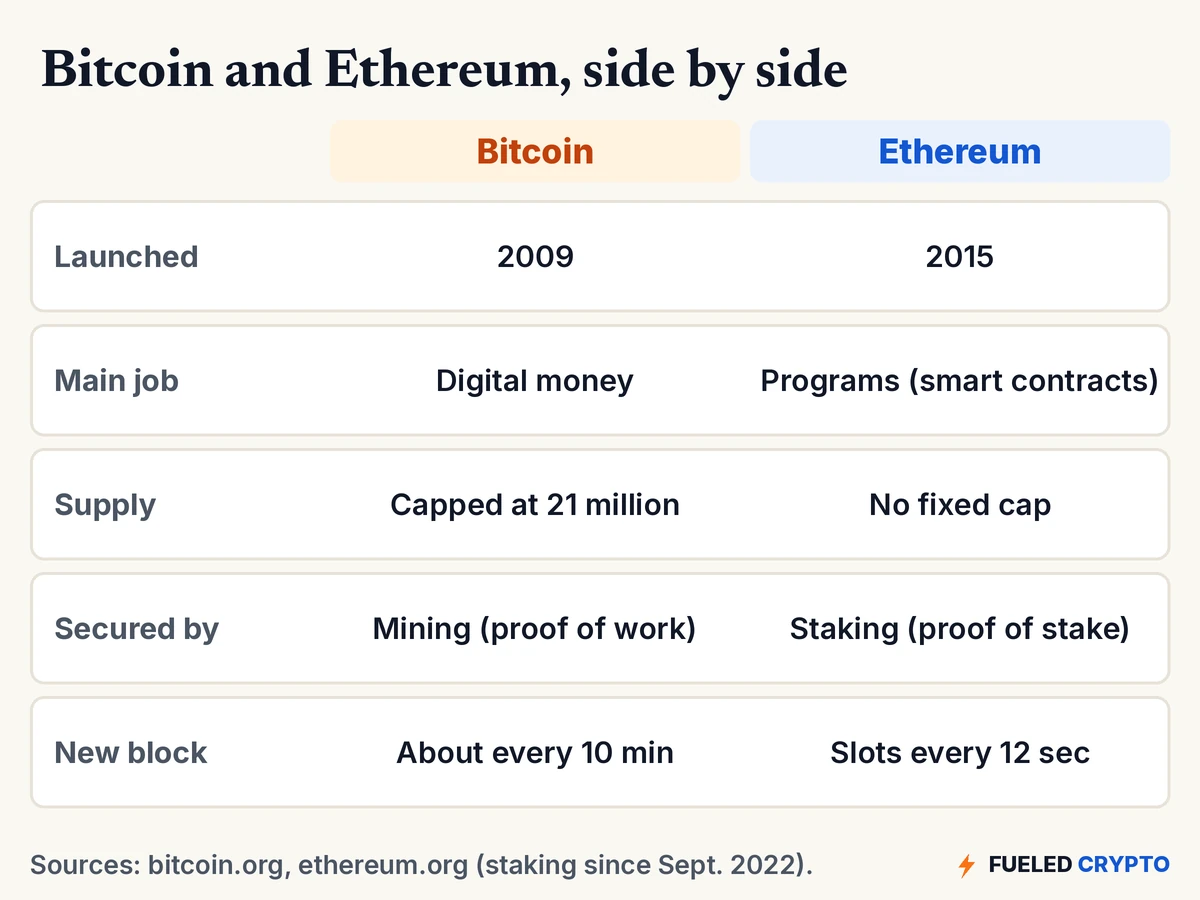
What's the difference between Ethereum and Bitcoin? Bitcoin was built mainly as digital money, has a 21 million cap and is secured by mining. Ethereum was built to run programs, has no fixed supply cap, and has been secured by staking since September 2022.
What is gas on Ethereum? Gas measures how much computing work an action takes. You pay for it in ETH. Part of the fee (the base fee) is burned and the rest (the tip) goes to the validator.
What was the Merge? The Merge was Ethereum's switch from mining to proof of stake on September 15, 2022. Ethereum.org says it cut the network's energy use by about 99.95%.
Is there a limit on how much ETH can exist? No. There's no fixed cap. New ETH is issued to validators while fee burning removes some, so the supply can rise or fall depending on how much the network is used.
What is a layer 2? A separate blockchain that extends Ethereum. It handles transactions off the main chain to make them cheaper and faster while relying on Ethereum for security.
Where to go next
- How a Blockchain Works and What Is Cryptocurrency, Really?
- What Is Bitcoin? and Stablecoins Explained.
- Keys, Addresses and Wallets, Explained and How Crypto Transactions Work.
- Tokenization of Real-World Assets, which builds on smart contracts.
Sources
- ethereum.org: What is Ethereum?, Smart contracts, What is ether (ETH)?.
- ethereum.org developer docs: Gas and fees, Proof-of-stake, ERC-20 token standard, Upgrading smart contracts.
- ethereum.org: The Merge, History of Ethereum (Frontier launch, July 30, 2015; DAO fork, July 20, 2016), Layer 2.
- Bitcoin figures: see the sources in our What Is Bitcoin? guide.
All diagrams and animations are original Fueled Crypto graphics. Names and amounts in the animation are made up.
Fueled Crypto publishes news and education, not investment, tax, or legal advice. Crypto assets are volatile and can lose value. Do your own research and consider a licensed professional before making financial decisions. See our full disclaimer.
Want plain-English crypto news once a week? Subscribe to Fueled Crypto.