Deck: Bitcoin is a payment network and a currency run by software rules instead of a company. Here's how new bitcoin gets created, why the amount is capped at 21 million, and what the "halving" actually is.
Last reviewed: October 24, 2026
Bitcoin was the first cryptocurrency, and it still sets the pattern most others follow. A lot of what you hear about it is about price. This guide skips all of that and sticks to the machinery: who runs it, how new coins come into existence, and the fixed schedule that decides how many will ever exist.
If blockchains are new to you, start with How a Blockchain Works, in Plain English. This guide builds on it.
The short version
- Bitcoin is two things with one name. The network (often written "Bitcoin") and the coin it moves ("bitcoin," or BTC).
- No company runs it. Thousands of computers run the same open-source rules and check each other's work.
- Miners add new blocks of transactions about every 10 minutes by winning a guessing race, and they're paid in new bitcoin plus fees.
- The halving cuts that new-bitcoin payment in half every 210,000 blocks, roughly every four years. The most recent one was in April 2024.
- The cap: the rules allow just under 21 million bitcoin, ever. About 20.1 million had been created by October 2026.
What Bitcoin is
In 2008, someone using the name Satoshi Nakamoto published a nine-page paper describing "a purely peer-to-peer version of electronic cash" that would let payments go "directly from one party to another without going through a financial institution" (Bitcoin whitepaper). The network started on January 3, 2009, when the first block was created (block 0 on mempool.space). Nobody has publicly proven who Satoshi is.
Bitcoin has no headquarters or CEO. The bitcoin.org FAQ compares it to email: "Nobody owns the Bitcoin network much like no one owns the technology behind email." Developers can propose changes, but "they can't force a change in the Bitcoin protocol because all users are free to choose what software and version they use" (bitcoin.org FAQ).
You don't have to deal in whole coins. One bitcoin divides into 100,000,000 smaller units called satoshis, or "sats" (same source).
How new bitcoin gets created: mining
Bitcoin's ledger grows one block at a time. Each block bundles a batch of waiting transactions. Whoever adds the next block is chosen by a race called proof of work, and the computers in that race are called miners.
Here's the race in plain terms:
- A miner gathers waiting transactions into a candidate block, plus one special line paying itself the reward.
- It runs the block through a hash function (Bitcoin uses SHA-256) together with a guess number. The output looks random.
- The rules only accept a block whose hash is below a target number. There's no shortcut, so miners just keep changing the guess and trying again.
- When one finds a winning guess, it shares the block. Every other computer can check it with a single hash, which takes a fraction of a second.
- The block joins the chain, and the winner keeps the reward.
The whitepaper describes the reward as "a special transaction that starts a new coin owned by the creator of the block," which "provides a way to initially distribute coins into circulation, since there is no central authority to issue them" (Bitcoin whitepaper, section 6). Miners also collect the fees attached to the transactions they include. Fees are covered in How Crypto Transactions Work.
Today, mining is done with specialized machines built only for this job, and it uses a lot of electricity. The U.S. Energy Information Administration's preliminary estimate was that crypto mining used roughly 0.6% to 2.3% of all U.S. electricity (EIA, Feb. 2024).
Why blocks keep coming about every 10 minutes
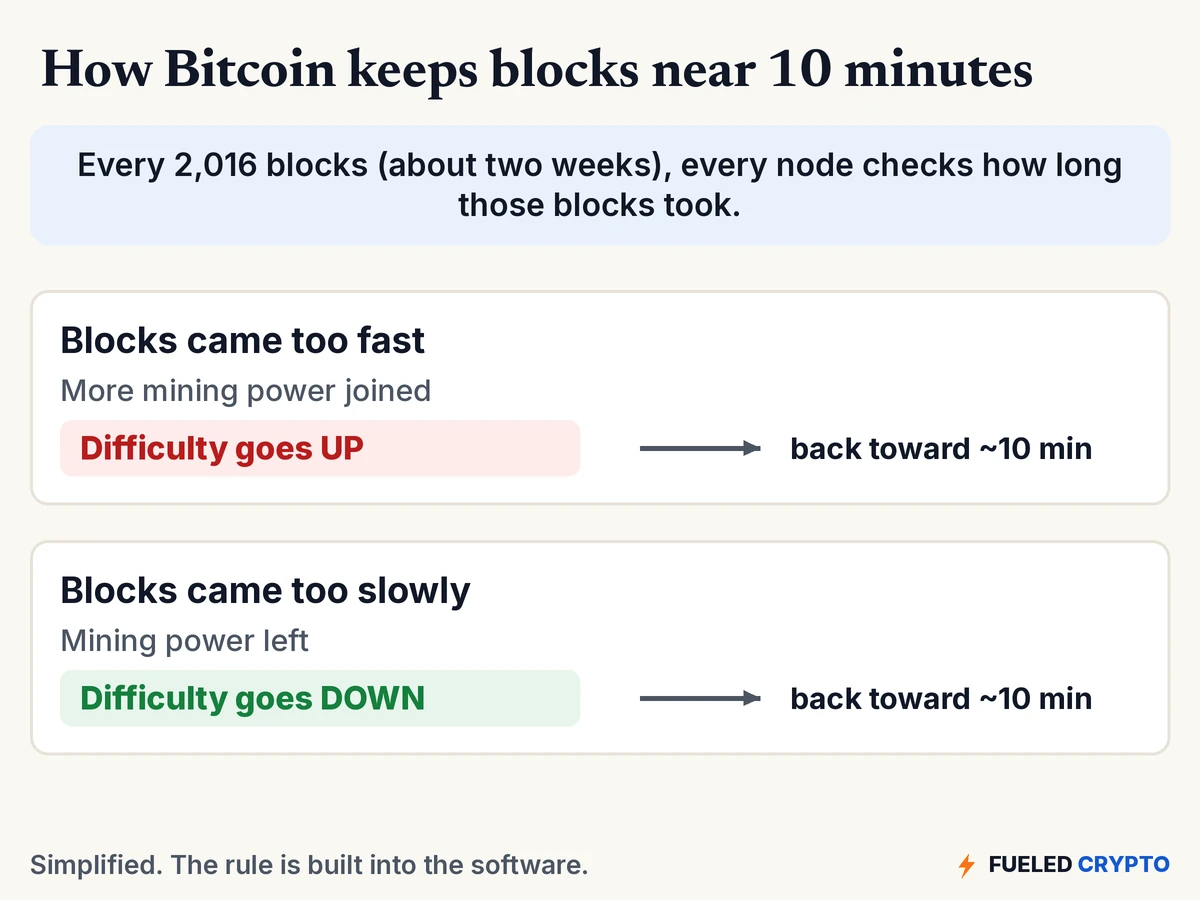
If more miners join, guesses get found faster. So Bitcoin adjusts how hard the puzzle is. Every 2,016 blocks, the network compares how long those blocks took with the ideal, which is two weeks. If they came too fast, the target gets harder; if too slow, easier (Bitcoin developer guide). That's how the network aims for an average of one block every 10 minutes, a number set in the software itself (Bitcoin Core source).
The ten-minute pace matters for the next part, because it makes the halving schedule roughly predictable in calendar time.
The halving
When Bitcoin started, each new block paid the miner 50 new bitcoin. The rules cut that amount in half every 210,000 blocks. In Bitcoin Core, the software most of the network runs, it's a short function that starts at 50 and halves it once per 210,000 blocks (Bitcoin Core source).
At about 10 minutes per block, 210,000 blocks take roughly four years. Here's what actually happened, using the time each block was mined (UTC):
| Halving block | Date mined | New bitcoin per block after |
|---|---|---|
| 210,000 | November 28, 2012 | 25 |
| 420,000 | July 9, 2016 | 12.5 |
| 630,000 | May 11, 2020 | 6.25 |
| 840,000 | April 20, 2024 (evening of April 19 in U.S. time zones) | 3.125 |
| 1,050,000 (next) | Not yet. Expected around 2028 | 1.5625 |
Dates from on-chain block timestamps (mempool.space).
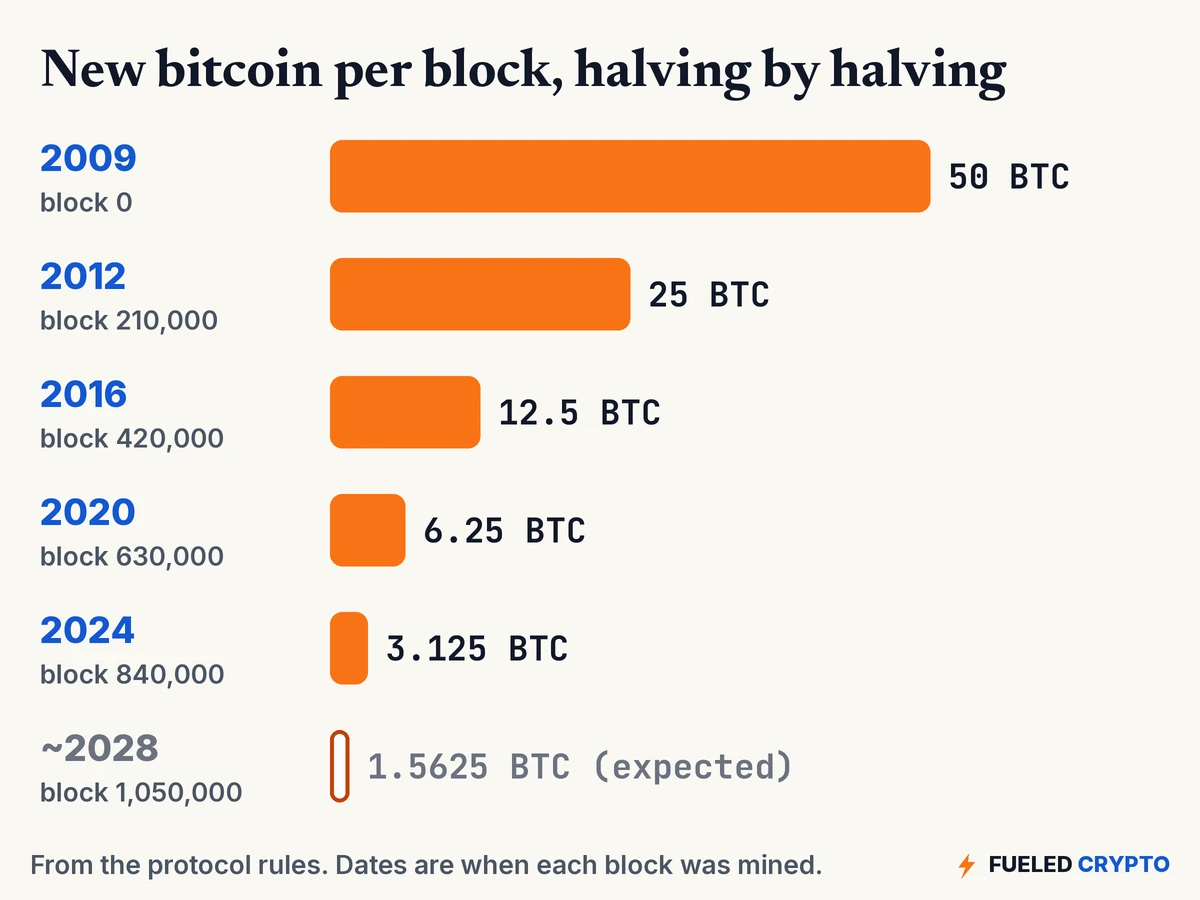
The next halving is set by block number, not by date. As of October 24, 2026, the chain was at block 972,919, so about 77,000 blocks remain. At roughly 10 minutes each, that points to around spring 2028, but the exact day depends on how fast blocks actually come.
A halving doesn't touch anyone's existing coins. It only changes how many new ones each block creates. People debate how halvings relate to price. That's a market question, covered (without predictions) in Crypto Market Cycles.
The 21 million cap
Add up every block's reward across all the halvings and you get the limit. In whole coins it's just under 21 million: 20,999,999.9769 bitcoin, because the reward eventually gets too small to divide further. The software also treats 21 million as the most bitcoin that can ever be valid (Bitcoin Core source).
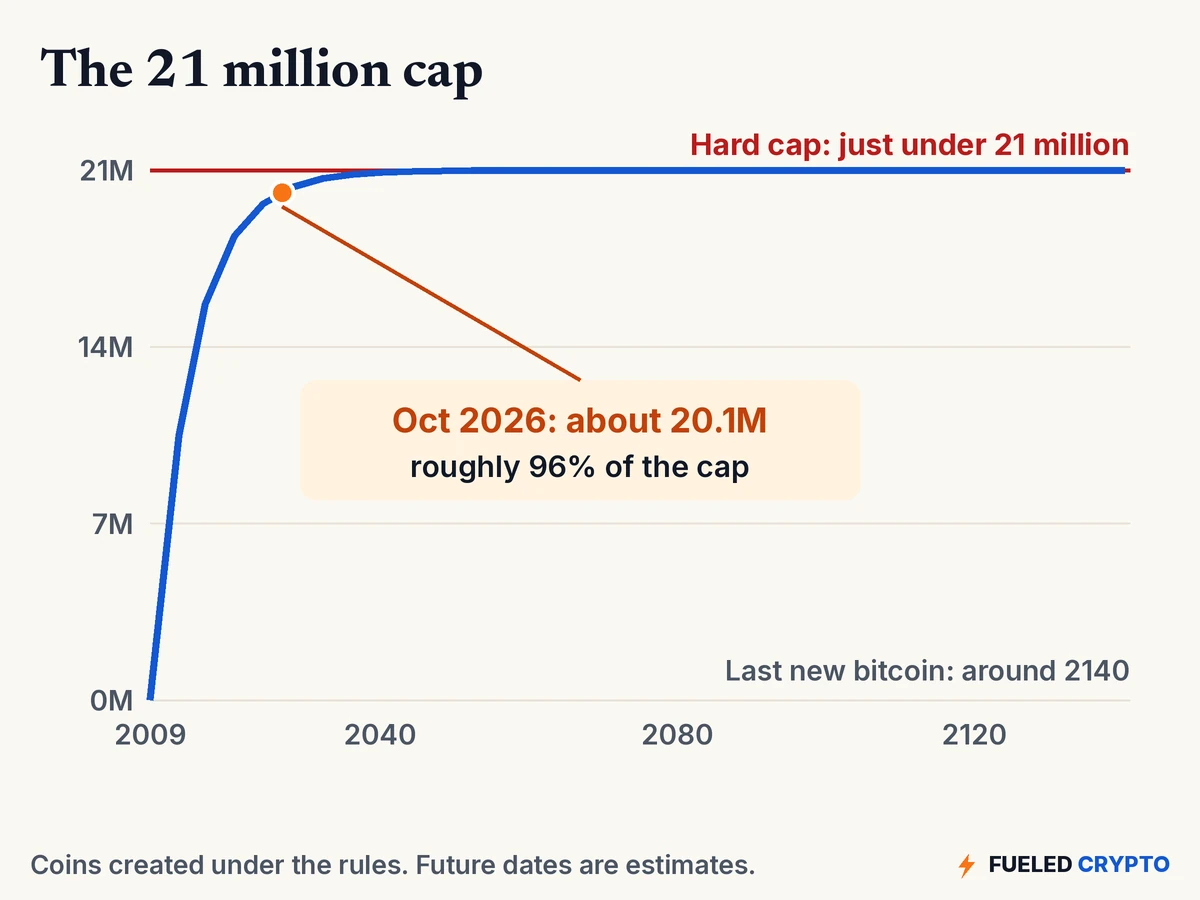
By block 972,919 (October 24, 2026), the rules had created about 20.1 million bitcoin, roughly 96% of the cap. The remaining 4% comes out more and more slowly. The block reward reaches zero after the 33rd halving, which at the current pace lands around the year 2140.
What then? The whitepaper anticipated it: once the coins are out, "the incentive can transition entirely to transaction fees" (Bitcoin whitepaper, section 6). Whether fees alone will pay for enough mining is a real open question that people in the industry debate.
Could the cap change? Only if the people running the network chose to run software with different rules. No company or person can change it on their own, for the same reason given by bitcoin.org above: everyone chooses the software they run, and a block that breaks the rules is rejected by the computers checking it.
Common mix-ups
- "Bitcoin is anonymous." Every transaction is public. The whitepaper says "the public can see that someone is sending an amount to someone else," just not who is behind the addresses. Addresses can often be linked to people over time. A blockchain explorer shows what's visible.
- "You have to buy a whole bitcoin." It divides into 100 million sats.
- "The halving cuts my bitcoin in half." No. It only changes the new-coin reward for miners.
- "Miners decide which transactions are valid." Miners choose which valid transactions to include, but every node checks the rules, and an invalid block gets rejected.
- "The halving happens on a set date." It happens at a set block number. The date is an estimate.
Words you'll keep hearing
- BTC: the ticker symbol for bitcoin.
- Satoshi (sat): 0.00000001 bitcoin, the smallest unit.
- Block reward (subsidy): the new bitcoin a miner gets for a block, now 3.125.
- Proof of work: the guessing race that decides who adds the next block.
- Hash rate: how many guesses per second the whole network is making.
- Difficulty: how hard it is to find a winning guess, reset every 2,016 blocks.
- Node: a computer that keeps a copy of the chain and checks the rules.
- Halving: the cut in half of the block reward every 210,000 blocks.
Frequently asked questions
What is Bitcoin in simple terms? A digital currency and payment network that runs on shared software instead of a company. Thousands of computers keep the same record of who owns what.
How many bitcoin are there? About 20.1 million had been created by October 2026, out of a maximum of just under 21 million.
What is the Bitcoin halving? Every 210,000 blocks, roughly every four years, the new bitcoin paid to miners per block is cut in half. It went from 6.25 to 3.125 in April 2024.
When is the next halving? At block 1,050,000. Based on the usual pace, that's expected around 2028. The exact date depends on how fast blocks are found.
What happens when all 21 million bitcoin are mined? No new bitcoin will be created, which is expected around 2140. Miners would then rely on transaction fees.
Who controls Bitcoin? No single company or person. People and businesses around the world run the software and choose which version to use.
Does mining use a lot of energy? Yes. The U.S. Energy Information Administration's preliminary estimate put U.S. crypto mining at roughly 0.6% to 2.3% of national electricity use.
Where to go next
- How a Blockchain Works and What Is Cryptocurrency, Really?
- Keys, Addresses and Wallets, Explained and How Crypto Transactions Work.
- Exchanges vs. Self-Custody.
- How to Read a Blockchain Explorer and Crypto Market Cycles.
Sources
- Satoshi Nakamoto, Bitcoin: A Peer-to-Peer Electronic Cash System (2008).
- bitcoin.org, Frequently Asked Questions.
- Bitcoin Core source code: block reward and halving, 210,000-block interval and 10-minute target, 21 million limit.
- Bitcoin Developer Guide, Block Chain: difficulty.
- On-chain data via mempool.space: block 0 and halving block timestamps; chain height 972,919 on Oct. 24, 2026.
- U.S. Energy Information Administration, Tracking electricity consumption from U.S. cryptocurrency mining operations (Feb. 2024).
All diagrams and animations are original Fueled Crypto graphics. Charts are calculated from Bitcoin's published protocol rules.
Fueled Crypto publishes news and education, not investment, tax, or legal advice. Crypto assets are volatile and can lose value. Do your own research and consider a licensed professional before making financial decisions. See our full disclaimer.
Want plain-English crypto news once a week? Subscribe to Fueled Crypto.