Deck: A normal crypto wallet has one key, so one lost backup or one thief is enough to lose everything. A multisig wallet needs several keys to approve a payment. Here's how that works, what it protects against, and the new homework it creates.
Last reviewed: October 24, 2026
If you've read our guide to keys and wallets, you know the uncomfortable truth about self-custody: whoever has the key controls the coins. Lose the key and its backup, and the coins are stuck forever. Let someone copy it, and they can take everything.
Multisig, short for "multi-signature," is one way people reduce that single point of failure. It sounds technical, and the setup can be. But the core idea is something you already know from everyday life: a safe-deposit box that needs two keys, or a business check that needs two signatures.
This guide explains the idea in plain English. It describes kinds of setups, not specific products, and doesn't recommend any.
The short version
- A multisig wallet needs more than one key to approve a payment. A "2-of-3" wallet has three keys, and any two of them can move the coins.
- It protects against losing one key (the other two still work) and against one key being stolen (a thief still needs a second).
- It adds homework. You have several keys to store in separate places, and you need to back up the wallet's setup details, not just the recovery phrases.
- Sending takes more steps, because you approve each payment with more than one key.
- It works differently on different networks. Bitcoin builds multisig into its scripts; on Ethereum, multisig is usually a smart contract wallet.
- It's one option, not a requirement. Many people use a single hardware wallet with a well-protected backup. Multisig trades simplicity for fewer single points of failure.
Two keys out of three
Picture Sam. Instead of one hardware wallet, he sets up a 2-of-3 multisig wallet. There are three keys, each with its own recovery phrase, and he keeps them in three different places: one at home, one at a second location, and one as a trusted backup.
To send bitcoin, Sam signs the payment with any two of the three keys. One signature alone isn't enough, and the network won't accept the payment. Bitcoin's developer documentation describes this as m-of-n: "m is the minimum number of signatures" required, and "n is the number of public keys" in the setup. Sam's wallet is m = 2, n = 3.
Now imagine two bad days:
- A burglar finds Key A. It isn't enough on its own. Sam still has time to move his coins to a fresh setup using Keys B and C.
- Key A is lost in a flood. Sam can still sign with Keys B and C, and then rebuild with a new third key.
That's the whole appeal: no single lost or stolen key decides the outcome.
Single key vs. multisig
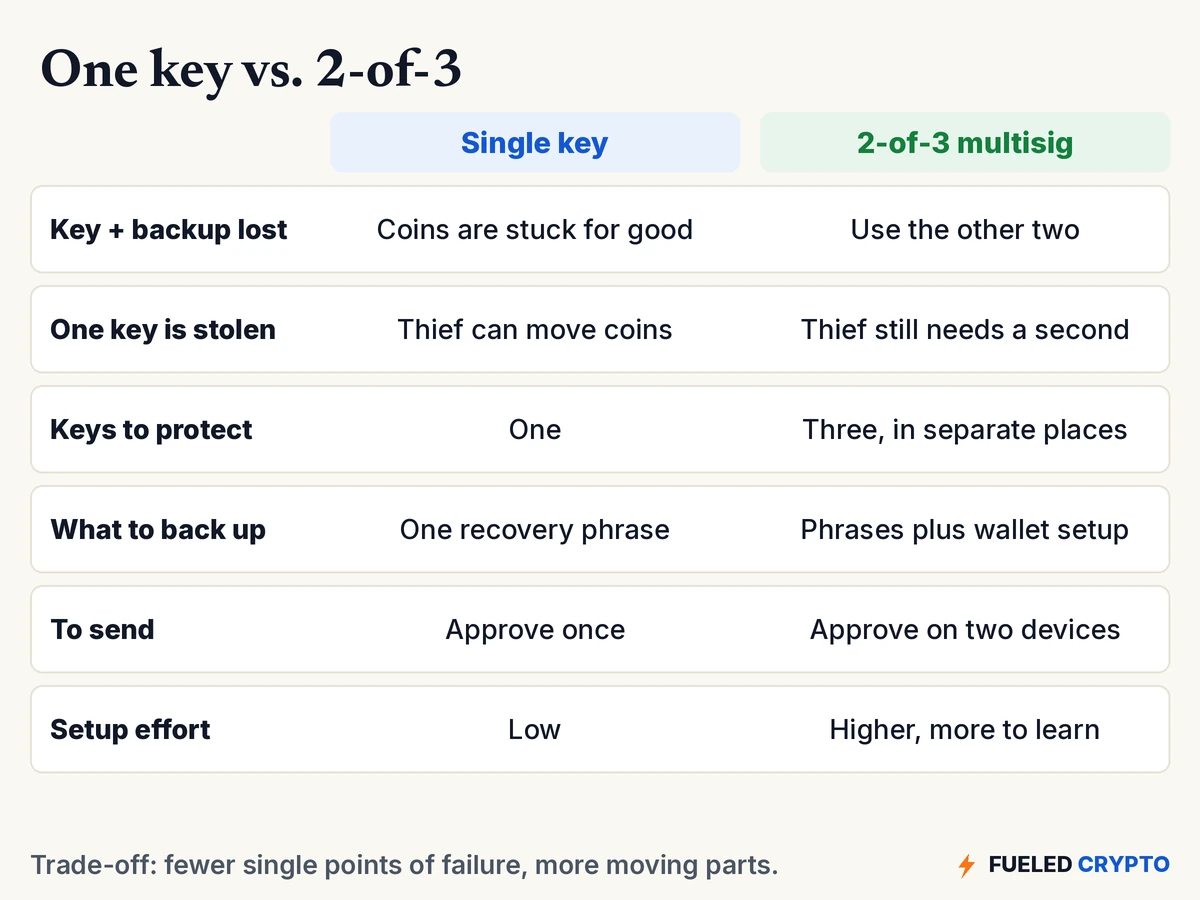
With a single-key wallet, your recovery phrase is everything. Our seed phrase guide covers how to protect it, and it's worth noting that guide also describes advanced options like a passphrase and Shamir backups, which spread risk in different ways.
With multisig, each key is less powerful on its own, so each one is less of a disaster to lose. The price is that there's more to manage: more devices, more backups, more places, and more steps every time you send.
How it works on different networks
On Bitcoin, multisig is built into the way coins are locked. When coins are sent to a multisig address, the rule "any 2 of these 3 keys" is part of what must be satisfied to spend them. Bitcoin's developer docs note that multisig is the most common use of one kind of Bitcoin address (pay-to-script-hash). Some newer techniques (such as MuSig2 on Taproot, for setups where every key signs) can make a shared wallet look like an ordinary single-key wallet on the blockchain, which helps privacy.
On Ethereum, a normal account is controlled by one private key. Ethereum.org defines multisig as "a digital wallet or account that requires multiple signatures or approvals to execute transactions." On Ethereum, that's usually done with a smart contract wallet, an account run by code with its own rules, such as "two of these three approvals." Ethereum.org's page on account abstraction notes that smart contract wallets can also let you "recover your account if you lose the keys" and "share your account security across trusted devices or individuals." Our What Is Ethereum? guide explains smart contracts.
A multisig on one network doesn't carry over to another. Each network, and often each wallet app, has its own way of doing it.
The part people forget: backing up the setup
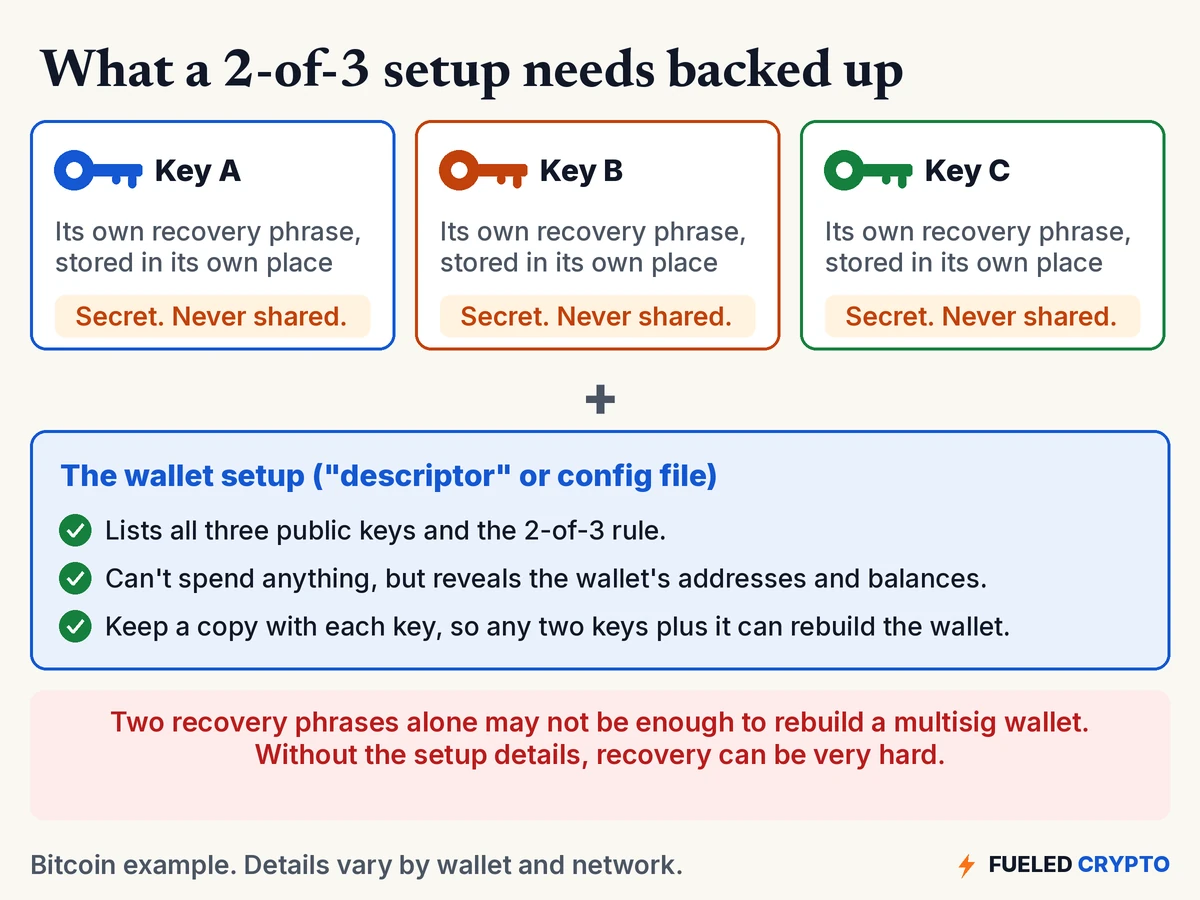
This is the single most important thing to understand before setting one up, especially on Bitcoin.
To rebuild a multisig wallet, you generally need enough keys (two, in a 2-of-3) plus the wallet's setup details: all three public keys and the rule that ties them together. Bitcoin Core calls this a descriptor, a short text that describes "a k-of-n multisig policy, where any k out of the n provided" keys must sign. Without it, finding your coins can be very hard, even with two good recovery phrases.
Bitcoin Core's own multisig example puts it plainly: each participant "must maintain (and backup) two separate wallets: a signer and the corresponding multisig."
The setup details can't move your coins on their own. But they include the wallet's public keys, and the Bitcoin standard for these keys (BIP 32) notes that sharing them lets someone see every incoming and outgoing payment. So keep the setup private, and keep a copy with each key, so that any two keys plus the setup can rebuild the wallet.
Common ways people arrange the keys
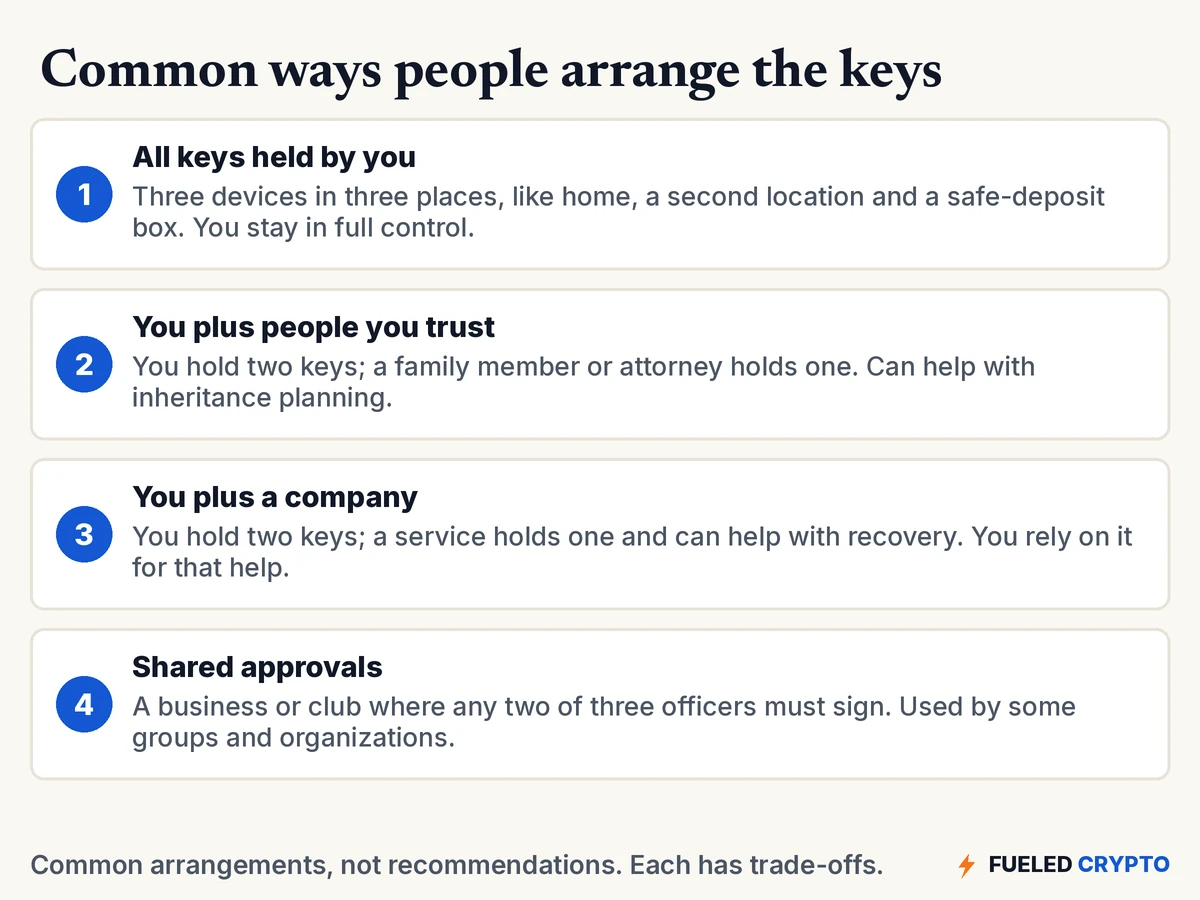
- All keys held by you, in different places. You keep full control, and you carry all the responsibility.
- You plus people you trust. For example, you keep two keys and a family member or attorney keeps one. That can make inheritance planning easier, but it means trusting that person to keep their key safe and not to work with anyone else against you.
- You plus a company. Some services hold one key and can help you recover or co-sign. You rely on that company for that help, and on its terms and its staying in business.
- Shared approvals. A business, club or family fund where any two of three people must sign.
None of these is right for everyone. Each just moves the trust and the work around.
Honest trade-offs
What multisig helps with: a single lost key or backup, a single stolen key, a single compromised device, and, in some setups, passing access to heirs without handing anyone full control today.
What it doesn't fix: scams that trick you into approving a bad payment with two keys, losing too many keys (two of three, in a 2-of-3), losing the setup details, or the price swings of whatever you hold.
What it adds: more devices, more backups, more steps to send, and more ways to make a setup mistake. A common habit with any new setup is to send a small amount first and practice a full recovery before moving more. As with any cold wallet, checking the receiving address on the device's own screen is a common safeguard.
Multisig and inheritance
One reason people look at multisig is to make sure family can reach their crypto someday, without giving anyone full access today. For example, a trusted person holds one key, and the will points to where the other key and the setup details are kept.
This is part of a bigger plan, though. Your family also needs to know what you hold and where things are, in plain instructions. Our crypto estate planning guide and free estate planning kit walk through that. Our kit notes that a will can become public in probate, so it isn't the place for recovery phrases or access details. An estate attorney can advise on your situation.
Common mix-ups
- "Multisig means my coins can't be stolen." It means one stolen key isn't enough. Scams that get you to approve a payment still work.
- "I just need the recovery phrases." On Bitcoin especially, you also need the wallet's setup details to rebuild it.
- "Multisig and splitting my seed phrase are the same." Splitting one phrase into pieces still creates one key. Multisig uses several separate keys, each signing on its own.
- "2-of-2 is safer than 2-of-3." 2-of-2 has no spare. Lose either key and the coins are stuck.
- "Every wallet can open any multisig." Setups differ by network and app. Note which app and settings you used.
Words you'll keep hearing
- Multisig (multi-signature): a wallet that needs more than one key to approve a payment.
- M-of-N: the rule. M signatures needed out of N keys, like 2-of-3.
- Signer / cosigner: one of the keys, often a hardware wallet.
- Descriptor (wallet setup / config): the text that lists all the public keys and the M-of-N rule.
- xpub (extended public key): a public key that can reveal a wallet's addresses, but can't spend.
- Smart contract wallet: on Ethereum, an account run by code that can enforce rules like multisig.
- Single-sig: an ordinary one-key wallet.
Frequently asked questions
What is a multisig wallet? A multisig (multi-signature) wallet needs more than one key to approve a payment. In a 2-of-3 wallet, there are three keys and any two of them can move the coins, but no single key can.
What does 2-of-3 multisig mean? It means three keys exist and any two must sign to send a payment. If one key is lost, the other two still work. If one is stolen, the thief still needs a second key.
Is multisig safer than a hardware wallet? It removes some single points of failure, like one lost or stolen key, but adds complexity and more backups to manage. Many multisig setups use several hardware wallets as the keys. Which fits depends on your situation.
What do I need to back up for a multisig wallet? Each key's recovery phrase, stored separately, plus the wallet's setup details (on Bitcoin, often called a descriptor), which list all the public keys and the M-of-N rule. Recovery phrases alone may not be enough to rebuild the wallet.
What happens if I lose one key in a 2-of-3 multisig? You can still sign with the other two. It's common to then move the coins to a fresh setup with a new third key, so you're back to having a spare.
Does multisig work on Ethereum? Yes, usually through a smart contract wallet, an account run by code that requires a set number of approvals. It works differently from Bitcoin's multisig, and a setup on one network doesn't carry over to another.
Can multisig help with inheritance? It can be part of a plan, for example by giving a trusted person one key so heirs can reach funds later. Family still needs clear instructions and the setup details. An estate attorney can advise on your situation.
Where to go next
- Keys, Addresses and Wallets, for what a key actually is.
- Seed Phrase Best Practices, for storing each backup.
- Hardware Wallet Setup Guide and How to Check If Your Hardware Wallet Has Been Tampered With, since each key is often a hardware wallet.
- Crypto Estate Planning, for making sure family can reach it.
Sources
- Bitcoin developer documentation: Transactions (m-of-n multisig and P2SH), Glossary.
- Bitcoin Core: Support for output descriptors (multisig descriptors, the basic multisig example, MuSig2).
- BIP 32: Hierarchical deterministic wallets (sharing extended public keys reveals payments).
- BIP 327: MuSig2 (outputs indistinguishable from single-signer outputs).
- Ethereum.org: Glossary: multisig, Account abstraction (smart contract wallets).
All diagrams and animations are original Fueled Crypto graphics. Names in the animation are made up.
Fueled Crypto publishes news and education, not investment, tax, or legal advice. Crypto assets are volatile and can lose value. Do your own research and consider a licensed professional before making financial decisions. See our full disclaimer.
Want plain-English crypto news once a week? Subscribe to Fueled Crypto.