Deck: Some crypto is built into its own blockchain. Other crypto is created on top of someone else's. That one difference explains why you need a second coin to pay fees, why the same name can show up on several networks, and why a copied name means nothing.
Last reviewed: October 24, 2026
For a while I used "coin" and "token" as if they meant the same thing. Most people do, and in casual conversation that's fine. It stopped being fine the day I tried to send a token and my wallet told me I didn't have enough of a completely different coin to pay the fee.
This guide explains the difference in plain English, and why it matters when you actually use crypto.
The short version
- A native coin is built into its own blockchain. Bitcoin's is BTC, Ethereum's is ETH, and the XRP Ledger's is XRP.
- A token is created on top of an existing blockchain, usually by a smart contract or a built-in ledger feature.
- Fees are usually paid in the native coin, even when you're sending a token.
- Anyone can usually create a token, with any name and symbol they like.
- A token's real identity is its contract address (or issuer), not its name.
- The everyday words are loose. Many "stablecoins" and "meme coins" are technically tokens.
Native coins: built into the blockchain
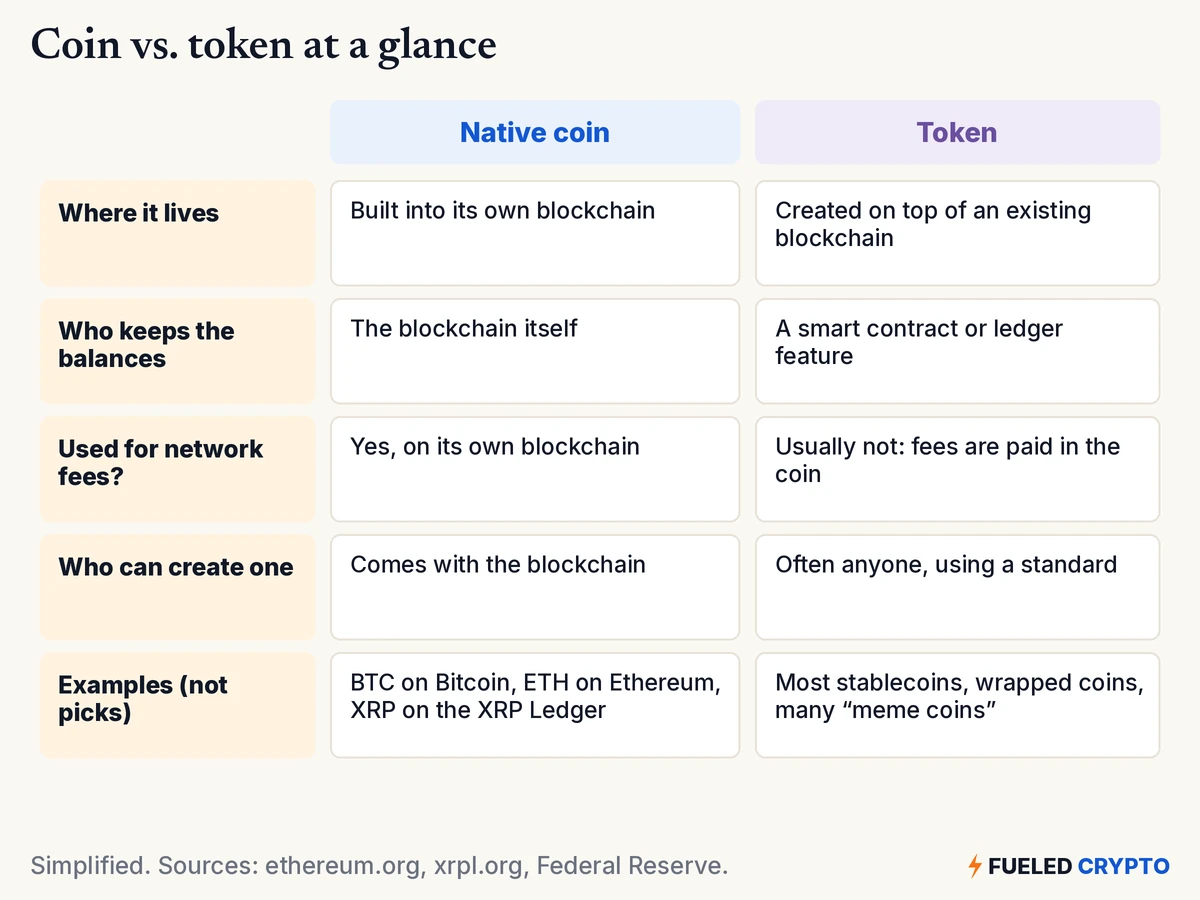
A native coin comes with the blockchain itself. The network tracks who holds it directly, and it's usually what pays for using the network. ethereum.org describes ether as "the native cryptocurrency that powers the Ethereum network. It's used to pay transaction fees (known as 'gas')."
The XRP Ledger's documentation makes the same distinction: XRP is "the native digital asset of the XRP Ledger," accounts "must burn small amounts of XRP as 'gas' to pay for sending transactions," and "All XRP was created along with the ledger itself." Bitcoin works the same way with BTC. Our guides to Bitcoin and Ethereum explain those two networks.
Tokens: built on top of a blockchain
A token borrows an existing blockchain instead of having its own. A Federal Reserve research note explains that on Ethereum, a smart contract can "define its own ledger for tracking user balances of a token (essentially a sub-ledger of Ethereum, specific to that particular smart contract)."
To keep tokens compatible with wallets and apps, blockchains use shared standards. On Ethereum the most widely used is ERC-20, which ethereum.org calls "a standard for Fungible Tokens," meaning every unit is interchangeable with every other. Other blockchains have their own versions. The XRP Ledger, for example, says "All assets other than XRP can be represented in the XRP Ledger as tokens."
What tokens are used for
ethereum.org says tokens "can represent virtually anything," from reputation points on a platform to "a fiat currency like USD" or "an ounce of gold." A few common categories:
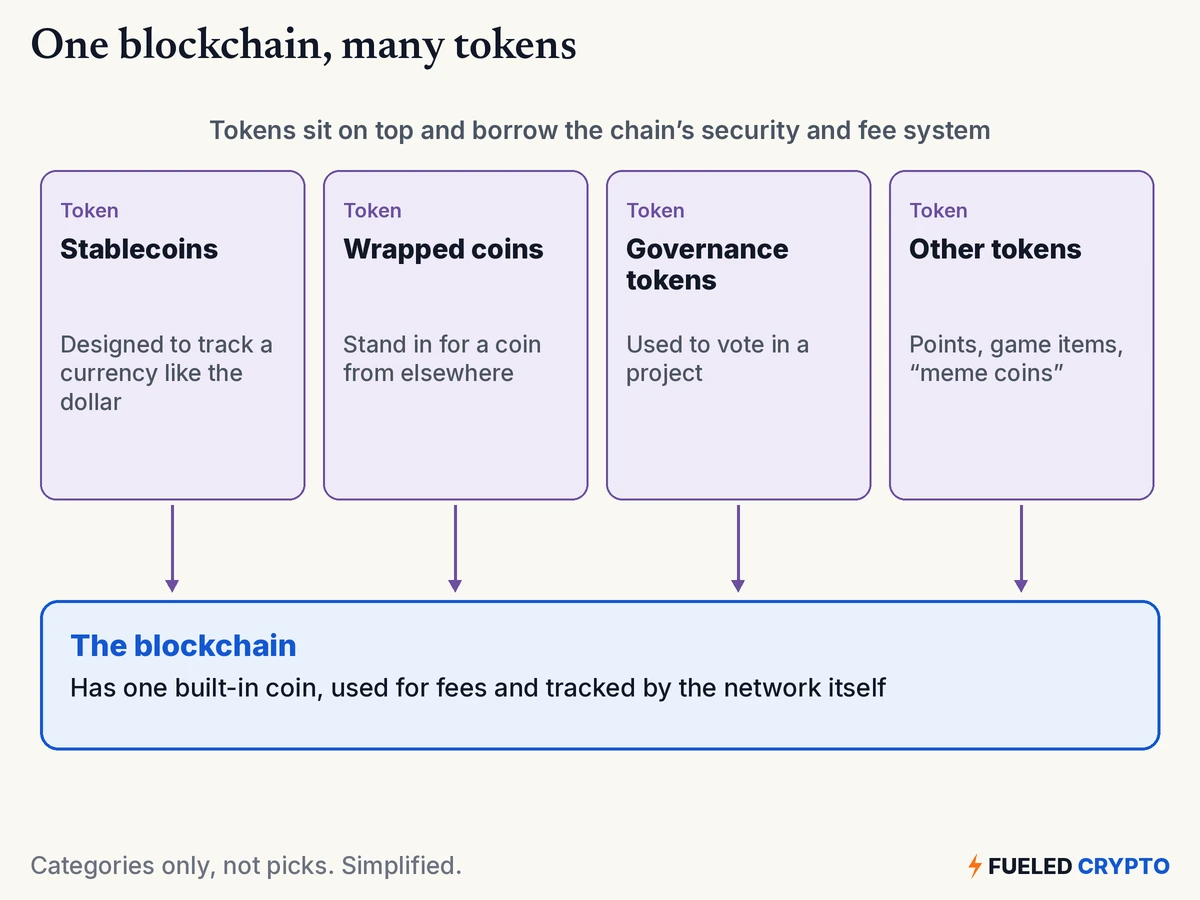
- Stablecoins. Most are tokens issued on one or more blockchains. Our stablecoins guide explains how they're backed.
- Wrapped coins. A token that stands in for another coin. The Fed note points out that ether "is not an ERC-20 token," and ethereum.org explains that because ETH "doesn't conform" to the ERC-20 standard, wrapped ETH was created so apps can treat it like one. Our bridges and wrapped tokens guide covers the risks.
- Governance tokens, used to vote on a project's decisions.
- NFTs, tokens where each one is unique. See What Are NFTs, Actually?
Why the difference matters
1. You need the coin to move the token
The Fed note puts it plainly: to send ERC-20 tokens, "a user must also maintain a balance of ether for paying network transaction fees." ethereum.org gives the same reminder for wrapped ETH: "You will still need native ETH to pay for gas fees." Other blockchains work similarly. Our network fees guide explains fees in more depth.
2. The same token name can live on several networks
Because a token is just a contract or ledger entry, an issuer can create versions on more than one blockchain. Those versions aren't interchangeable, so the network matters when you send. Our before-you-send checklist walks through it.
3. A name and symbol can be copied
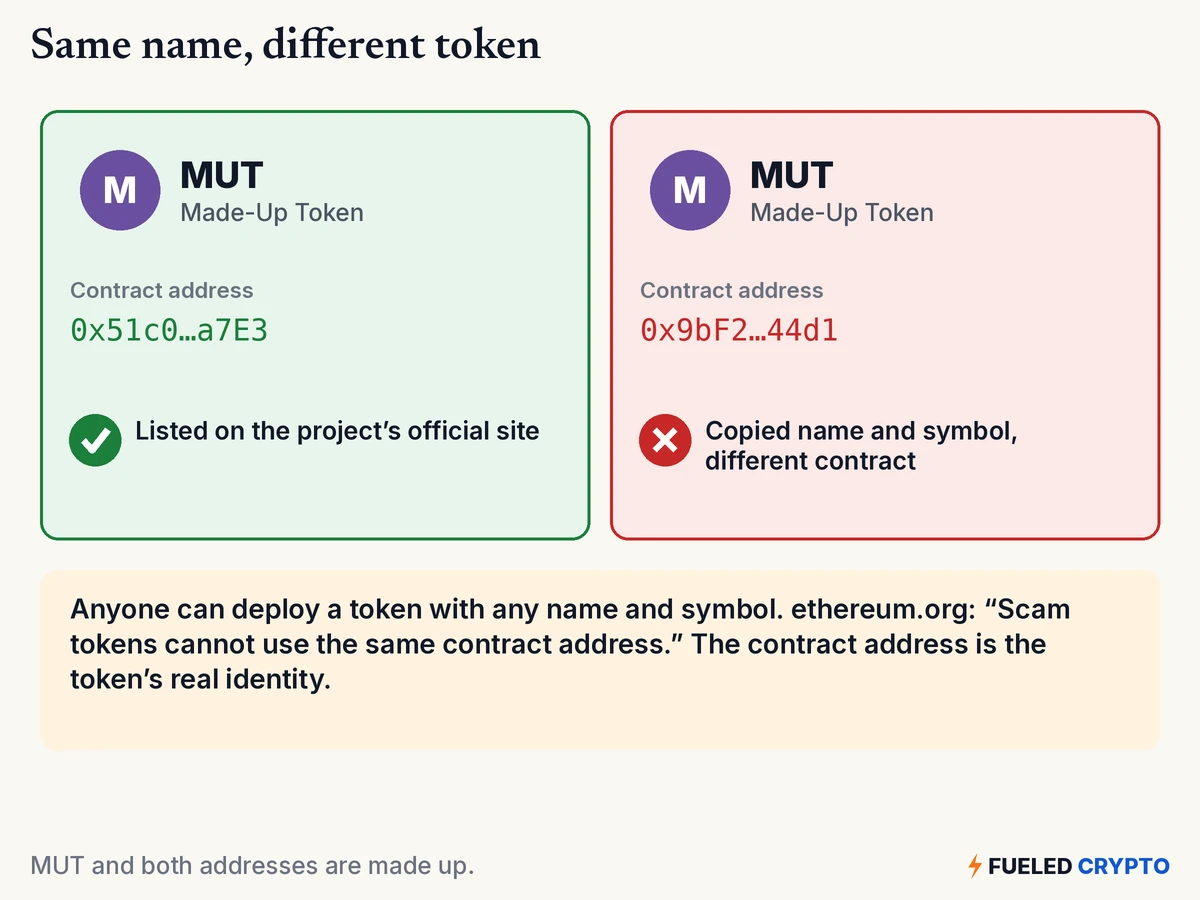
ethereum.org warns that token contracts "can have the same symbol and name as other ERC-20 contracts. You cannot count on those fields for security." What a copycat can't fake is the contract address. ethereum.org adds that "The best source for the address of the legitimate token is the organization whose token it is." A block explorer shows which contract a token in your wallet came from. Our rug pull guide covers other token red flags.
4. Some networks make you opt in to a token
On the XRP Ledger, anyone can receive XRP by default, but tokens can only be received "after you have sent a transaction indicating your willingness to hold them," per xrpl.org. That opt-in is called a trust line. Our payment networks guide covers the XRP Ledger.
Why "coin" is used so loosely
In everyday speech, "coin" often just means "a crypto asset." That's why tokens are often called coins: "stablecoins" are mostly tokens, and xrpl.org notes that people commonly create and trade "meme coins" as tokens on the XRP Ledger. Price sites usually list coins and tokens side by side. Our market cap and supply guide explains those numbers.
So when the difference matters, like paying a fee, picking a network, or checking that a token is real, it helps to ask which blockchain it lives on and whether it's that chain's native coin.
Common mix-ups
- "Coin and token mean the same thing." In casual talk, often yes. Technically, a native coin belongs to its own blockchain and a token is built on one.
- "If I have the token, I can send it." Usually only if you also hold some of the native coin to pay the fee.
- "The name and symbol prove it's the real token." Anyone can copy those. The contract address is what identifies it.
- "A stablecoin is its own blockchain." Most stablecoins are tokens issued on existing blockchains, often on several.
- "Tokens are less real than coins." It's a technical difference, not a judgment. Each token is only as trustworthy as whoever issued it and the contract behind it.
Words you'll keep hearing
- Native coin: the asset built into a blockchain, usually used for its fees.
- Token: an asset created on top of an existing blockchain.
- Smart contract: a program on a blockchain. On Ethereum, each token is one.
- Contract address: the address of a token's smart contract, which is its real identity.
- ERC-20: Ethereum's standard for fungible tokens.
- Fungible: every unit is interchangeable with every other.
- Wrapped token: a token that stands in for a coin from somewhere else.
- Trust line: on the XRP Ledger, an opt-in to hold a particular token.
More terms are in our crypto glossary.
Frequently asked questions
What is the difference between a coin and a token? A native coin is built into its own blockchain and usually pays that network's fees. A token is created on top of an existing blockchain, usually by a smart contract or a built-in ledger feature.
Is ETH a coin or a token? ETH is Ethereum's native coin. A Federal Reserve research note says ether is not an ERC-20 token, and ethereum.org explains that a wrapped version exists for apps built around ERC-20 tokens.
Are stablecoins coins or tokens? Despite the name, most stablecoins are tokens issued on one or more existing blockchains.
Why do I need ETH to send a token? On Ethereum, network fees are paid in ether. A Federal Reserve research note explains that sending ERC-20 tokens requires keeping an ether balance for fees, and other blockchains work in a similar way.
Can anyone create a token? On many blockchains, yes. xrpl.org says "Anyone can issue" tokens on the XRP Ledger, and ethereum.org notes that scammers "can deploy any smart contract they wish."
How can I tell if a token is the real one? Check its contract address, not its name. ethereum.org says to get a legitimate token's address from the organization that issued it, and a block explorer shows which contract a token came from.
Is a token less valuable or less safe than a coin? Being a token is a technical detail, not a measure of value or safety. Each one depends on its issuer, its contract and the blockchain it runs on.
Where to go next
- Bridges and Wrapped Tokens, for tokens that move between chains.
- What Are Stablecoins?, for the most common kind of token.
- Crypto Network Fees, Explained, for why fees use the coin.
- How to Spot a Rug Pull, for token red flags.
- Market Cap, Supply and Tokenomics, for the numbers on a price page.
- Crypto Glossary, for any other term.
Sources
- ethereum.org: What is ether (ETH)? (last updated October 5, 2026).
- ethereum.org: Wrapped ether (WETH).
- ethereum.org: ERC-20 Token Standard.
- ethereum.org: How to identify scam tokens (last updated June 6, 2026).
- Federal Reserve, FEDS Notes: Tokens and accounts in the context of digital currencies (December 23, 2020).
- xrpl.org: Tokens (differences from XRP, trust lines, who can issue).
All diagrams and animations are original Fueled Crypto graphics. Kim, Lee, the MUT token and the addresses are made-up examples.
Fueled Crypto publishes news and education, not investment, tax, or legal advice. Crypto assets are volatile and can lose value. Do your own research and consider a licensed professional before making financial decisions. See our full disclaimer.
Want plain-English crypto news once a week? Subscribe to Fueled Crypto.