Deck: Open any crypto price page and you'll see a wall of numbers: market cap, circulating supply, max supply, FDV. Here's what each one measures, and why a low price per coin doesn't mean what it seems to.
Last reviewed: October 24, 2026
When I first looked at crypto price pages, I sorted coins by one number: price. A coin at a fraction of a cent looked like a bargain next to one at thousands of dollars. It took me a while to see that price per coin, on its own, says very little. You need to know how many coins there are.
This guide walks through the numbers you'll see on most price pages, using made-up tokens so the math is easy to follow. It doesn't say whether any coin is a good or bad buy. That's not what these numbers can tell you.
The short version
- Market cap = price per coin × coins in circulation. It's a multiplication, not a count of money invested.
- Price per coin alone can mislead. A one-cent token can have the same market cap as a $100 token if it has far more coins.
- There are three supply numbers: circulating (out in the market now), total (exists now, including locked coins) and max (the most that can ever exist, if there's a limit).
- Fully diluted value (FDV) applies today's price to a bigger supply number. Sites don't all use the same one.
- Tokenomics is the set of rules and plans for a token's supply: how coins are created, destroyed, shared out and unlocked over time.
- The numbers come from somewhere. Data sites rely partly on what token teams report, and they don't always agree.
What market cap means
Market cap is short for market capitalization. For a company's stock, the SEC's Investor.gov defines it as the share price multiplied by "the number of total outstanding shares." Crypto price sites borrowed the idea. CoinGecko's methodology spells out its version: market cap is the current price multiplied by the circulating supply.
Here's a made-up example:
- Token A costs $100 per coin, and 1 million coins are in circulation. Market cap: $100 × 1 million = $100 million.
- Token B costs $0.01 per coin, and 10 billion coins are in circulation. Market cap: $0.01 × 10 billion = $100 million.
Same market cap, very different prices. Token B isn't "cheaper" in any meaningful way. It just has its value split into far more pieces, a bit like a pizza cut into 10,000 slices instead of 8.
This is where I tripped up early on. A thought like "if this one-cent token reached $1" sounds small. But with 10 billion coins, a $1 price would mean a $10 billion market cap, 100 times bigger than today. The per-coin price hides that math. (That's arithmetic, not a forecast. Nothing here says where any price is going.)
Market cap isn't money that went in
This one surprised me. Market cap takes the most recent price and applies it to every coin in circulation. It doesn't count how much money people actually put in.
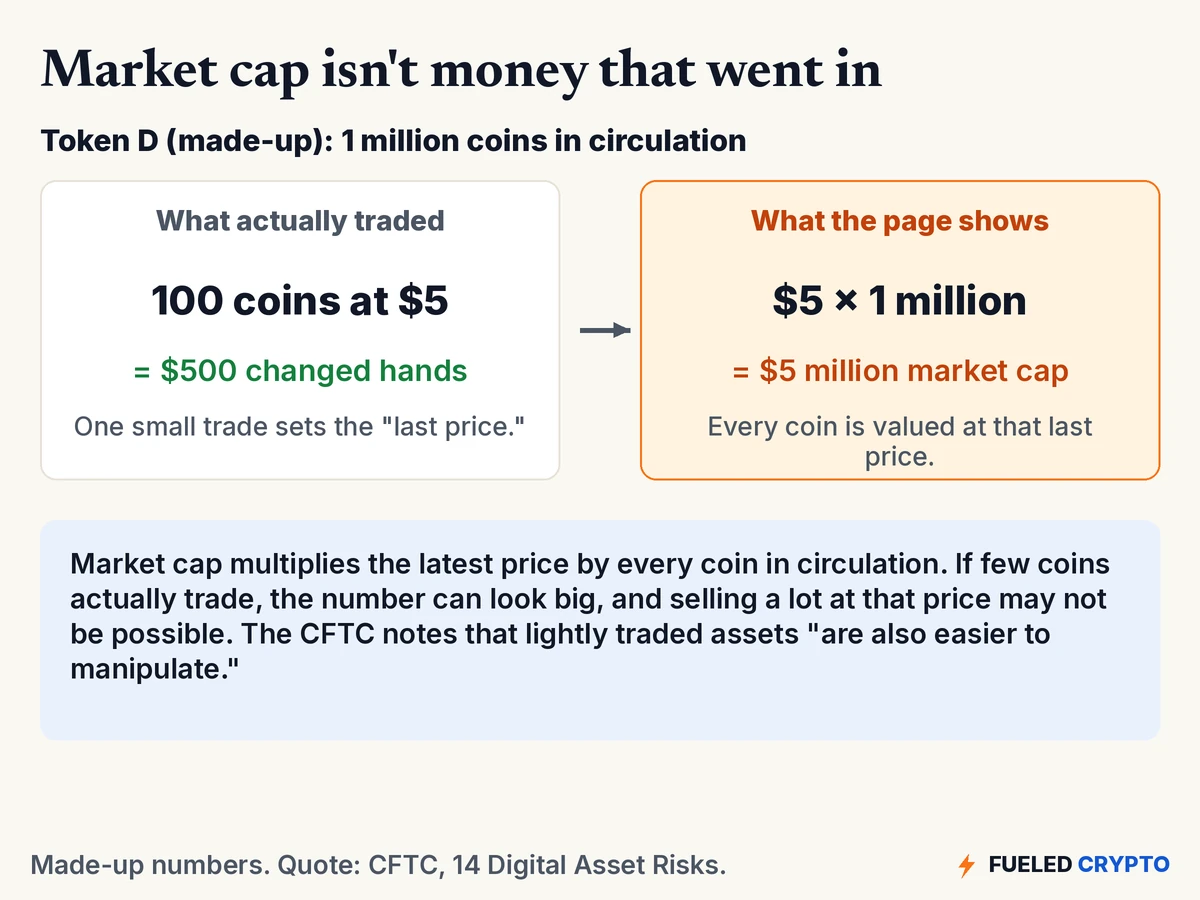
Say made-up Token D has 1 million coins in circulation. Someone buys 100 coins at $5. That one $500 trade sets the latest price, and the page now shows a $5 million market cap. If lots of holders tried to sell at once, they might not find buyers anywhere near $5.
That's why how much a token actually trades matters too. The CFTC's list of digital asset risks says it "may be hard to sell digital assets that aren't commonly traded," and that lightly traded assets "are also easier to manipulate." Market cap on its own can't tell you that.
The three supply numbers
Most price pages show some version of these three. Here they are on a made-up Token C, which has a maximum of 1 billion coins.
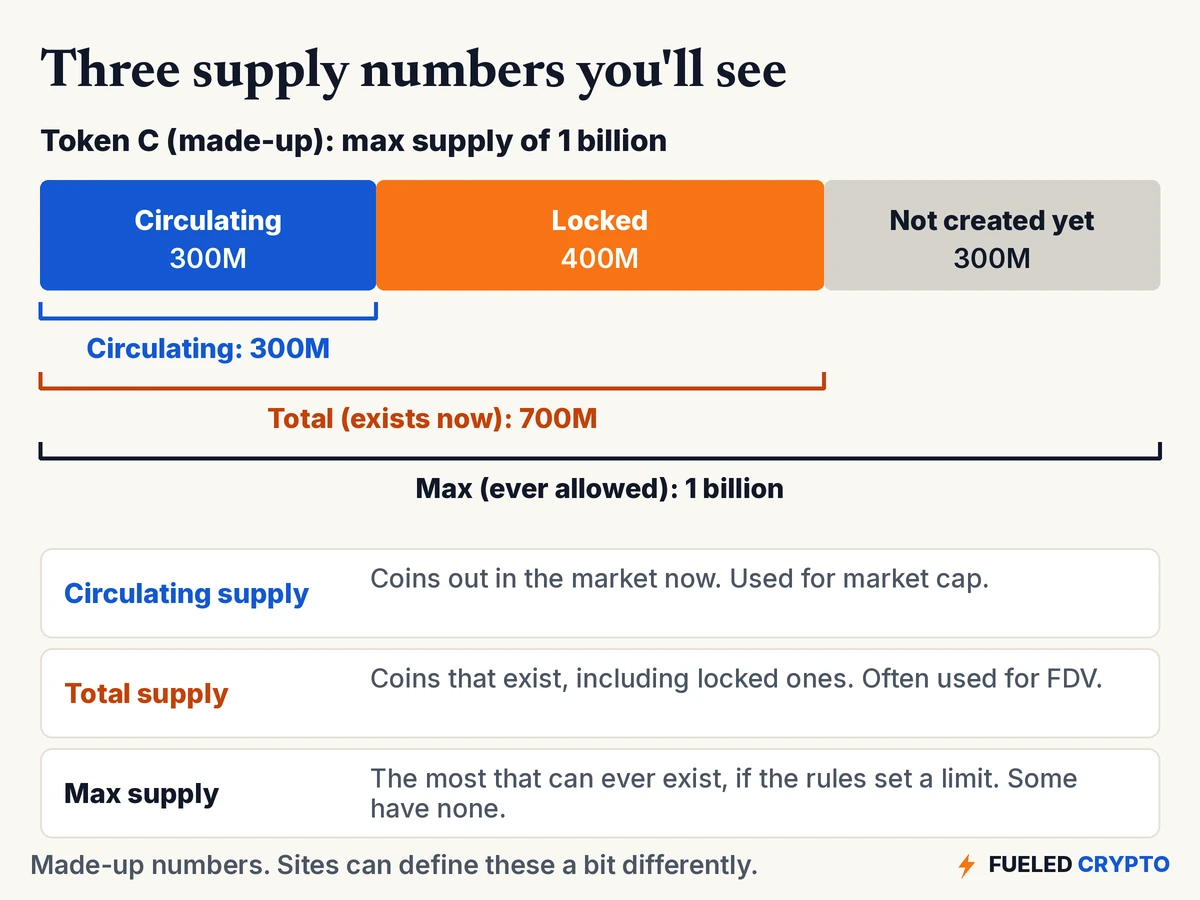
Circulating supply is the number of coins out in the market now. It's the number market cap uses. CoinGecko says that for tokens on smart contract networks, it calculates circulating supply "by deducting locked tokens from Total Supply," and that locked tokens can include a foundation's funds and team or investor tokens that haven't been released.
Total supply is the number of coins that exist right now, including locked ones. CoinMarketCap defines it as "the total amount of coins in existence right now, minus any coins that have been verifiably burned."
Max supply is the most that can ever exist under the token's rules, if there's a limit at all. Some networks set a hard limit. Bitcoin.org's FAQ says "only 21 million bitcoins will ever be created" (our What Is Bitcoin? guide explains how that limit works). Others have no fixed maximum. On Ethereum, ethereum.org describes ETH supply as a balance of two forces, "issuance and burn": new ETH is created as staking rewards, and part of every transaction fee is destroyed. Neither design is good or bad on its own. They're different rules.
Small differences between sites are normal. For example, CoinGecko says it counts pre-mined coins as circulating "as these coins can be sold by whoever that has control of these coins." Another site may draw that line differently.
Fully diluted value (FDV)
FDV asks: what would the total be if more coins were counted at today's price? The catch is that sites don't agree on which supply number to use.
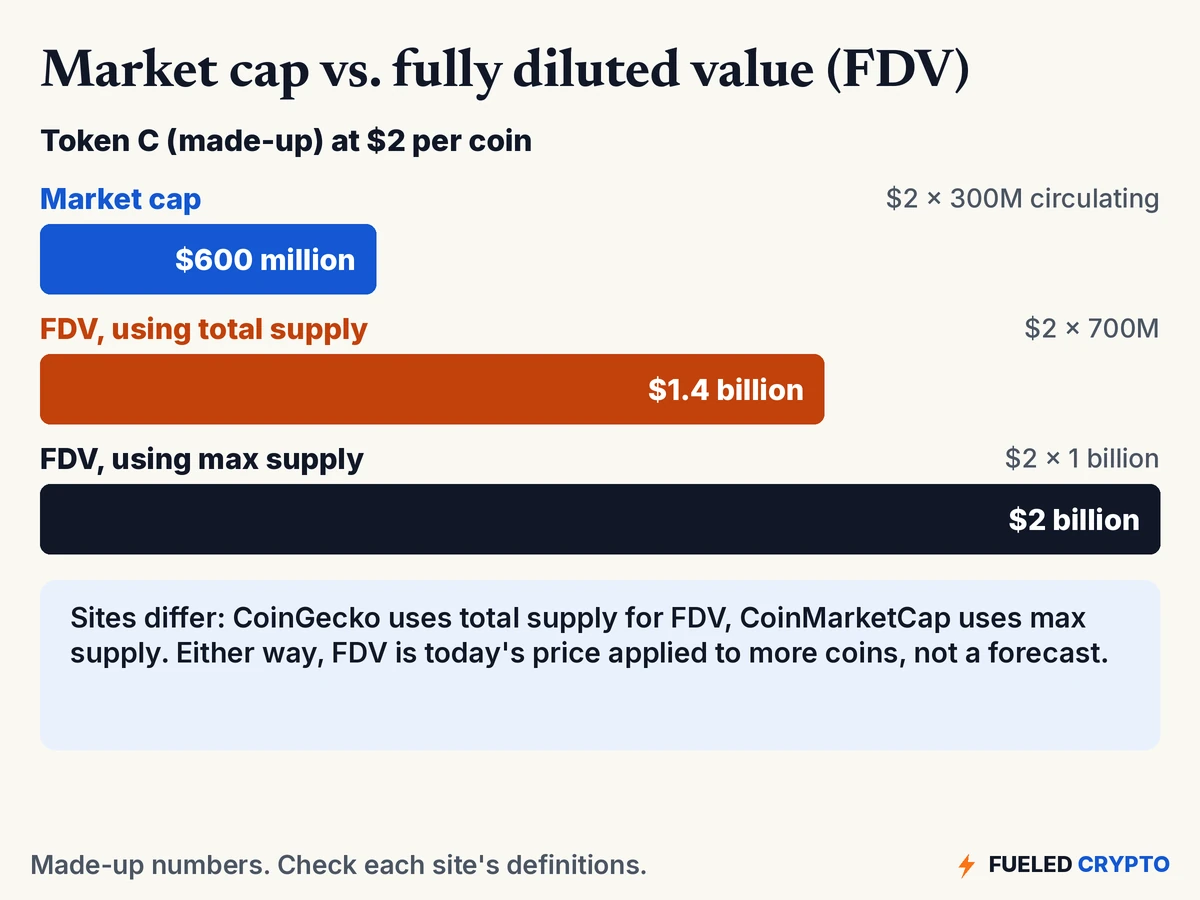
- CoinGecko's guide gives the formula as "Token Price X Total Supply."
- CoinMarketCap's support page gives "Fully Diluted Valuation (FDV) = Max Supply x Price."
With made-up Token C at $2 per coin:
- Market cap: $2 × 300 million circulating = $600 million
- FDV using total supply: $2 × 700 million = $1.4 billion
- FDV using max supply: $2 × 1 billion = $2 billion
So the same token can show different FDVs on different sites, and neither site is wrong. When I compare numbers now, I check which supply each site used.
A big gap between market cap and FDV tells you a lot of coins aren't circulating yet. It doesn't tell you what happens when they arrive. FDV is today's price applied to more coins, not a prediction.
What "tokenomics" means
Tokenomics is a mash-up of "token" and "economics." It covers the rules and plans for a token's supply: how many there are, how new ones get made, whether any get destroyed, who holds them, and when locked ones are released.
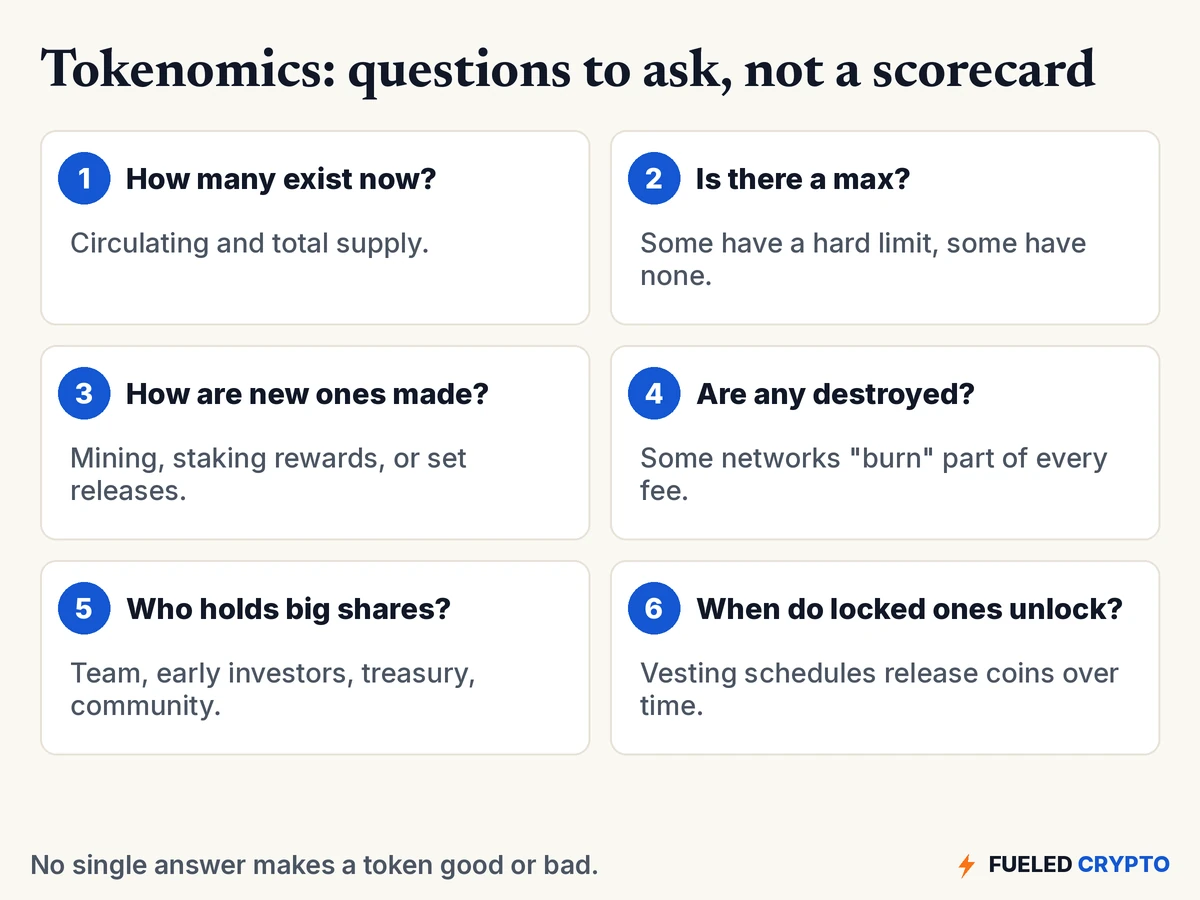
These are the questions I find helpful when I'm trying to understand a token. They're questions, not a scorecard:
- How many exist now? Circulating and total supply.
- Is there a max? Some tokens have a hard limit and some don't.
- How are new ones made? Mining rewards, staking rewards, or a set release schedule are common.
- Are any destroyed? Some networks "burn," meaning permanently remove, part of each fee.
- Who holds big shares? Allocations often include the team, early investors, a treasury, and the community.
- When do locked ones unlock? Many projects release team and investor tokens gradually, under a "vesting" schedule. Each release is often called an "unlock."
Answers usually come from the project's own documents and from data sites. Those can change, and they can be incomplete. CoinGecko says circulating supply information is "obtained from the various token teams" and verified by its own team. If it can't verify the number, the field is marked with a "-". CoinMarketCap's support page puts it bluntly: "many actors in this space have every incentive to inflate" their circulating supply numbers.
Common mix-ups
- "Lower price per coin means more room to grow." Price per coin depends on how many coins exist. Market cap is the more comparable number, and even it isn't a forecast.
- "Market cap is how much money is invested." It's the latest price times the circulating coins. Far less money may have actually gone in.
- "Max supply is the same as circulating supply." Often far from it. Many coins are locked or not created yet.
- "FDV is a price target." It's today's price applied to more coins. Sites calculate it differently.
- "A fixed supply means the price can only go up." Supply is one side. Demand is the other, and it can fall.
- "Burning tokens guarantees a higher price." Burning reduces supply. What happens to price depends on many other things.
Words you'll keep hearing
- Market cap: price per coin × circulating supply.
- Circulating supply: coins out in the market now.
- Total supply: coins that exist now, including locked ones, minus burned coins.
- Max supply: the most that can ever exist, if there's a limit.
- Fully diluted value (FDV): price × total or max supply, depending on the site.
- Tokenomics: a token's supply rules and plans.
- Burn: permanently removing tokens from supply.
- Vesting / unlock: a schedule for releasing locked tokens, and each release along the way.
- Pre-mine: coins created before a network launches publicly, often for the team or early backers.
Frequently asked questions
What is market cap in crypto? It's the current price per coin multiplied by the number of coins in circulation. A token at $2 with 300 million coins circulating has a $600 million market cap.
Is a coin worth less than a penny "cheap"? Not necessarily. Price per coin depends on how many coins exist. A one-cent token with 10 billion coins has the same market cap as a $100 token with 1 million coins.
What's the difference between circulating, total and max supply? Circulating is what's out in the market now. Total is what exists now, including locked coins. Max is the most that can ever exist, if the rules set a limit.
What is fully diluted value (FDV)? It's today's price multiplied by a larger supply number than circulating supply. CoinGecko uses total supply and CoinMarketCap uses max supply, so the same token can show different FDVs.
Does market cap show how much money is invested in a coin? No. It applies the latest price to every coin in circulation. If few coins actually trade, the number can look much bigger than the money that changed hands.
What does tokenomics mean? It's a token's supply rules and plans: how coins are created, whether any are burned, who holds them, and when locked coins are released.
What is a token unlock? It's when coins that were locked, often team or investor tokens on a vesting schedule, are released and can be moved or sold. Unlocks increase circulating supply.
Where to go next
- What Is Cryptocurrency?, for the basics.
- What Is Bitcoin?, for how the 21 million limit and the halving work.
- What Is Ethereum?, for more on ETH, staking and fees.
- How to Read a Crypto Price Chart, for the chart on the same page.
- How to Avoid Crypto Scams, since hyped numbers often show up in scam pitches.
- Crypto Glossary, for any other term.
Sources
- SEC Investor.gov: Market capitalization (stock market definition).
- CoinGecko: Methodology (market cap formula, circulating supply, locked tokens, pre-mine), What Is Fully Diluted Valuation (FDV)? (FDV = price × total supply).
- CoinMarketCap: Supply (Circulating, Total, Max) (total supply definition, FDV = max supply × price, verification).
- Bitcoin.org: FAQ (21 million limit).
- Ethereum.org: How The Merge impacted ETH supply (issuance and burn).
- CFTC: 14 Digital Asset Risks to Remember (liquidity risk, manipulation).
All diagrams and animations are original Fueled Crypto graphics. All tokens in the examples are made up.
Fueled Crypto publishes news and education, not investment, tax, or legal advice. Crypto assets are volatile and can lose value. Do your own research and consider a licensed professional before making financial decisions. See our full disclaimer.
Want plain-English crypto news once a week? Subscribe to Fueled Crypto.