Deck: An NFT is a one-of-a-kind token on a blockchain. That part is simple. What trips people up is everything around it: where the picture is, what rights come with it, and why "royalties" don't always get paid. Here's the plain version.
Last reviewed: October 24, 2026
For a long time I thought buying an NFT meant buying a picture. That's not quite right, and the gap between what people think they're getting and what they actually get is where a lot of confusion (and a fair number of scams) lives.
This guide explains what an NFT is under the hood, using a made-up example so nothing here reads as a pick. It won't tell you whether any NFT is worth buying. It's about understanding what the thing actually is.
The short version
- An NFT is a unique token. It's an entry in a smart contract that says which address holds a specific token ID.
- The image usually isn't on the blockchain. Most NFTs store a link to a file kept somewhere else.
- Owning the token isn't owning the copyright. Any rights you get come from a license, not from the token itself.
- Royalties are a request, not a guarantee. The common royalty standard leaves payment up to the marketplace.
- NFTs are a format, not just art. Tickets, certificates, game items and domain names can be NFTs too.
- NFT scams lean on surprise and urgency. Unexpected NFTs, rushed "mints" and "approve all" requests are classic red flags.
What "non-fungible" means
"Fungible" means interchangeable. Ethereum.org's explainer puts it this way: "You don't care which specific dollar bill" you have, because one is as good as another. Bitcoin and ether work the same way. One unit is like any other.
A non-fungible token is the opposite. Ethereum.org describes NFTs as "tokens that are individually unique." Token #42 in a collection is not the same as token #43, the way seat 12B at a concert isn't the same as seat 40F.
Most NFTs follow a shared template called a token standard. On Ethereum, the main one is ERC-721. It defines how a contract tracks which address holds each token ID and how tokens get transferred. Other blockchains have their own standards for the same idea.
What you actually hold
Here's a made-up example. A small venue creates a collection called "Pine Tickets" (made up). Sam holds token #42.
On the blockchain, that's a short record inside the Pine Tickets smart contract:
- the contract's address,
- the token ID, #42,
- the address that holds it (Sam's), and
- a link called the token URI.
That's about it. "Ownership of an asset is publicly verifiable on Ethereum," as ethereum.org notes, so anyone can look up which address holds #42 on a block explorer. What controls it is Sam's wallet keys. Whoever controls those keys controls the token.
Where the image lives
That token URI is the key to the whole "where's the picture?" question. The ERC-721 standard says the link "may point to a JSON file," a small text file usually called metadata. The metadata holds a name, a description, sometimes traits, and another link to the actual image, video or audio.
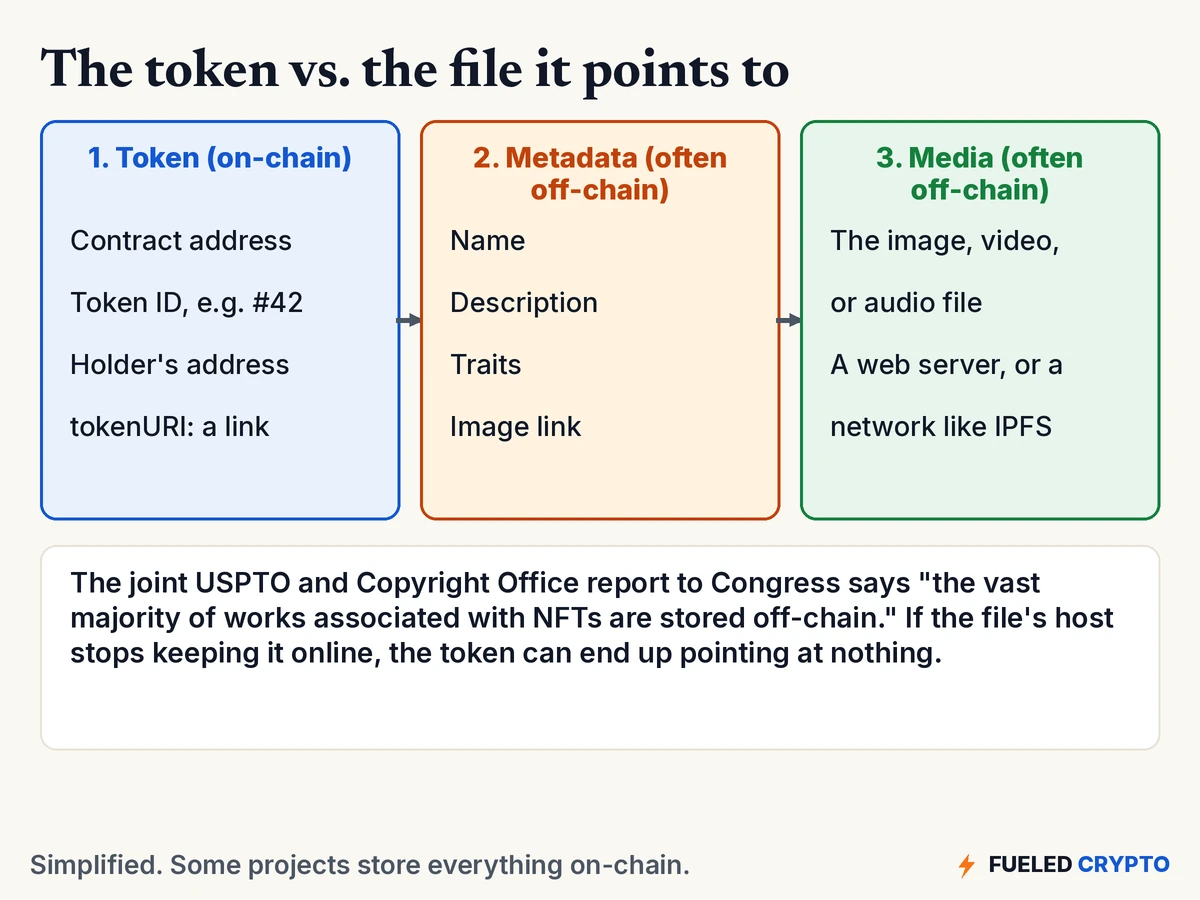
Those files can live in a few places:
- On a regular web server. It works like any website. If the owner stops paying for it or takes it down, the link breaks.
- On a shared storage network such as IPFS. Files are found by their content rather than by one server's address, but someone still has to keep a copy online.
- On the blockchain itself. Some projects store everything on-chain. It costs more, and it's less common.
The U.S. Patent and Trademark Office and U.S. Copyright Office looked at this in a 2024 joint report to Congress. Their finding: "The vast majority of works associated with NFTs are stored off-chain." So if the file's host goes away, the token still exists, but it can end up pointing at nothing.
What you own, and what you don't
This is the part that surprises most people. The same joint report says that "ownership of an NFT and ownership of any copyright interests in the associated work are separate," just as owning a copy of a painting doesn't give you the copyright in it. The report also notes that "there is nothing inherent to a token that would automatically transfer the rights" in the work it's linked to.
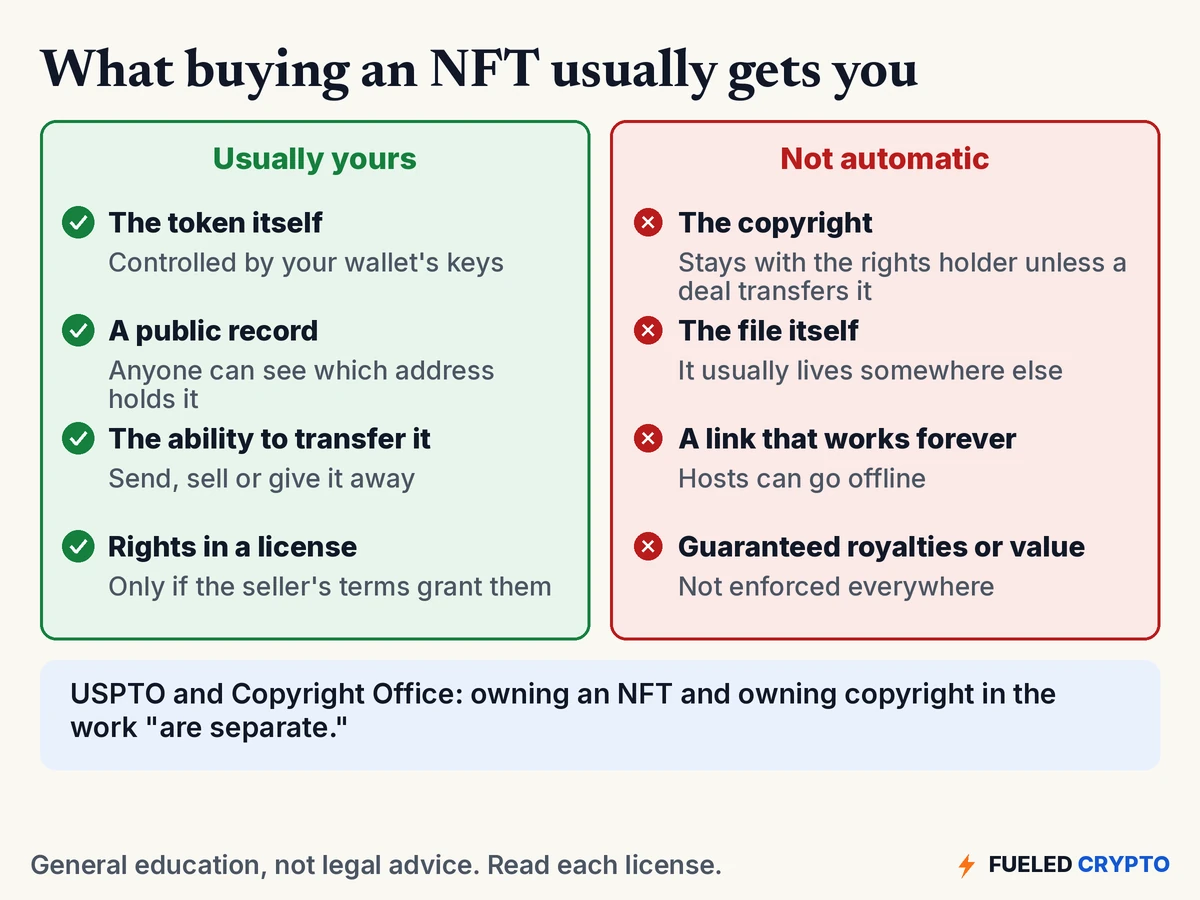
Any rights to use, display or print the work come from the project's written license or terms. Some grant a lot, some grant almost nothing. If those rights matter to you, the license is the thing to read, and for anything important a lawyer is the person to ask. This guide isn't legal advice.
How royalties work (and why they're not guaranteed)
Many creators like NFTs because they can ask for a cut of every resale. Ethereum.org explains that a creator can "program royalties directly into the NFT contract," for example 5% of each sale.
There's a catch. The widely used royalty standard on Ethereum, EIP-2981, lets a contract signal a royalty amount. But the standard itself states that "the royalty payment must be voluntary," partly because a transfer between wallets doesn't always mean a sale happened. Whether a royalty gets paid depends on the marketplace and its rules. The USPTO and Copyright Office made a similar point: these resale payments "depend on the code underlying the NFTs and the rules of the platforms on which they're sold rather than any statutory entitlement."
What NFTs get used for
Art and collectibles are the most familiar use, but the format is broader. Ethereum.org lists examples like event attendance, course certificates, in-game items, tickets and domain names.
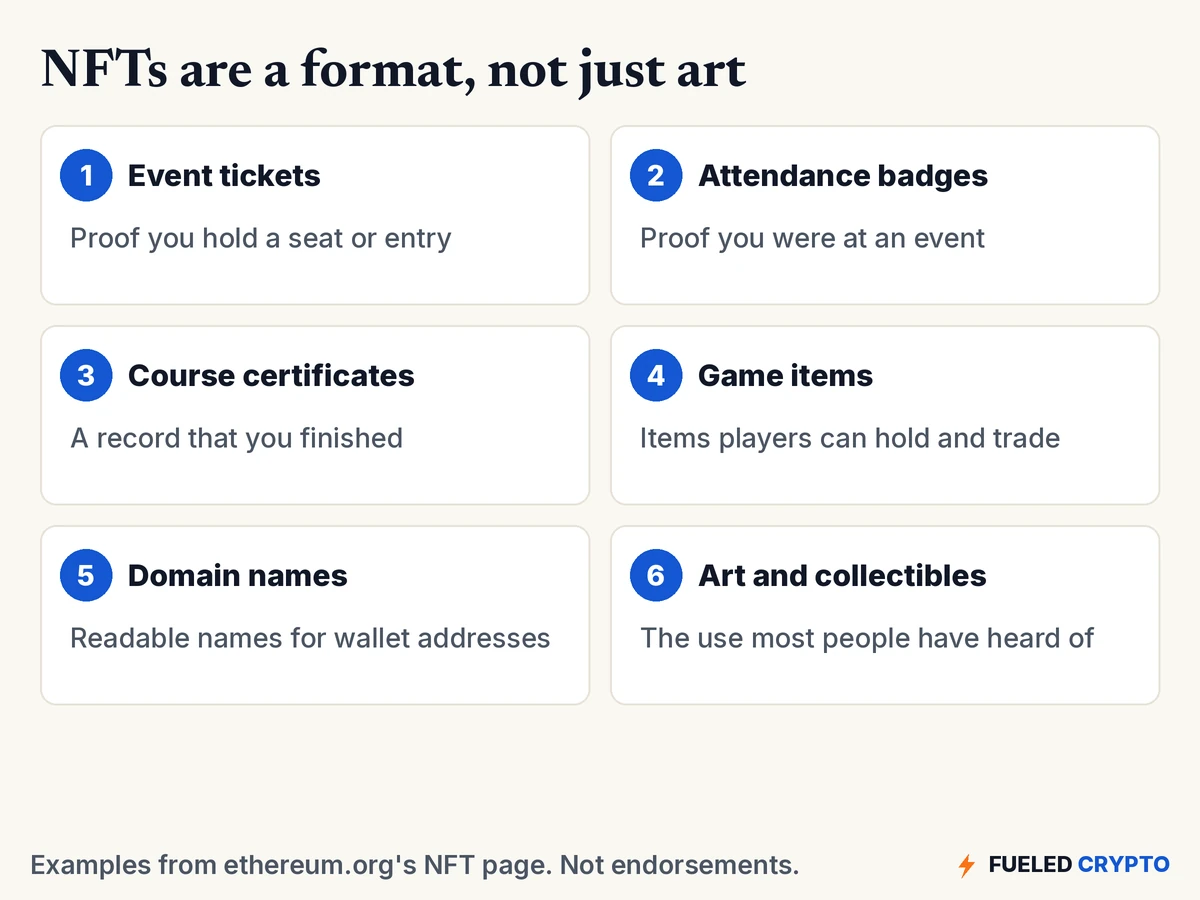
In each case the idea is the same: a public, transferable record that a specific address holds a specific, unique token. Whether that's useful depends on who issued it and what they promise to honor. A ticket NFT only gets you in the door if the venue checks for it.
NFT scams and red flags
Ethereum.org's NFT page notes that security issues "are most often related to phishing scams, smart contract vulnerabilities or user errors." A few patterns come up again and again:
- Surprise NFTs. Ethereum.org describes "airdrop scams," where an NFT or token shows up in your wallet and sends you to a site to "claim" it. The site then asks you to sign or approve something that hands over your assets.
- "Approve all" requests. Some signatures let a contract move every NFT in a collection on your behalf. A scam site can use that to empty a wallet. Our token approvals guide explains how approvals work.
- Rushed mints. Countdown timers, "last spots," and DMs with links to a mint page.
- Fake support. Someone reaches out first to "help." Real support never needs your seed phrase.
- Lookalike collections. Copied art and names under a different contract address.
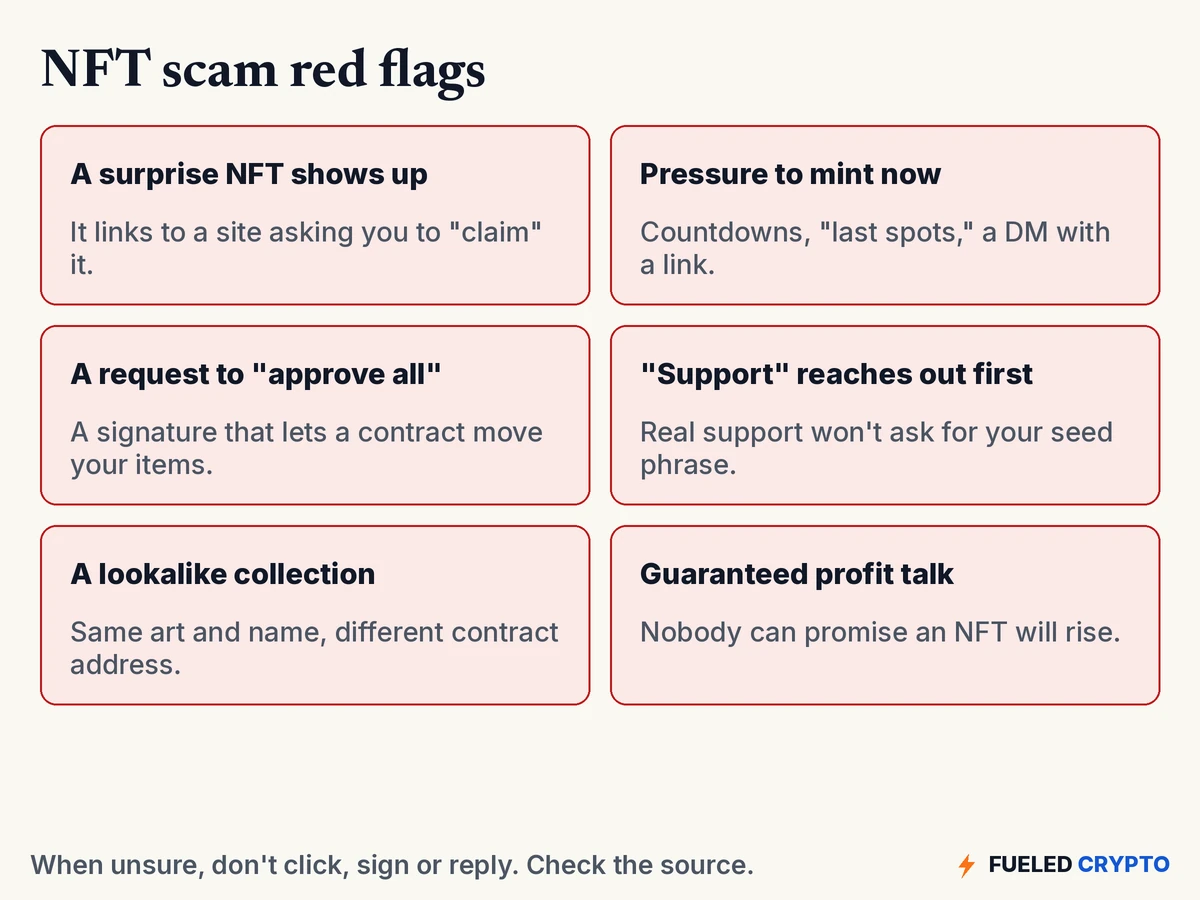
The FTC's advice applies here too: "Never click on a link from an unexpected text, email, or social media message, even if it seems to come from a company you know." And because a blockchain can't tell an owner from a thief, a stolen NFT usually can't be pulled back. The USPTO and Copyright Office report puts it bluntly: "Blockchain technology cannot distinguish between 'ownership' and 'possession.'" Our scam guide covers the wider picture.
A quick note on taxes
The IRS lists NFTs as an example of a digital asset, and "for U.S. tax purposes, digital assets are considered property, not currency." Selling, trading or receiving one can matter at tax time. Our crypto tax guide explains the basics. For your own situation, a tax professional is the right call.
Common mix-ups
- "I bought the picture." You hold a token that usually links to the picture. The file normally lives elsewhere.
- "I own the rights now." Not automatically. Any rights come from the license.
- "The art is safe forever on the blockchain." Only if it's stored on-chain. Off-chain files depend on someone keeping them online.
- "Royalties are built in, so they're always paid." The common standard leaves payment voluntary.
- "NFT means JPEG." The same format is used for tickets, certificates, game items and names.
- "If it's in my wallet, it's safe to interact with." Unexpected NFTs are a common scam opener.
Words you'll keep hearing
- NFT (non-fungible token): a unique token, tracked by token ID inside a smart contract.
- Fungible: interchangeable, like dollars or bitcoin.
- Mint: to create a new NFT on the blockchain.
- Token ID: the number that makes one NFT different from the others in its contract.
- Token URI: the link stored with a token, pointing to its metadata.
- Metadata: the file describing an NFT: name, description, traits and a link to the media.
- IPFS: a shared file storage network that finds files by their content.
- ERC-721: the main NFT standard on Ethereum.
- Royalty: a creator's requested share of resales, which marketplaces may or may not pay.
- Airdrop: tokens or NFTs sent to wallets without being asked for. Sometimes legitimate, often a scam opener.
Frequently asked questions
What is an NFT in simple terms? It's a unique token on a blockchain. A smart contract records which address holds each token ID, and the token usually links to a file such as an image.
When I buy an NFT, do I own the image? You hold the token. The image file usually lives somewhere else, and owning the token doesn't automatically give you the copyright. Any rights come from the project's license.
Where is an NFT's image stored? Usually off-chain, on a web server or a storage network like IPFS. The token stores a link to a metadata file, which links to the image. Some projects store everything on-chain.
Can an NFT's image disappear? It can. If the file is stored off-chain and nobody keeps it online, the link can break. The token still exists, but it may point to nothing.
Are NFT royalties always paid? No. The common Ethereum royalty standard, EIP-2981, says payment "must be voluntary." Whether royalties get paid depends on the marketplace and its rules.
Are NFTs only for art? No. They're also used for event tickets, attendance badges, course certificates, game items and domain names.
What's the most common NFT scam? Phishing in its many forms: surprise NFTs that lead to "claim" sites, fake mint pages, fake support, and requests to approve a contract to move all your NFTs.
Where to go next
- What Is Ethereum?, for the network most NFTs started on.
- How Blockchain Works, for what "on-chain" means.
- Crypto Wallets and Keys, Explained, since your keys control your NFTs.
- What Is a DAO?, for another way tokens get used.
- How to Avoid Crypto Scams, for the wider scam picture.
- Crypto Glossary, for any other term.
Sources
- Ethereum.org: Non-fungible tokens (NFT) (definition, fungibility, public ownership, royalties, uses, security note), Ethereum security and scam prevention (airdrop scams).
- Ethereum Improvement Proposals: ERC-721: Non-Fungible Token Standard (token URI and metadata), ERC-2981: NFT Royalty Standard (royalties are voluntary).
- U.S. Patent and Trademark Office and U.S. Copyright Office: Non-Fungible Tokens and Intellectual Property: A Report to Congress (March 2024; off-chain storage, copyright, resale royalties, ownership vs. possession), study page.
- FTC: What To Know About Cryptocurrency and Scams.
- IRS: Digital assets (NFTs as digital assets; property treatment).
All diagrams and animations are original Fueled Crypto graphics. The "Pine Tickets" collection and everyone in the examples are made up.
Fueled Crypto publishes news and education, not investment, tax, or legal advice. Crypto assets are volatile and can lose value. Do your own research and consider a licensed professional before making financial decisions. See our full disclaimer.
Want plain-English crypto news once a week? Subscribe to Fueled Crypto.