Deck: A DAO is a group that makes decisions by voting and keeps its money in a shared account run by code. Here's how proposals, token votes and treasuries work, and the risks that don't make it into the pitch.
Last reviewed: October 24, 2026
DAO stands for "decentralized autonomous organization," which is a mouthful that didn't help me at all the first time I heard it. Once I saw one decision play out from proposal to payment, it made a lot more sense.
So that's how this guide works: one made-up group, one made-up decision, start to finish. Then the parts that get less attention, like who really holds the votes and what the law says. It doesn't recommend joining or buying into any DAO.
The short version
- A DAO is a group run by votes and code. Ethereum.org calls it "a collectively-owned organization working towards a shared mission."
- Decisions start as proposals. Members vote, and if a proposal passes, the result is carried out.
- The money sits in a shared treasury. It's held by a smart contract or a multi-signature wallet, not one person's account.
- Votes are often weighted by tokens. More tokens usually means more votes, so a few large holders can have a lot of say.
- The risks are real. Code bugs, low turnout, governance attacks and unclear legal status all come up.
- The legal picture is unsettled. A U.S. court has held a DAO liable as a "person," and a few states have DAO laws.
What a DAO is
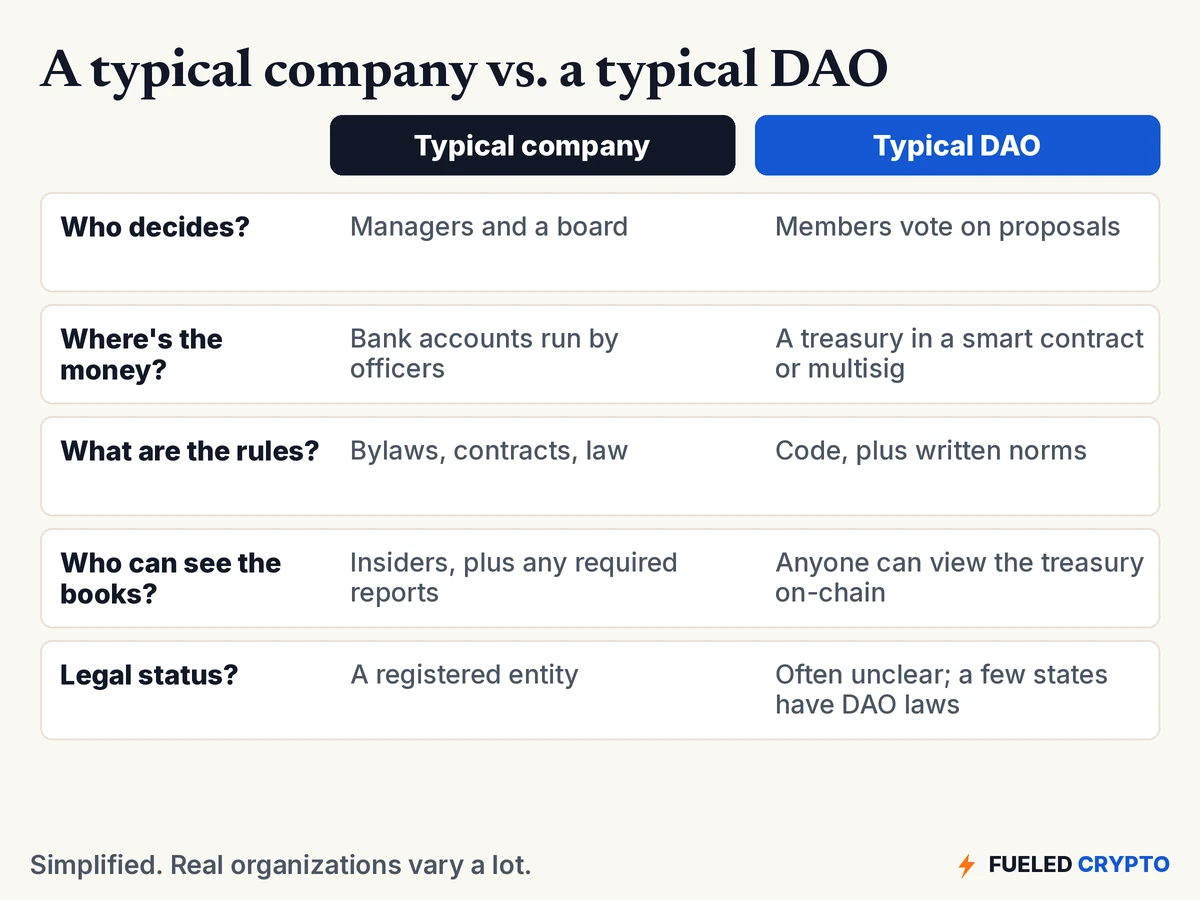
A DAO is an organization whose rules and money are managed, at least partly, on a blockchain. Ethereum.org describes the core idea: "The backbone of a DAO is its smart contract, which defines the rules of the organization and holds the group's treasury." Instead of a manager signing off on spending, "decisions are governed by proposals and voting."
That treasury is the point for many DAOs. Per ethereum.org, they "have built-in treasuries that no one has the authority to access without the approval of the group." Anyone can look up the treasury's balance on a blockchain, the same way they can look up any address.
How a decision works, start to finish
Here's a made-up example. The "Garden Club DAO" (made up) has a $10,000 treasury and 1,000 voting tokens. Ana holds 250, Lee 200, Kim 150 and Sam 400. Its rules say at least 40% of all tokens must vote for a result to count. That minimum is called a quorum.
- Propose. Ana posts a proposal: send $2,000 from the treasury to fix the fence.
- Vote. Ana and Lee vote yes (450 tokens). Kim votes no (150). Sam doesn't vote.
- Result. Turnout is 600 of 1,000 tokens, or 60%, so quorum is met. Yes wins, 450 to 150.
- Execute. The $2,000 is sent and the treasury drops to $8,000.
That last step can happen in different ways. Ethereum.org describes DAOs where "transactions will be automatically executed if a quorum of members votes affirmative," so the code itself sends the money. In others, the treasury sits in a multisig wallet shared by a small group of trusted signers (ethereum.org gives 5 to 20 as a typical range), and they carry out what the vote decided. That second setup relies on people doing what was agreed.
Who gets a vote
Ethereum.org outlines three common membership models:
- Token-based. Holding the DAO's governance token gives you votes. These tokens can often be bought and sold, so voting power can change hands.
- Share-based. People apply to join, usually offering something of value. Shares give voting power, and members can leave with their share of the treasury.
- Reputation-based. Voting power is earned by contributing. It "cannot be bought, transferred or delegated."
Many DAOs also allow delegation, which ethereum.org calls "the DAO version of representative democracy." You keep your tokens but hand your voting power to someone who follows the proposals more closely.
Why token weight matters
In a token-based DAO, one token usually means one vote. That's simple, but it means the people with the most tokens have the most say.
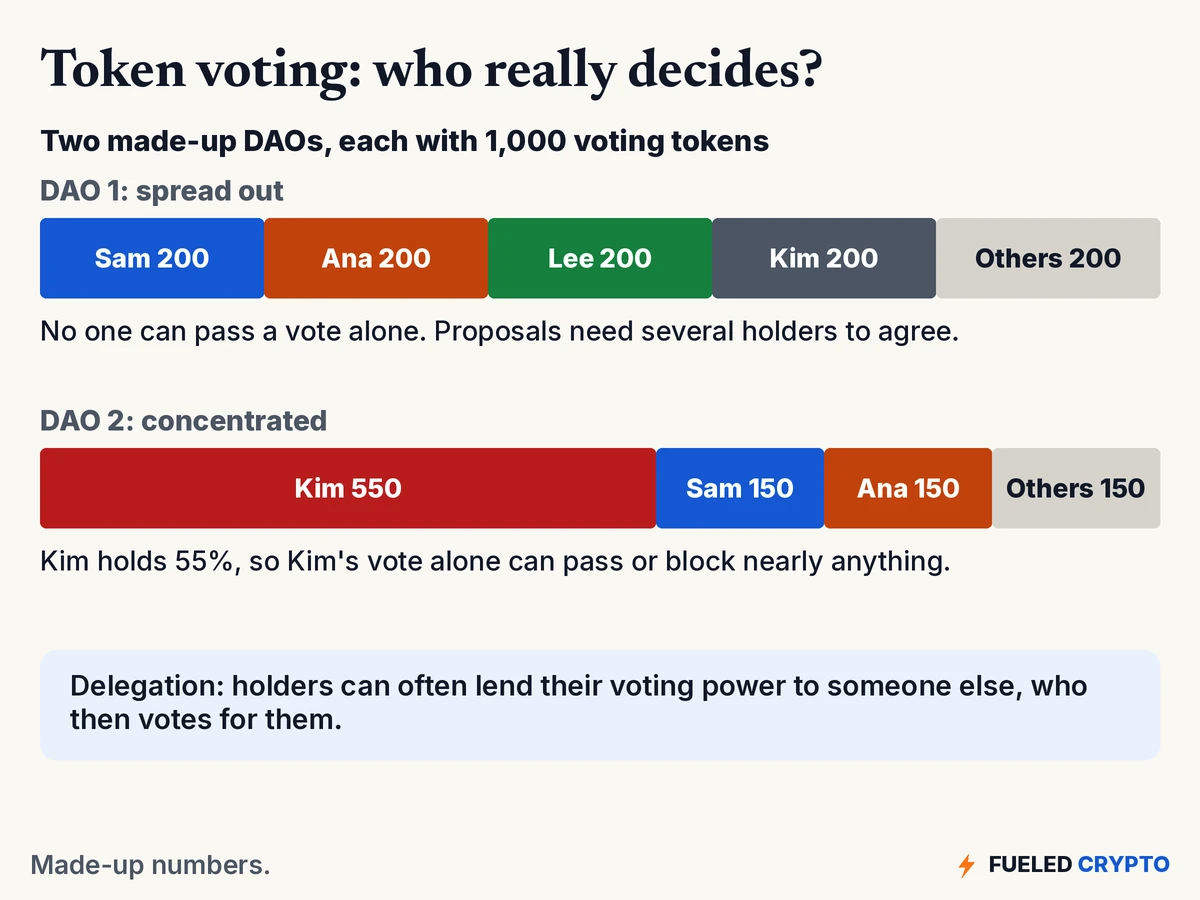
Turnout matters too. In our made-up example, 600 tokens decided for all 1,000. If turnout is low, a small group can decide for everyone, as long as the quorum is met.
The risks worth understanding
DAO pitches tend to focus on openness and fairness. Here's the side that gets less airtime.
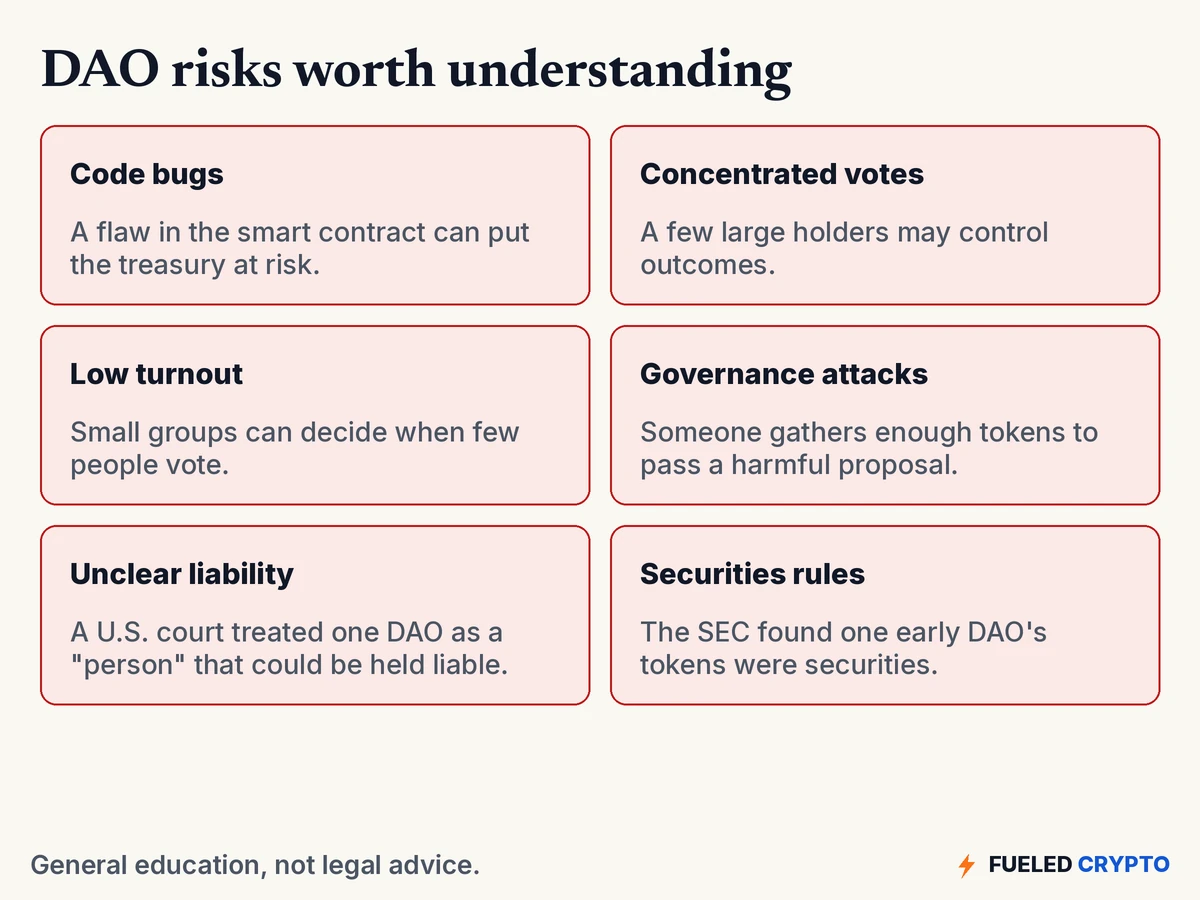
- Code bugs. If the smart contract that holds the treasury has a flaw, the money can be at risk. Code doesn't have an undo button.
- Governance attacks. Ethereum.org's developer docs warn that "smart contract governance mechanisms may introduce new risks if implemented incorrectly," and describe an attacker borrowing a huge number of tokens for a moment (a "flash loan") to push through a harmful proposal.
- Concentrated votes and low turnout. As above, a few holders, or a few voters, can steer the outcome.
- Trust in signers. Where a multisig carries out decisions, members rely on those signers to act as voted.
- Look-alike scams. Fake proposal pages and "claim your governance tokens" links work just like other crypto phishing. Our scam guide covers the patterns.
The legal gray area
This is where it gets genuinely unsettled, and nothing here is legal advice.
- A DAO can be held liable. In a 2023 case brought by the CFTC, a federal court held that the DAO involved "is a 'person' under the Commodity Exchange Act and thus can be held liable for violations of the law," according to the agency. In an earlier related order, the CFTC also found some founders liable "as members" of that DAO.
- DAO tokens can be securities. In 2017 the SEC concluded in an investigative report that one early DAO's tokens "were securities." It said federal securities laws apply "regardless whether the issuing entity is a traditional company or a decentralized autonomous organization."
- Some states have DAO laws. Ethereum.org notes that "Wyoming, Vermont, and the Virgin Islands have DAO laws in some form," which can give a DAO a recognized legal form.
The practical takeaway is that members of a DAO without a legal wrapper may face legal questions an ordinary investor in a company wouldn't. If you're thinking about joining or starting one, that's a conversation for a lawyer.
Common mix-ups
- "DAO means no one's in charge." Large token holders, delegates or multisig signers can hold a lot of power.
- "The code runs everything automatically." Some DAOs execute votes in code. Others rely on human signers.
- "Voting is one person, one vote." In token-based DAOs it's usually one token, one vote.
- "It's on a blockchain, so it's safe." Smart contracts can have bugs, and governance can be gamed.
- "A DAO isn't a legal entity, so members aren't responsible." U.S. regulators and courts have taken a different view.
- "Holding a governance token is like owning a share." Rights vary a lot from one DAO to the next.
Words you'll keep hearing
- DAO: decentralized autonomous organization. A group that decides by voting and keeps funds in a shared on-chain treasury.
- Proposal: a suggested decision put up for a vote.
- Governance token: a token that gives voting power in a DAO.
- Quorum: the minimum share of votes needed for a result to count.
- Delegation: handing your voting power to someone else while keeping your tokens.
- Treasury: the DAO's shared funds.
- Multisig: a wallet that needs several people's approval to move funds.
- Smart contract: code on a blockchain that runs the rules it's given.
- Flash loan: a loan taken and repaid in a single transaction. It can be misused to borrow voting power for a moment.
Frequently asked questions
What does DAO stand for? Decentralized autonomous organization. It's a group that makes decisions by voting and keeps its money in a shared treasury on a blockchain.
How does a DAO make decisions? Someone posts a proposal, members vote, and if it passes (and enough votes were cast to meet the quorum), the result is carried out, either automatically by code or by a group of multisig signers.
What is a governance token? A token that gives you votes in a DAO. In most token-based DAOs, one token equals one vote, so bigger holders have more say.
Who controls a DAO's money? The treasury is held by a smart contract or a multisig wallet. Spending normally needs an approved proposal, and anyone can see the balance on the blockchain.
Are DAOs legal? DAOs exist and operate, but their legal status is unsettled. A U.S. court has held one DAO liable as a "person," the SEC has found one DAO's tokens were securities, and a few states have DAO laws. This isn't legal advice.
Can a DAO be hacked or taken over? It can. A bug in its smart contract can put funds at risk, and someone who gathers enough voting power, even briefly, may push through a harmful proposal.
What's the difference between a DAO and a company? A typical company is run by managers and a board, with money in bank accounts. A typical DAO is run by member votes, with money in an on-chain treasury. Many DAOs lack a clear legal form.
Where to go next
- What Is Ethereum?, for the network many DAOs run on.
- How Blockchain Works, for the basics behind on-chain records.
- Multisig Wallets, Explained, for how shared wallets work.
- What Are NFTs, Actually?, for another way tokens get used.
- Crypto Wallets and Keys, Explained, since your keys control your votes.
- Crypto Glossary, for any other term.
Sources
- Ethereum.org: Decentralized autonomous organizations (DAOs) (definition, treasury, proposals and voting, delegation, automatic execution, multisig governance, membership models, state DAO laws), Smart contract security (governance risks, flash loan scenario).
- CFTC: Statement on the Ooki DAO litigation (June 2023; DAO held to be a "person" that can be held liable).
- SEC: SEC Issues Investigative Report Concluding DAO Tokens, a Digital Asset, Were Securities (July 2017).
All diagrams and animations are original Fueled Crypto graphics. The Garden Club DAO and everyone in the examples are made up.
Fueled Crypto publishes news and education, not investment, tax, or legal advice. Crypto assets are volatile and can lose value. Do your own research and consider a licensed professional before making financial decisions. See our full disclaimer.
Want plain-English crypto news once a week? Subscribe to Fueled Crypto.