Deck: You hit send, and either the fee was way bigger than you expected or the transaction has said "pending" for hours. Here's what's usually going on, and the common ways people deal with it.
Last reviewed: October 24, 2026
The first time I paid a network fee bigger than the amount I was moving, I assumed I'd done something wrong. The first time a transaction sat on "pending" all afternoon, I assumed my money was gone. Neither was true. Both had ordinary explanations.
Our guide What Happens When You Send Crypto covers the basics: blocks have limited room, and the fee is what you offer to get into one. This guide picks up from there, with the two questions people ask most often.
The short version
- Fees are about space and work, not the amount you send. Moving $10 or $10,000 can cost the same network fee.
- Fees jump when the network is busy. More people want into each block, so they offer more.
- On Ethereum, complex actions cost more. A swap or token mint uses more "gas" than a plain transfer.
- A failed Ethereum transaction still costs a fee. The network did the work, even though nothing happened.
- "Stuck" usually means the fee was too low for how busy the network was. It's waiting, not lost.
- Many wallets can "speed up" or "cancel" a pending transaction by sending a replacement with a higher fee. It only works before the original confirms.
- On Ethereum, one stuck transaction can hold up the ones after it from the same account.
Why did it cost so much?
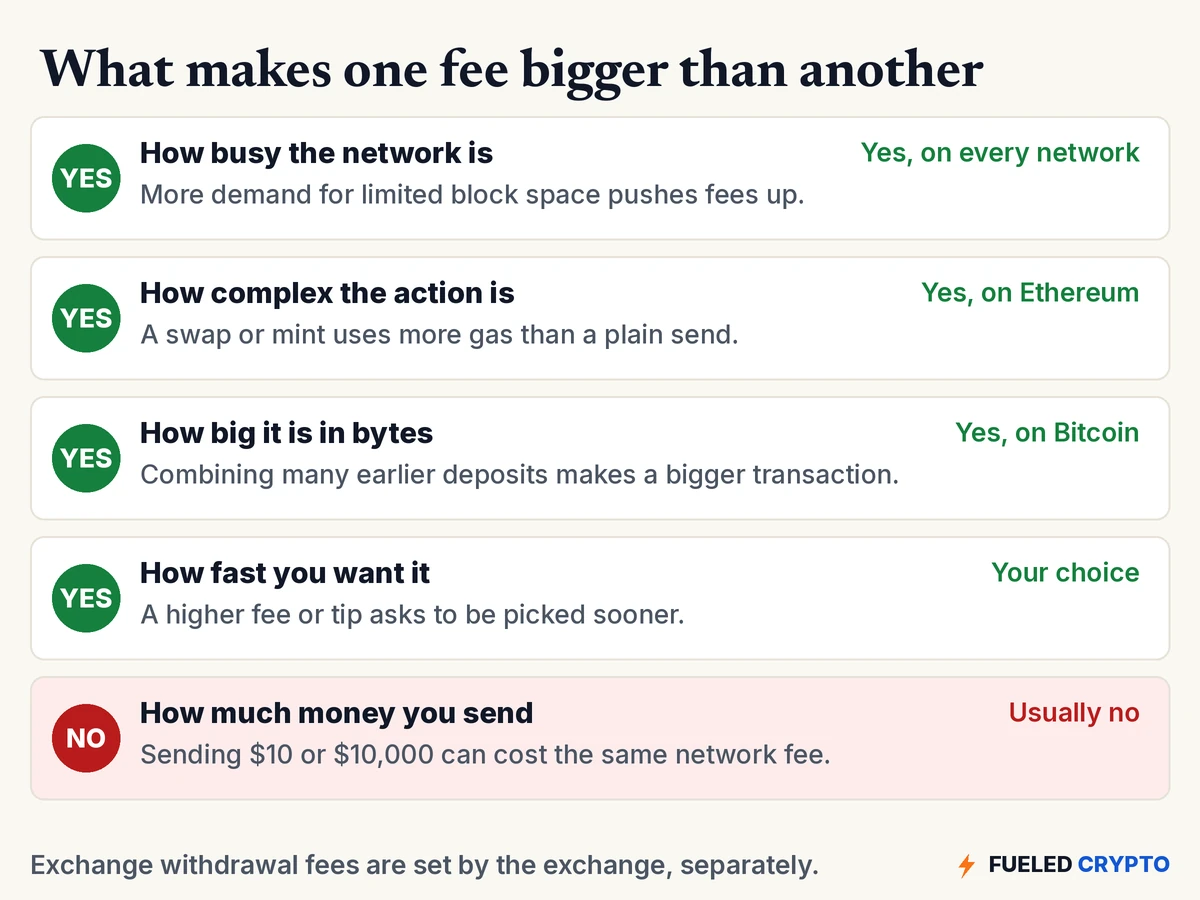
When a fee surprises you, it's usually one of these:
1. The network was busy. Bitcoin's developer guide explains that fees per byte rise "as demand increases." Ethereum.org says the same about gas: when "there's too much demand, users must offer higher tip amounts to try and outbid other users' transactions." A busy hour can cost many times more than a quiet one.
2. The action was complex (Ethereum and similar networks). Gas measures "the amount of computational effort required." A plain ETH transfer uses 21,000 gas. Swapping tokens, minting an NFT or using a DeFi app runs more code, so it uses more gas. Ethereum.org notes that "more complex smart contract apps might be doing lots of operations... making them consume a lot of gas."
3. The transaction was big in bytes (Bitcoin). Bitcoin fees are "based on the total byte size of the signed transaction." If your wallet has to gather coins from many small earlier deposits to make one payment, the transaction has more parts and takes more space.
4. You picked "fast." Most wallets suggest a fee, and many offer slower-and-cheaper or faster-and-pricier choices. On Ethereum, the faster option mostly means a bigger tip.
5. It wasn't the network fee at all. If you withdrew from an exchange, the exchange may charge its own withdrawal fee, which can be higher or lower than the actual network fee. Check its fee page.
What's inside an Ethereum fee
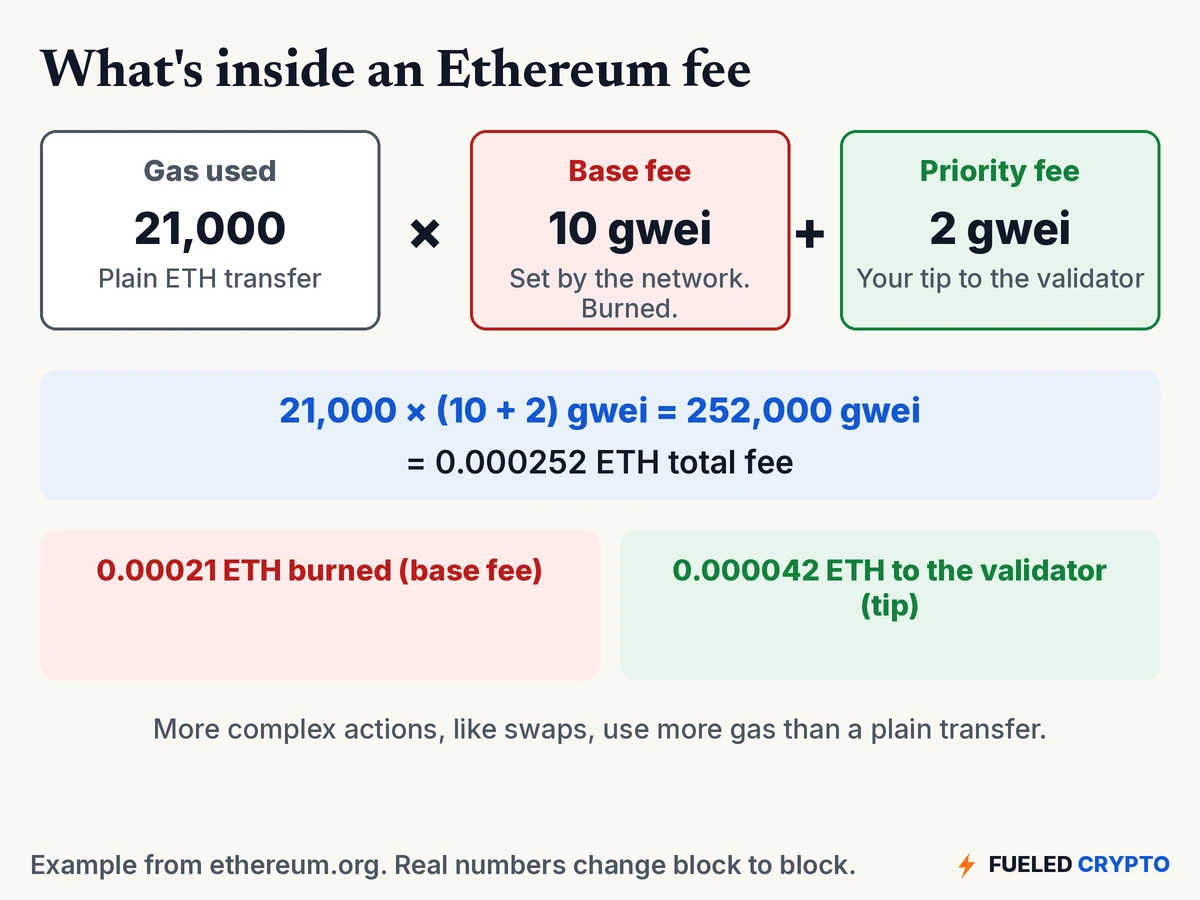
Ethereum splits the fee into two parts:
- Base fee: set by the network for each block, based on demand. You must pay at least this much. It's burned (destroyed), not paid to anyone.
- Priority fee (tip): extra you add "to make your transaction attractive to validators."
Ethereum.org's example: Jordan sends 1 ETH. That uses 21,000 gas, the base fee is 10 gwei and Jordan tips 2 gwei. The fee is 21,000 × (10 + 2) = 252,000 gwei, or 0.000252 ETH. A gwei is a billionth of an ETH.
Why the dollar amount can feel random: the fee is set in ETH, and its dollar value moves with ETH's price, too.
Why a failed transaction still costs a fee
This one stings. You try a swap, it fails, and you still paid. Ethereum.org explains that the gas fee "is paid regardless of whether a transaction succeeds or fails." If a transaction runs out of gas, the network will "revert any changes, but all the gas provided will still be consumed for the work performed." The validators did the work of trying, so they're still paid for it.
One common cause is a gas limit set too low for the work involved. Another is conditions changing between the moment you sign and the moment the transaction runs, such as prices moving during a swap.
Why is it stuck?
A "pending" transaction has been sent to the network but isn't in a block yet. It's sitting in the waiting room (often called the mempool). Usually it's there because its fee was low compared with everyone else's at that moment. As things calm down, it often goes through on its own.
On Ethereum there's an extra wrinkle: the queue. Every transaction from an account gets a number, called a nonce, that counts up: 5, 6, 7. Ethereum.org describes it as "a sequentially incrementing counter which indicates the transaction number from the account." Transactions have to go in order. Etherscan's help center puts it plainly: if an earlier one has a problem, "the ensuing transaction will not be included in the blockchain until the one with the lower nonce is successfully included."
That's what happens to Lee in the animation. His number 5 offered too little on a busy day. Numbers 6 and 7 offered normal fees but still can't go, because 5 hasn't gone yet.
On Bitcoin, there's no account queue, but a low-fee payment can still wait a long time. Bitcoin's developer guide notes that never-confirmed transactions "tend to slowly disappear from the network" as computers restart or clear space. If that happens, the coins never moved, and your wallet will show them as spendable again.
Common ways people unstick a transaction
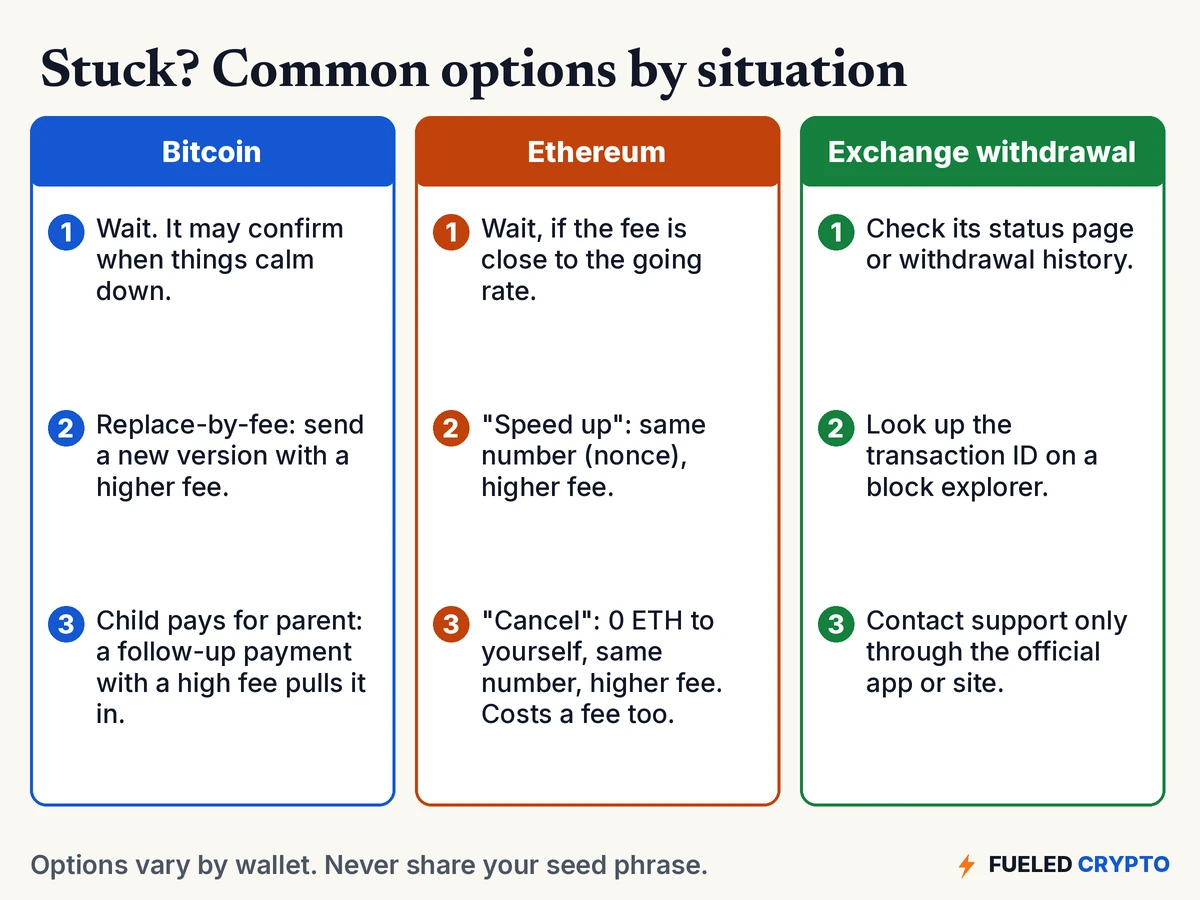
These are the common approaches. Which ones you can use depends on your wallet, so check its help pages first.
On Bitcoin:
- Wait. Many low-fee transactions go through once things quiet down.
- Replace-by-fee (RBF). Many wallets have a "bump fee" or "speed up" button. It sends a new version of the payment that pays a higher fee. Bitcoin Optech describes RBF as replacing an unconfirmed transaction with one "which pays a higher fee."
- Child pays for parent (CPFP). You (or the person you paid) spend the incoming coins in a new transaction with a high fee. Miners want that fee, and they can only collect it by including both, so the original gets pulled in too.
On Ethereum:
- Wait, if your fee is close to what the network is currently charging.
- Speed up. Your wallet sends the same transaction again with the same nonce and a higher fee. Only one transaction per nonce can ever confirm, so the higher-paying one usually wins.
- Cancel. Your wallet sends 0 ETH to yourself with the same nonce and a higher fee. If that confirms first, the original never happens. You still pay the fee for the replacement.
- Fix the oldest one first. If several are pending, the lowest nonce has to clear before the others can.
Speeding up or canceling only works while the original is still pending. If the original confirms first, there's nothing left to replace.
From an exchange: a withdrawal that hasn't reached the blockchain yet is in the exchange's hands. Check its withdrawal history or status page, look the transaction ID up on a block explorer once you have one, and contact support only through the exchange's official app or website.
Watch out for "unstuck" scams
A stuck transaction is a favorite opening for scammers. Someone in a comment thread or direct message offers to "sync your wallet" or "fix the pending transaction," then asks for your recovery phrase. Ethereum.org's security page says "No legitimate service, support agent, or website will ever ask you for these." Our scam guide and seed phrase vs. password guide explain why.
Ways people keep fees down
These are common habits, not rules:
- Check the fee before you confirm, and compare it with the amount you're sending.
- If it isn't urgent, choose the slower option or wait for a quieter time.
- On Ethereum, some people use layer 2 networks, which, as ethereum.org puts it, "bundle (or 'roll up') hundreds of transactions into a single transaction" on Ethereum, spreading the cost. Our layer 1 vs. layer 2 guide explains the trade-offs, including that you need to be on the right network when sending and receiving.
- For exchange withdrawals, read the fee page. Some exchanges charge different amounts on different networks.
Common mix-ups
- "Bigger amount, bigger fee." Usually not. Network fees depend on space and work, not value.
- "Pending means my money is lost." Usually it's just waiting. A block explorer will show where it stands.
- "A failed transaction is free." On Ethereum, you still pay for the work done.
- "I can cancel a confirmed transaction." No. Once confirmed, it can't be reversed.
- "Canceling is free." A cancel is its own transaction, and it costs a fee.
- "The fee goes to the person I'm paying." It doesn't. The recipient gets the amount you sent.
Words you'll keep hearing
- Mempool: the waiting room for transactions that haven't made it into a block yet.
- Gas: Ethereum's unit for measuring computational work.
- Gwei: a billionth of an ETH, used to quote gas prices.
- Base fee / priority fee (tip): Ethereum's two fee parts. The base fee is burned; the tip goes to the validator.
- Nonce: on Ethereum, the order number of each transaction from an account.
- Replace-by-fee (RBF): replacing an unconfirmed Bitcoin transaction with one that pays more.
- Child pays for parent (CPFP): a follow-up transaction with a high fee that pulls an earlier low-fee one into a block.
Frequently asked questions
Why are crypto network fees so high sometimes? Blocks have limited room. When many people want in at once, they offer higher fees to be picked first. On Ethereum, complex actions like swaps also use more gas than a plain transfer.
Does sending more crypto cost a bigger fee? Usually not. Bitcoin fees depend on the transaction's size in bytes, and Ethereum fees depend on the computational work. Sending a small or large amount can cost the same network fee. Exchange withdrawal fees are set separately by each exchange.
Why did I pay gas for a failed transaction? On Ethereum, the fee pays for the work the network did trying to run your transaction. Ethereum.org says the fee "is paid regardless of whether a transaction succeeds or fails."
Why is my crypto transaction stuck on pending? Usually because the fee was low compared with others at that time, so it's still waiting to be included in a block. On Ethereum, it can also be waiting behind an earlier pending transaction from the same account.
Can I cancel a pending crypto transaction? Sometimes, while it's still pending. On Ethereum, many wallets send a replacement with the same nonce and a higher fee. On Bitcoin, replace-by-fee works in a similar way. A confirmed transaction can't be canceled.
What is a nonce on Ethereum? It's the order number of a transaction from your account: 0 for the first, then 1, 2 and so on. Transactions must confirm in order, so a stuck one can hold up later ones.
Will a stuck Bitcoin transaction eventually go through? Often, once the network quiets down. If it never confirms, it can eventually drop out of the network, and the coins show as spendable in your wallet again. Fee bumping is another option, if your wallet supports it.
Where to go next
- What Happens When You Send Crypto, for the basics of blocks, fees and confirmations.
- How to Read a Blockchain Explorer, to check where a transaction stands.
- What Is Ethereum?, for more on gas and smart contracts.
- Crypto Glossary, for any other term.
Sources
- Bitcoin developer documentation: Transactions (fees based on byte size, rising with demand), P2P network (unconfirmed transactions "slowly disappear from the network").
- Bitcoin Optech: Replace-by-fee, Child pays for parent.
- Ethereum.org: Gas and fees (base fee, priority fee, worked example, failed transactions), Transactions (nonce), Layer 2: how it works, Security.
- Etherscan Information Center: How to "cancel" Ethereum pending transactions (nonce order, same-nonce replacement).
All diagrams and animations are original Fueled Crypto graphics. Names in the animation are made up.
Fueled Crypto publishes news and education, not investment, tax, or legal advice. Crypto assets are volatile and can lose value. Do your own research and consider a licensed professional before making financial decisions. See our full disclaimer.
Want plain-English crypto news once a week? Subscribe to Fueled Crypto.