Deck: A busy blockchain gets slow and expensive. One fix is to do most of the work on a separate network and report back to the main chain. Here's what "layer 1" and "layer 2" mean, how that reporting works, and the trade-offs.
Last reviewed: October 24, 2026
Spend a little time in crypto and you'll hear people say a token is "on layer 2," or that an app moved "to an L2 to cut fees." It sounds like jargon, but the idea is fairly simple. It's also worth understanding before you move money, because a layer 2 isn't just a cheaper button. It has its own rules, its own waiting periods and its own risks.
This guide explains the layers in plain English. It describes kinds of networks, not specific ones, and doesn't recommend any.
The short version
- Layer 1 is the base blockchain, like Bitcoin or Ethereum. It has its own validators or miners and its own security.
- A layer 2 is built on top of a layer 1. It handles transactions on its own, then reports back to the main chain, which acts as the final judge.
- The point is scale. By packing many transactions into one entry on the main chain, a layer 2 lets many people share one fee.
- Rollups are the most common kind on Ethereum. Optimistic rollups assume transactions are valid unless challenged. ZK rollups prove each batch with math.
- Sidechains aren't the same thing. They run their own security and connect to the main chain through a bridge.
- Convenience comes with trade-offs. Withdrawal waits, bridges and the companies or groups running a layer 2 all add risk.
The problem: a main chain can only do so much
Every computer running a blockchain checks every transaction. That's what makes it trustworthy, as How Blockchain Works explains. It's also what limits it. Each block holds only so many transactions, so when lots of people want in at once, they bid against each other with fees. How Crypto Transactions Work covers how that fee auction works.
Ethereum's developer docs describe the goal of scaling as raising transaction speed and throughput "without sacrificing decentralization or security." A main chain could just make blocks bigger and faster, but then fewer people could afford to run the computers that check it. So instead of changing the base layer much, many projects build on top of it.
Layer 1 and layer 2, in plain English
Think of a layer 1 as a court of record. It's slow and careful, and its decisions are final. A layer 2 is more like a busy office that handles day-to-day business and files a summary with the court on a regular schedule.
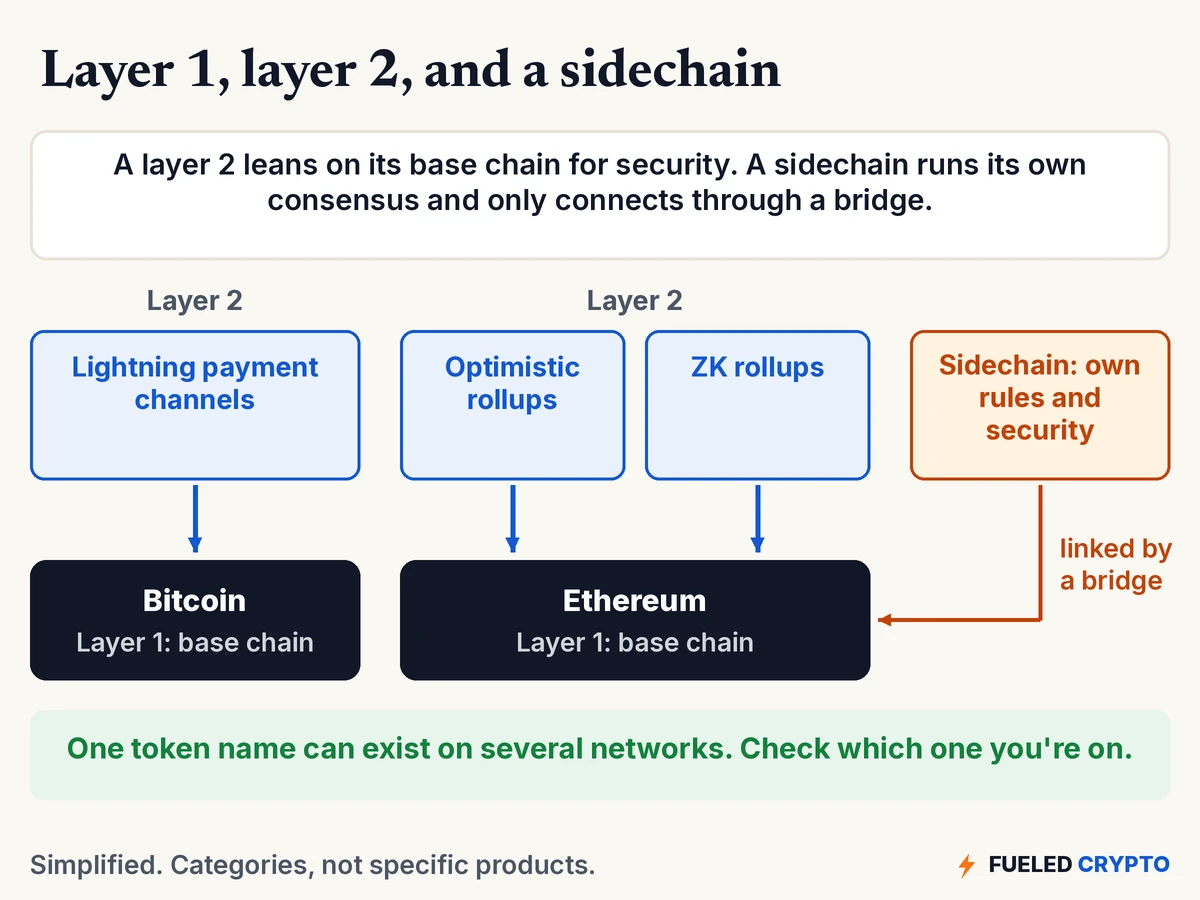
- Layer 1 (L1): The base blockchain. Ethereum.org names Ethereum and Bitcoin as examples. It runs its own consensus, the process by which its computers agree.
- Layer 2 (L2): A separate network that, in ethereum.org's words, "extends Ethereum and inherits the security guarantees of Ethereum." It processes transactions on its own and posts data, and sometimes proofs, back to the layer 1.
Layer 2s aren't only an Ethereum idea. Ethereum.org lists Bitcoin's Lightning Network as a layer 2. With Lightning, two people lock funds in a shared entry on the Bitcoin blockchain that needs both of them to sign. They can then pay each other many times off-chain and settle the final balance on Bitcoin later.
How rollups work
On Ethereum, the most common layer 2s are rollups. They "roll up" lots of transactions into a batch, compress it, and post it to Ethereum as a single transaction. Ethereum.org sums up the payoff: "By combining multiple transactions into a single transaction on layer 1, transaction fees are massively reduced."
The hard part is making sure the layer 2 isn't lying about what happened. There are two main approaches.
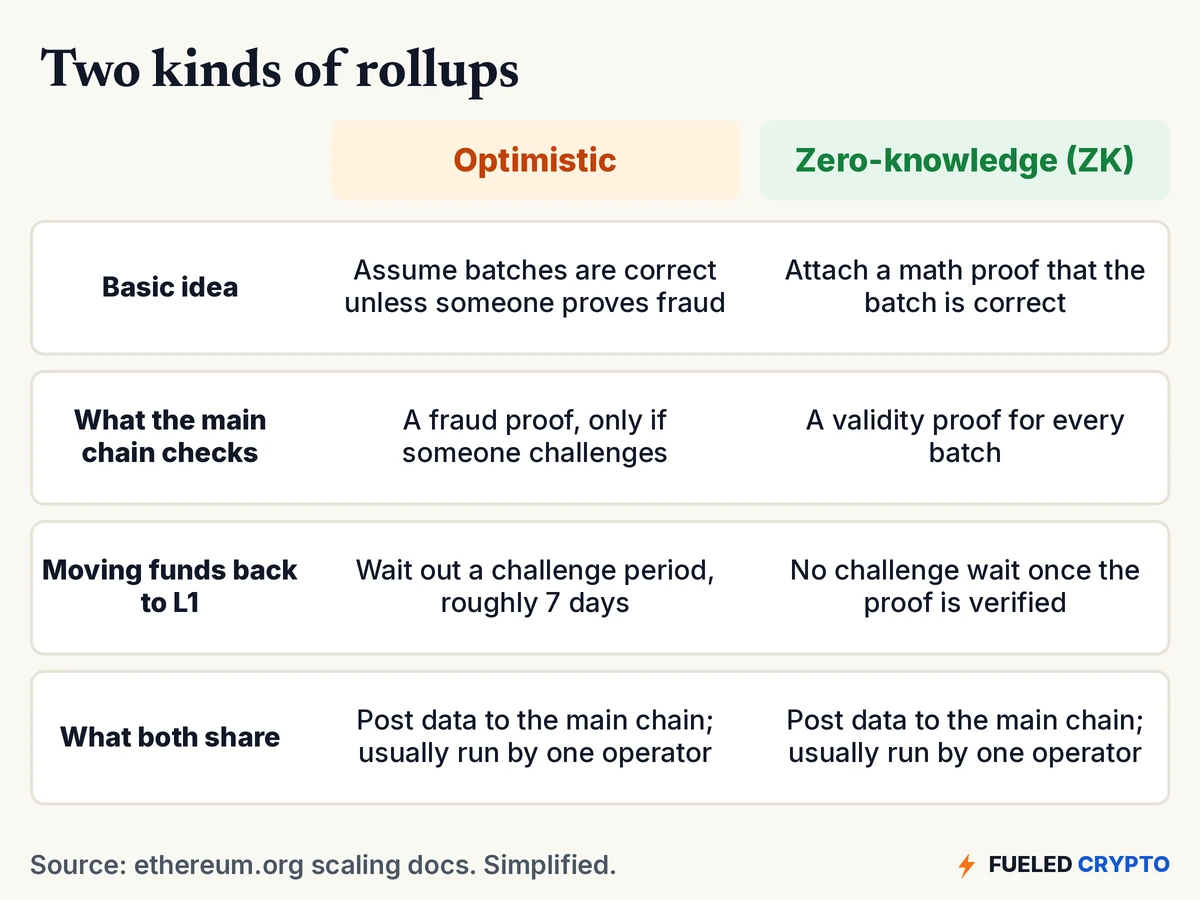
Optimistic rollups assume each batch is correct unless someone proves otherwise. After a batch is posted, there's a window called a challenge period when anyone can submit a "fraud proof" showing a transaction was processed wrong. If they're right, the batch is corrected and the operator responsible is penalized. That safety net has a cost: when you move funds from an optimistic rollup back to Ethereum, you generally wait until the challenge period ends. Ethereum.org says that's "roughly seven days."
Zero-knowledge (ZK) rollups attach a validity proof to each batch. It's a piece of math that shows the batch was processed correctly without making Ethereum redo all the work. Once Ethereum verifies the proof, the batch is final. Ethereum.org notes there's no challenge-period delay when moving funds from a ZK rollup back to Ethereum.
Why the data matters
Both kinds of rollups post transaction data to Ethereum. That isn't busywork. If the layer 2's operator disappears or acts badly, the data on Ethereum lets someone else rebuild the layer 2's state and lets users prove what they own. Ethereum.org's docs say optimistic rollups rely on this to stop operators from hiding the state or blocking withdrawals.
Why layer 2 fees dropped
Posting that data used to be the expensive part. In March 2024, Ethereum's Dencun upgrade added blobs, a cheaper kind of data built for rollups. Blobs are deleted from nodes after about 18 days. Rollups only need the data long enough for anyone to check it, so the network doesn't have to keep it forever. Ethereum's Fusaka upgrade, which went live on December 3, 2025, added a way (called PeerDAS) for the network to handle more blobs. Fees still go up and down with demand, so "cheap" isn't a promise.
Sidechains and bridges: close cousins, different security
Some networks look like layer 2s but aren't. A sidechain is a separate blockchain that runs alongside a main chain and connects to it through a bridge. Ethereum.org is direct about the trade-off: sidechains "do not inherit Ethereum's security properties." They don't post their transaction data back to Ethereum, and they run their own consensus. If a sidechain's validators fail or collude, Ethereum can't step in.
A bridge is how tokens move between networks. Ethereum.org sorts bridges into two broad types:
- Trusted bridges depend on a central operator. You're relying on that operator's honesty and security.
- Trust-minimized (or "trustless") bridges use smart contracts and aim to be as secure as the chains they connect. They still carry smart contract risk.
Ethereum.org lists the risks plainly, including bugs in the code, operator misconduct on trusted bridges and outright hacks, and notes that "many of the top hacks in blockchains involved bridges." Whatever kind of network you're using, the bridge you cross to get there is part of what you're trusting.
The trade-offs nobody puts on the button
A layer 2 can be cheaper and faster, and ethereum.org's own FAQ notes that safety "depends on the underlying technology, smart contract security, and maturity of the network." A few things to understand before moving money:
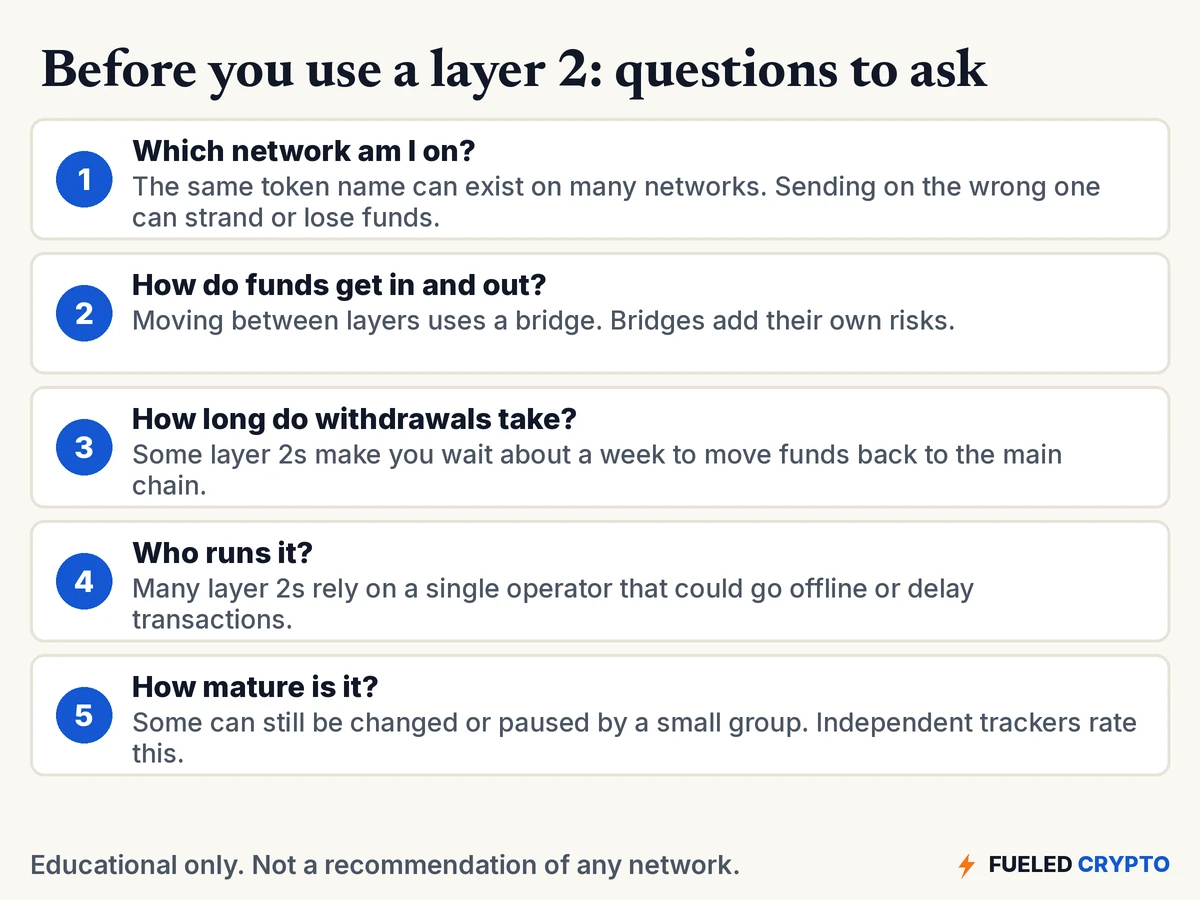
- One operator, for now. Ethereum.org explains that in an optimistic rollup, a single entity (the operator, often called a sequencer) usually orders and submits transactions. It could go offline or refuse certain transactions. Data posted to Ethereum is the backstop, but it can mean delays.
- Training wheels. Some layer 2s still have upgrade keys or emergency controls held by a small group. L2BEAT, an independent research site, publishes a "Stages" framework for this. Stage 0 means a project is "fully controlled by few entities," Stage 2 means it's "fully controlled by code," and Stage 1 sits in between. L2BEAT itself cautions that the stages measure decentralization, not overall security, and that users should still do their own research.
- Withdrawal waits. On optimistic rollups, moving back to Ethereum the native way usually takes about a week.
- Same name, different network. A token on a layer 2 is on a different network from the "same" token on layer 1. Sending on the wrong network can strand or lose funds. Crypto Wallets, Keys and Addresses Explained covers why networks matter when sending.
- More smart contracts, more approvals. Bridges and layer 2 apps often ask for token approvals. Token Approvals and DeFi Basics explains what those allow.
Before connecting a wallet to any bridge or layer 2 app, make sure you're on the real site. How to Avoid Crypto Scams covers the common tricks.
Common mix-ups
- "Layer 2 is a different coin." Often it's the same token, like ETH, moved to another network. Some layer 2s also have their own tokens, which are a separate thing.
- "Layer 2 means less secure." Not necessarily. Rollups are designed to lean on their base chain's security, but how well that works in practice depends on the project's code and maturity.
- "Every network that connects to Ethereum is a layer 2." No. Sidechains and other networks connected only by a bridge have their own security.
- "Withdrawals are always instant." Moving back to the main chain from an optimistic rollup usually takes about a week through the official route.
- "Layer 2s replace layer 1." They depend on it. Without the base chain, a rollup has nothing to settle to.
Words you'll keep hearing
- Layer 1 (L1): The base blockchain, with its own consensus and security.
- Layer 2 (L2): A network built on a layer 1 that handles transactions separately and settles back to it.
- Rollup: A layer 2 that bundles transactions into batches and posts them to the main chain.
- Optimistic rollup: A rollup that assumes batches are valid unless someone submits a fraud proof.
- ZK rollup: A rollup that proves every batch with a validity proof.
- Sequencer (operator): The party that orders and submits a rollup's transactions.
- Sidechain: A separate blockchain with its own consensus, connected by a bridge.
- Bridge: A system for moving tokens between networks.
- Blob: A cheaper, temporary kind of data on Ethereum, made for rollups.
- Payment channel: Lightning's method: two people lock funds on-chain and trade payments off-chain.
Frequently asked questions
What is the difference between layer 1 and layer 2? A layer 1 is a base blockchain, like Bitcoin or Ethereum, with its own consensus and security. A layer 2 is built on top of a layer 1: it processes transactions separately and reports back to the main chain, which it relies on for security.
Why are layer 2 fees lower? A layer 2 packs many transactions into one batch and posts it to the main chain as a single entry, so everyone in the batch shares the cost. On Ethereum, blobs added in 2024 also made posting that data cheaper. Fees still change with demand.
What is a rollup? A rollup is a kind of layer 2 that bundles transactions, compresses them and posts them to the main chain along with the data needed to check them. Optimistic rollups and ZK rollups are the two main types.
What's the difference between optimistic and ZK rollups? Optimistic rollups assume each batch is correct and allow a challenge period, roughly seven days on Ethereum, for anyone to prove fraud. ZK rollups attach a mathematical validity proof to each batch, so there's no challenge wait once the proof is verified.
Is a sidechain a layer 2? No. A sidechain runs its own consensus and doesn't post its transaction data back to the main chain, so it doesn't inherit the main chain's security. It connects through a bridge.
Is the Lightning Network a layer 2? Yes. Ethereum.org lists it as a layer 2 on Bitcoin. Two people lock funds in a shared on-chain entry, pay each other off-chain as often as they like and settle the final balance on Bitcoin.
Are layer 2s safe? It depends on the project. Ethereum.org says safety depends on the technology, smart contract security and the network's maturity. Some layer 2s still rely on a single operator or a small group that can upgrade or pause them, and bridges add their own risks.
Where to go next
- What Is Ethereum?, the main chain most rollups build on.
- What Is Bitcoin?, the base layer for Lightning.
- What Is Staking?, for how Ethereum's layer 1 is secured.
- How Crypto Transactions Work, for fees and confirmations.
- Token Approvals and DeFi Basics, before you use a bridge or layer 2 app.
Sources
- Ethereum.org: Layer 2, What is layer 2?, Scaling, Optimistic rollups, Zero-knowledge rollups, Sidechains, Introduction to blockchain bridges, Danksharding (blobs and the Dencun upgrade), Fusaka.
- Lightning Network: lightning.network (payment channels) and the Lightning Network paper by Joseph Poon and Thaddeus Dryja.
- L2BEAT: Stages framework.
All diagrams and animations are original Fueled Crypto graphics. Names and transactions in the animation are made up.
Fueled Crypto publishes news and education, not investment, tax, or legal advice. Crypto assets are volatile and can lose value. Do your own research and consider a licensed professional before making financial decisions. See our full disclaimer.
Want plain-English crypto news once a week? Subscribe to Fueled Crypto.