Deck: Staking is how many newer blockchains stay secure: people lock up coins and put them at risk to help run the network. Here's what that work is, where the rewards really come from, and what can go wrong.
Last reviewed: October 24, 2026
You've probably seen the word "staking" next to a percentage in an app. The number gets the attention. What gets less attention is the reason the money exists at all, and what you're agreeing to when you lock up coins to get it.
This guide covers how staking works, using Ethereum as the main example because its documentation is the most detailed. It explains where rewards come from and the risks that come with them. It doesn't quote reward rates, compare platforms or tell you whether to stake.
The short version
- Staking is a security deposit. On a proof-of-stake blockchain, the computers that check and add transactions (validators) must lock up coins. Honest work earns rewards. Breaking the rules can cost part of the deposit.
- Rewards mostly come from the network itself. That means newly created coins, plus fees people pay to get their transactions included. They aren't interest paid by a borrower.
- New coins aren't free money. When rewards come from new coins, total supply grows. A reward rate tells you how many more tokens you'll have, not whether they'll be worth more.
- There are real risks. These include penalties, waiting periods to get out, price swings and the risks of any company or smart contract you stake through.
- How you stake changes who you trust. Running your own validator, delegating, pooling and staking on an exchange each hand a different piece of control to someone else.
Why blockchains need staking at all
A blockchain is a shared record kept by thousands of computers that don't know each other. As How Blockchain Works explains, they need a way to agree on what goes into the record and to make cheating expensive.
Bitcoin does this with mining (proof of work): adding a block costs real electricity and hardware. Proof of stake makes cheating costly a different way. To help run the network, you put up coins as collateral. Ethereum's developer docs put it simply: staked ETH acts as collateral that can be destroyed if a validator behaves dishonestly or lazily.
Ethereum switched from mining to staking in September 2022, in an upgrade called the Merge. Many other networks, including Solana and Hedera, use some form of proof of stake too, though the details differ a lot.
What a validator actually does
A validator is a piece of software, running on a computer that stays online, that's tied to a staked deposit. On Ethereum, a validator needs at least 32 ETH. Since the Pectra upgrade in May 2025, one validator can hold up to 2,048 ETH.
Its jobs are simple to describe:
- Vote (attest). Most of the time, validators check new blocks and vote on whether they look right.
- Propose. Every so often, a validator is randomly chosen to build and propose the next block.
- Stay online and honest. The network rewards validators that do these jobs on time and penalizes those that don't.
When you hear that someone "staked their coins," one of two things happened. Either they run a validator themselves, or they handed their coins (or control of them) to someone who does.
Where the rewards come from
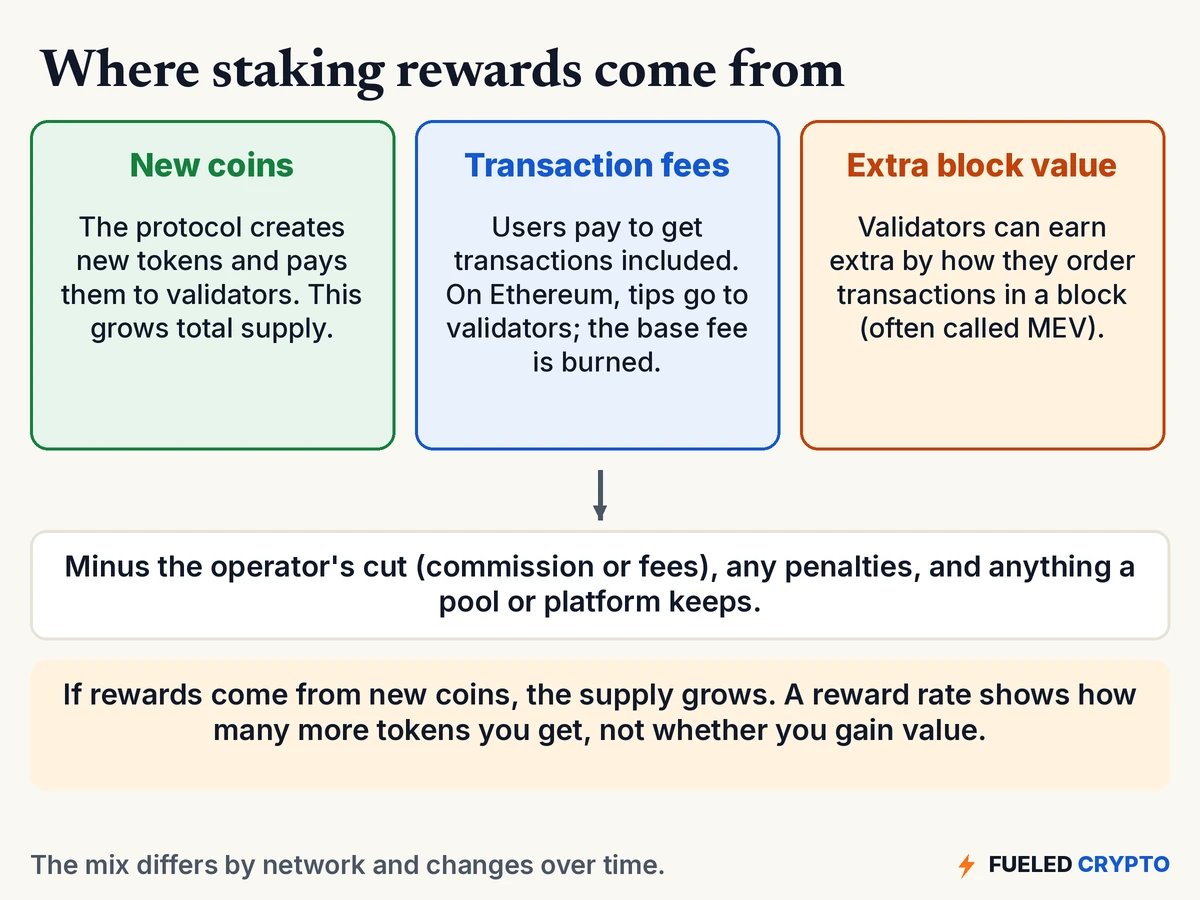
This is the part most "earn" screens skip. Staking rewards aren't conjured by an app. They come from a few specific places, and the mix depends on the network.
1. Newly created coins (issuance). The protocol creates new tokens and pays them to validators for their work. On Ethereum, ethereum.org estimated issuance to stakers at about 1,700 ETH a day, based on about 14 million ETH staked at the time it was written. It also notes this changes as the amount staked changes. Solana's staking FAQ says its rewards also come from inflation, on a schedule set to decline each year toward a long-term floor.
2. Fees from users. People pay fees to get their transactions included. On Ethereum, each fee has two parts: a base fee that is burned (destroyed) and a tip that goes to the validator who proposes the block.
3. Extra block value. A validator that proposes a block can also earn from how transactions are ordered in it. This is called maximal extractable value, or MEV. On Ethereum it usually reaches validators through specialized "block builders."
Why the rate moves around
Reward rates aren't promises. On Ethereum, the base reward for each validator shrinks as more validators join. Ethereum's docs describe it as inversely proportional to the square root of the total number of validators. More stakers means each one gets a smaller slice. Fees and MEV rise and fall with how busy the network is. And anyone standing between you and the protocol, like an operator, pool or exchange, typically takes a cut.
The part about dilution
If rewards are mostly new coins, everyone who doesn't stake owns a slightly smaller share of the total supply each year. Staking can offset that dilution, but it doesn't create value out of nothing. And because rewards are paid in the same token you staked, the token's price usually matters far more than the reward rate. If the price falls 30%, a few percent more tokens won't cover it.
How penalties and slashing work
Rewards are one side of the deal. The other side is that your deposit can shrink.
- Missed duties. On Ethereum, a validator that's offline or late misses its rewards and pays small penalties roughly equal to what it would have earned. For a validator that's offline now and then, this is usually a small cost.
- Slashing. Provable cheating, like proposing two different blocks for the same slot or casting contradictory votes, is punished harder. Ethereum burns part of the stake (up to 1 ETH up front), then forces the validator out over 36 days. About halfway through, it applies a further penalty that grows if many validators were slashed around the same time. That rule exists to punish coordinated attacks.
- The inactivity leak. If the network stops finalizing blocks for more than four epochs (about 25 minutes), Ethereum slowly drains stake from inactive validators until the active ones can finalize again.
Rules differ by network. Solana's docs, for example, say slashing isn't currently implemented in its protocol, though it could be in the future. Before staking anywhere, read that network's own documentation on penalties.
Getting your coins back
Staked coins aren't always available the moment you want them.
- On Ethereum, a validator that wants to stop has to exit, and exits go through a queue. When lots of people want out at once, the wait gets longer. Ethereum's docs describe a separate queue for new validators joining, too.
- On Solana, stake "warms up" when you delegate and "cools down" when you deactivate. Both happen over epochs, so coins aren't instantly withdrawable.
- On some networks, there's no lock-up at all. Hedera, for example, lets holders stake to a node without locking their HBAR.
The practical point: if you might need the money soon, a waiting period isn't a technicality. During a sharp market drop, it can mean watching a price fall without being able to sell.
Common ways people stake, and who you're trusting
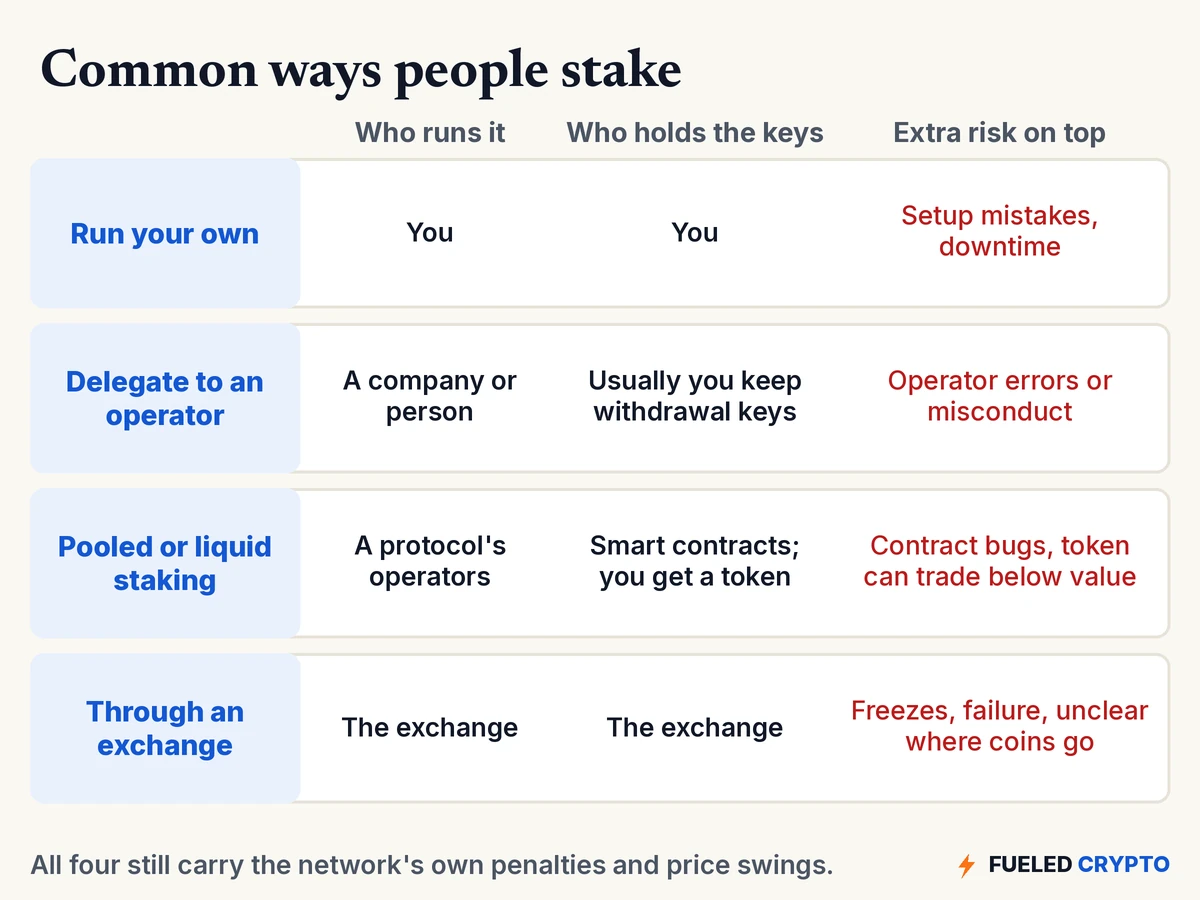
Not everyone runs a validator. Here are the common options, roughly from most control to least. Each one moves more trust onto someone else.
- Running your own validator. You run the software and hold the keys. You need the full deposit (32 ETH on Ethereum), reliable hardware and internet, and the know-how to keep it updated. Mistakes and downtime are your penalties to pay.
- Delegating to an operator. A company or person runs the validator for you. On Ethereum, these setups are often built so you keep the withdrawal keys while the operator holds the signing keys. You're trusting the operator not to make mistakes, or worse.
- Pooled or liquid staking. Many people's coins are combined so smaller amounts can take part. ethereum.org notes this isn't native to Ethereum: the protocol pays the pool's validators, and the pool's smart contracts handle the rest. Many pools give you a "liquid staking token" that represents your share and can be traded. That adds smart contract risk. The token can also trade below the value of what it represents, which is sometimes called a depeg.
- Staking through an exchange. You click a button, and the exchange handles everything. This is the simplest option and, as ethereum.org notes, the one with the highest trust assumptions. You don't hold the keys, and you rely on the exchange to actually stake your coins, pay out fairly and process withdrawals. If an exchange fails or freezes withdrawals, customers can be stuck. That's the counterparty risk explained in Exchange vs. Self-Custody.
A caution from ethereum.org is worth repeating: products that hide how they work "may not be staking at all." If a provider can't explain where rewards come from, that's a reason to be careful. The FTC puts a related point plainly: "Only scammers will guarantee profits or big returns." For more on spotting those, see How to Avoid Crypto Scams.
Pooled and liquid staking also usually means approving smart contracts with your wallet. Token Approvals and DeFi Basics explains what those approvals allow.
The risks, all in one place
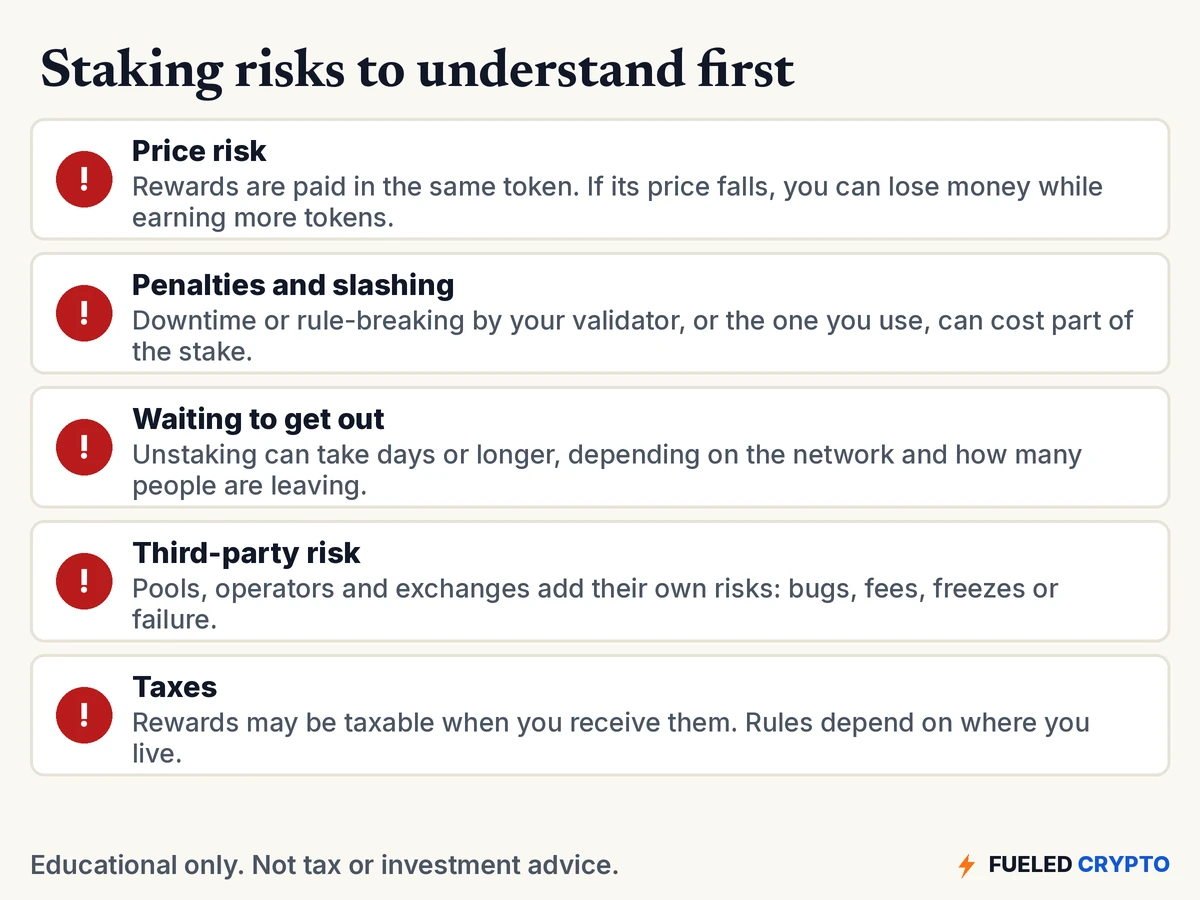
A short note on taxes. In the U.S., the IRS said in Revenue Ruling 2023-14 that a cash-method taxpayer who receives staking rewards includes their fair market value in income in the year they gain "dominion and control" over them. That's when the rewards can be sold or moved. Rules elsewhere differ, and this isn't tax advice. Our crypto tax guide covers reporting, and a licensed tax professional can apply it to your situation.
Common mix-ups
- "Staking is like a savings account." It isn't. There's no deposit insurance, the rewards come in a volatile token, and your deposit can be penalized.
- "The rate is guaranteed." Network rewards change with how many people stake and how busy the network is. Fixed promises come from a company, not the protocol.
- "Staking and lending are the same." Lending means someone borrows your coins and pays interest. Staking means your coins help secure a network. Some products blur the two, so it's worth asking which one you're actually getting.
- "If I stake, my coins are locked forever." Usually not. But getting out can take time, and the wait depends on the network and how many others are leaving.
- "Liquid staking tokens are always worth exactly what's behind them." They can trade at a discount, especially during market stress.
Words you'll keep hearing
- Proof of stake: A way for a blockchain to reach agreement where participants lock up coins as collateral.
- Validator: Software tied to a stake that votes on blocks and sometimes proposes them.
- Issuance: New coins the protocol creates, partly to pay validators.
- Slashing: A penalty that destroys part of a validator's stake for provable cheating.
- Delegation: Letting someone else's validator use your stake while (usually) keeping ownership.
- Liquid staking token: A token that represents staked coins in a pool and can be traded.
- Unbonding / exit queue: The waiting period between asking to unstake and getting coins back.
- Commission: The cut an operator or platform keeps from rewards.
Frequently asked questions
What is staking in crypto? Staking means locking up coins on a proof-of-stake blockchain so they can back a validator, the software that helps check and add transactions. Validators that do their job earn rewards. Validators that break the rules can lose part of their stake.
Where do staking rewards come from? Mostly from the network itself. That includes newly created coins (issuance), fees users pay to get transactions included and, on some networks, extra value from ordering transactions in a block. Any operator, pool or platform in between usually keeps a cut.
Is staking free money? No. When rewards come from new coins, the total supply grows, so staking partly offsets dilution rather than creating value. Rewards are paid in the same token, so a falling price can outweigh them.
Can you lose money staking? Yes. The token's price can fall, validators can be penalized or slashed, and third parties like pools, operators or exchanges can make mistakes, get hacked or fail. Waiting periods to unstake can also keep you from selling when you want to.
What is slashing? Slashing is a penalty for provable cheating, like a validator signing two conflicting blocks. On Ethereum, part of the stake is destroyed and the validator is forced out. Not every network uses slashing; Solana's docs say it isn't currently implemented there.
What is liquid staking? Liquid staking pools many people's coins and gives each person a token representing their share, which can be traded or used elsewhere. It adds smart contract risk and the risk that the token trades below the value of what it represents.
Are staking rewards taxed? In the U.S., the IRS's Revenue Ruling 2023-14 treats staking rewards as income when you gain control over them. Other countries have their own rules. This isn't tax advice; see our tax guide and a licensed professional.
Where to go next
- What Is Ethereum?, the network used as the main example here.
- How Blockchain Works, for why networks need a way to agree.
- Exchange vs. Self-Custody, for what it means when someone else holds your coins.
- Payment Networks: XRP Ledger, Stellar and Hedera, for networks that agree without mining and, in two cases, without staking.
- Crypto Wallets, Keys and Addresses Explained, for the difference between signing keys and withdrawal keys.
Sources
- Ethereum.org: Ethereum staking, Proof-of-stake, Proof-of-stake rewards and penalties, Staking withdrawals, Pooled staking, Staking as a service, Home staking, Ethereum issuance, Pectra.
- Solana: Staking on Solana, Staking and Inflation FAQ; Anza docs: Stake delegation and rewards (warmup and cooldown).
- Hedera docs: Staking.
- Federal Trade Commission: What To Know About Cryptocurrency and Scams.
- IRS: Internal Revenue Bulletin 2023-33, Revenue Ruling 2023-14 (tax treatment of staking rewards).
All diagrams and animations are original Fueled Crypto graphics. Names and numbers in the animation are made up and are not real reward rates.
Fueled Crypto publishes news and education, not investment, tax, or legal advice. Crypto assets are volatile and can lose value. Do your own research and consider a licensed professional before making financial decisions. See our full disclaimer.
Want plain-English crypto news once a week? Subscribe to Fueled Crypto.