Deck: Three networks built mainly with payments in mind, and none of them uses mining. Here's how each one gets thousands of computers to agree, what XRP, XLM and HBAR actually do, and where the three differ.
Last reviewed: October 24, 2026
If you've read How Blockchain Works, you've seen the basic problem every crypto network has to solve: lots of computers that don't trust each other need to agree on one shared record. Bitcoin solves it with mining. Ethereum solves it with staking.
The XRP Ledger, Stellar and Hedera take different routes. They come up together a lot, partly because all three were designed with fast, low-cost payments in mind. But under the hood they work in noticeably different ways. This guide sticks to how they work. It isn't about whether any of their tokens is worth buying.
The short version
- None of the three uses mining. Nobody races to solve puzzles. Agreement comes from voting-style processes among the computers running the network.
- The XRP Ledger has each server pick a list of validators it trusts. When enough of them agree on the next ledger, it's final. Its token is XRP.
- Stellar lets each validator choose whose agreement it needs, and those overlapping choices tie the network together. Its token is XLM, also called lumens.
- Hedera isn't a chain of blocks at all. Its computers gossip, and the history of that gossip is used to settle the order of transactions. Its token is HBAR.
- On all three, a new transaction is typically settled within seconds, and fees are tiny by design.
First, what "agreement without mining" means
On any shared ledger, the hard part isn't recording a payment. It's making sure everyone records the same payments, in the same order, even if some computers are broken or dishonest.
Mining (proof of work) handles that by making it expensive to add a block. Staking (proof of stake) handles it by making validators put money at risk. The three networks in this guide lean on a different idea: a group of known participants votes, and the system is built so that a dishonest minority can't overrule an honest majority.
You'll sometimes see this called Byzantine fault tolerance, after an old computer-science puzzle about generals who can't trust every messenger. In plain English it means: "the network still gets the right answer even if some participants lie or go quiet, as long as there aren't too many of them."
How each network decides who gets a vote, and how the votes are counted, is where they differ.
The XRP Ledger: trusted validators, a new ledger every few seconds
The XRP Ledger went live in June 2012. It was built by David Schwartz, Jed McCaleb and Arthur Britto, and it's open-source software that anyone can run. Ripple, a company that builds payment products, is closely associated with it (more on that below), but the ledger itself is kept by independent servers around the world.
Here's the process, simplified:
- Each server keeps a list of validators it trusts. This is called its UNL, short for Unique Node List. Anyone can run a validator, but a validator only counts toward agreement for the servers that choose to trust it.
- Validators propose. Each one shares which waiting transactions it thinks should go into the next version of the ledger.
- They converge. Over several quick rounds, validators adjust toward what the validators they trust are proposing. Transactions that aren't widely agreed on wait for a later ledger.
- The ledger is validated. Once a large enough share of trusted validators agree (xrpl.org describes the threshold as 80%), that ledger version is final. It can't be reversed later.
The whole cycle takes a few seconds, then starts over. The XRP Ledger's own documentation describes the safety margins this way: with fewer than 20% of trusted validators faulty, the network keeps going normally. Getting an invalid transaction confirmed would need more than 80% of them to collude. In between, the network would stop making progress rather than confirm something wrong.
What XRP does on the ledger
XRP is the XRP Ledger's built-in currency. All 100 billion XRP were created when the ledger launched; no new XRP is made by mining or staking. On the network itself, XRP has a few practical jobs:
- Paying the transaction cost. Every transaction burns a tiny amount of XRP. It isn't paid to anyone, it's destroyed. The cost rises when the network is busy, which makes spamming it expensive.
- The reserve. An account has to hold a small minimum amount of XRP to exist, plus a bit more for each item it owns on the ledger (such as an open order or a token it holds). As of this writing the docs list 1 XRP as the base reserve and 0.2 XRP per item. Validators can vote to change these numbers, so check the source for current values.
- A go-between currency. The ledger has a built-in exchange where people can trade tokens issued on it, and XRP can be used to bridge between two tokens when that's cheaper.
Where Ripple fits
At launch, 80 billion XRP went to the company now called Ripple, and in 2017 Ripple placed 55 billion XRP into escrow on the ledger. Ripple builds payment products that some financial companies use, and some of those products use XRP while others don't. Ripple does not control the ledger's consensus by itself: each server operator decides which validators to trust. If you want the business side of that story, our XRP page covers the news.
Stellar: everyone picks whom to trust
Stellar is a network designed for moving money and issuing digital versions of currencies and other assets. It launched in 2014, supported by the Stellar Development Foundation, a nonprofit that maintains its code. Its native token is the lumen (XLM). It uses the Stellar Consensus Protocol (SCP), which is a kind of federated Byzantine agreement. That's a mouthful, so here's the idea.
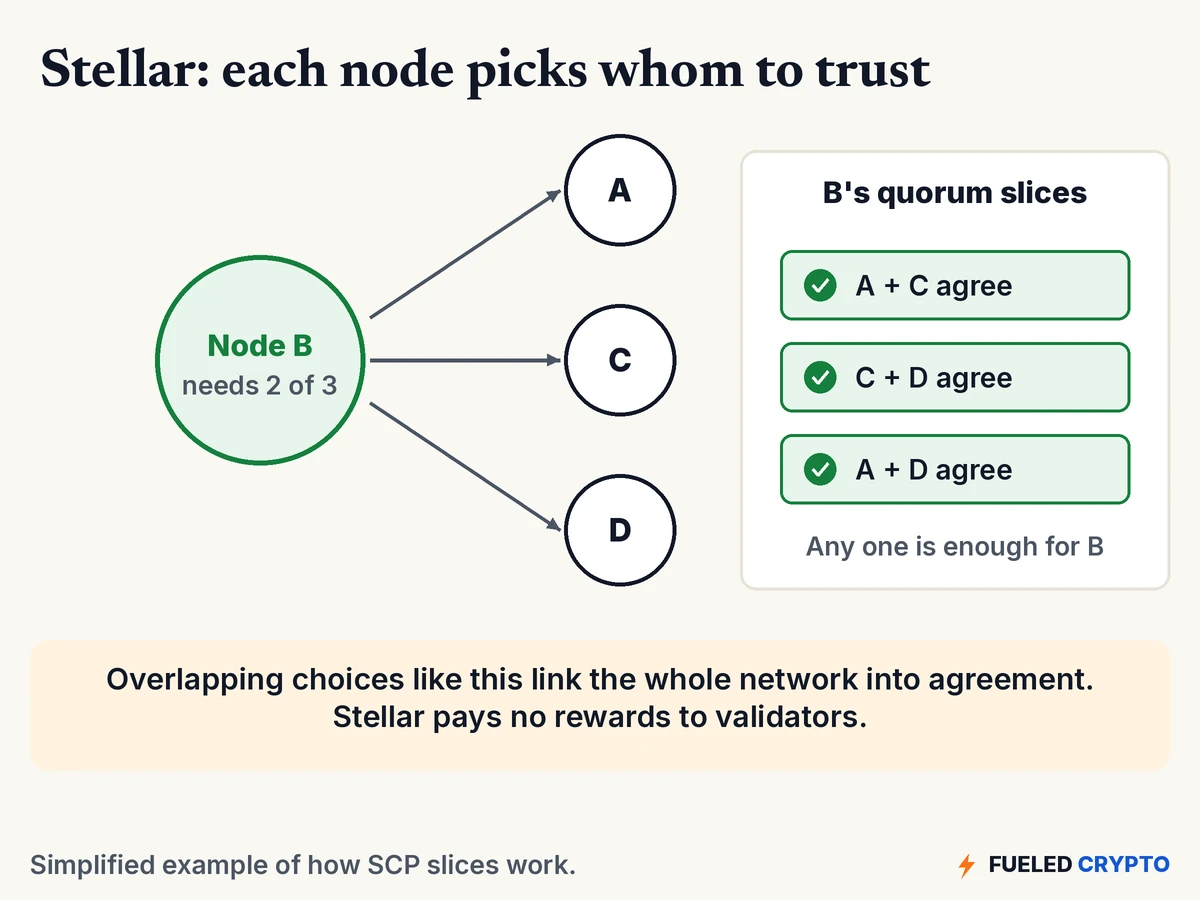
- Each validator chooses its own "quorum set." That's the group of other validators whose agreement it needs before it accepts a result, plus a threshold, such as "any two of these three."
- Those choices overlap. Because many validators trust some of the same others, agreement spreads across the whole network, much like how trust works between people and institutions in real life.
- Anyone can become a validator, and no central authority decides whose vote is required. Stellar pays no rewards to validators; organizations run them because they rely on the network.
- Safety comes first. If validators can't reach agreement, SCP is designed to pause rather than let the network split into two conflicting histories.
New ledgers close every few seconds. Like the XRP Ledger, Stellar has no mining and no staking rewards.
What XLM does on Stellar
- Fees. Every operation carries a tiny fee in XLM. The minimum is 100 stroops (a stroop is one ten-millionth of an XLM), so 0.00001 XLM per operation. When the network is busy, fees can rise through what Stellar calls surge pricing.
- A minimum balance. Accounts must keep a small reserve of XLM, made up of "base reserves" (currently 0.5 XLM each; a basic account needs two), plus more for each extra item the account holds. Like XRP's reserve, this discourages people from flooding the ledger with empty accounts.
Anchors: the bridge to regular money
Much of Stellar's design revolves around anchors. An anchor is a business, such as a financial institution or fintech, that takes in regular money and issues a matching token on Stellar, or does the reverse. In other words, anchors are the on- and off-ramps between bank accounts and the network. Stellar also has a built-in exchange for trading assets issued on it. If you're curious how dollar-backed tokens work in general, see What Are Stablecoins?
Hedera: not a chain at all
Hedera is a public network whose native token is HBAR. Hedera describes itself as a distributed ledger rather than a blockchain, because it uses a different data structure called a hashgraph.
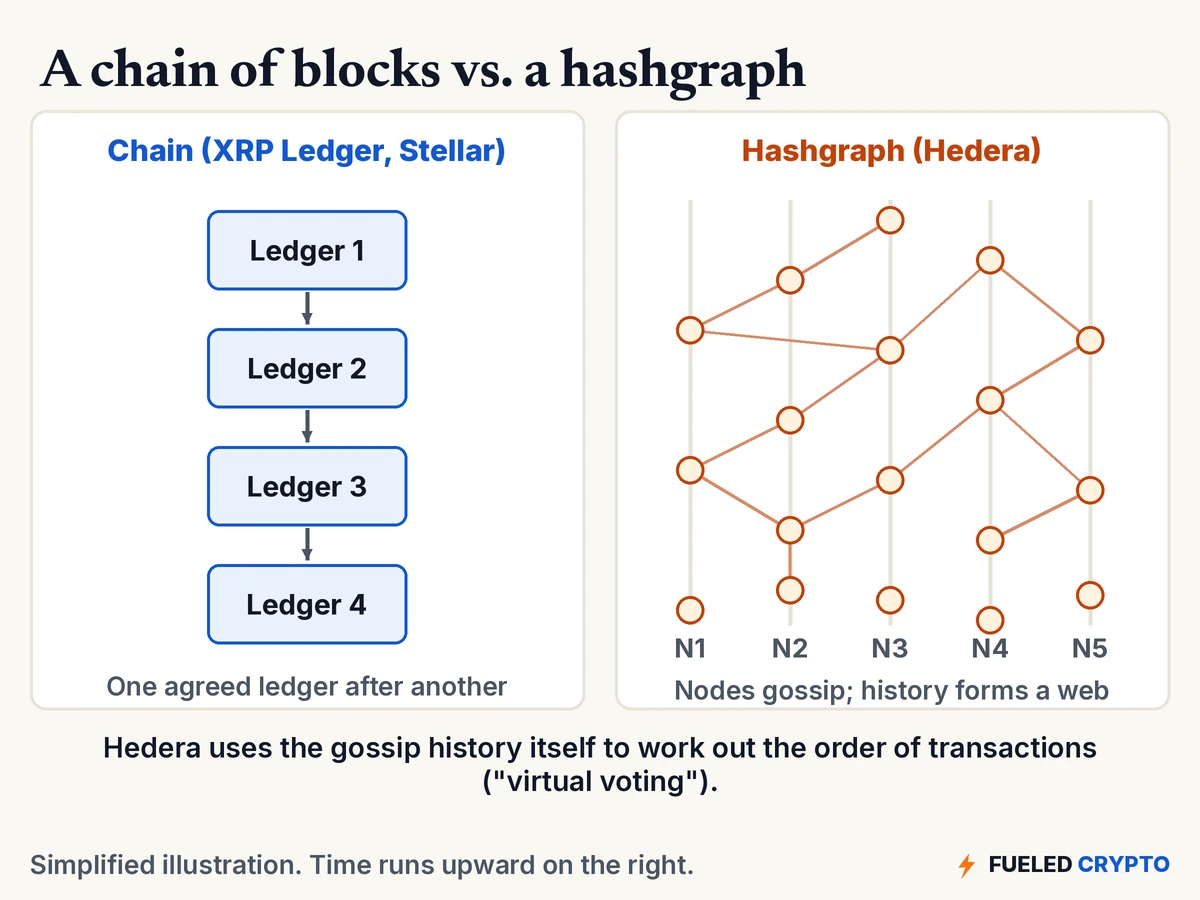
Here's the idea in two steps:
- Gossip about gossip. Each node tells a randomly chosen other node everything it has heard recently, including who it heard it from. Those messages pile up into a web of linked events: the hashgraph.
- Virtual voting. Because every node ends up with the same history of who told whom what, and when, each node can work out how the others would vote without anyone actually sending votes. That's how the network settles the order of transactions.
Hedera's documentation says this design is asynchronous Byzantine fault tolerant. That means no single member or small group can block the community from reaching agreement or change it afterward, even if messages are delayed.
Who runs Hedera
This is the biggest structural difference. Hedera's network nodes are run by members of the Hedera Council, a group of organizations that includes large companies and universities. Council members have equal votes and term limits, and the Council also steers the network's direction. Hedera's own materials describe the network as starting out "public permissioned" (anyone can use it, but node operators are invited) and state a goal of moving toward open, permissionless nodes over time. Check hedera.com for the current status.
What HBAR does on Hedera
- Fees. Hedera sets its fees in U.S. dollar terms and charges them in HBAR at the current exchange rate, so the dollar cost of a given action stays roughly steady. Hedera's fee table lists a basic HBAR transfer at $0.0001.
- Staking. Hedera's docs describe it as proof of stake: each node's weight in consensus is proportional to the HBAR staked to it, and a transaction reaches consensus once nodes representing over two-thirds of the staked HBAR have processed it. Holders can stake HBAR to a node, there is no lock-up, and the reward rate is set by the Council.
Hedera also offers built-in services beyond payments, such as creating tokens and timestamping messages.
The three side by side
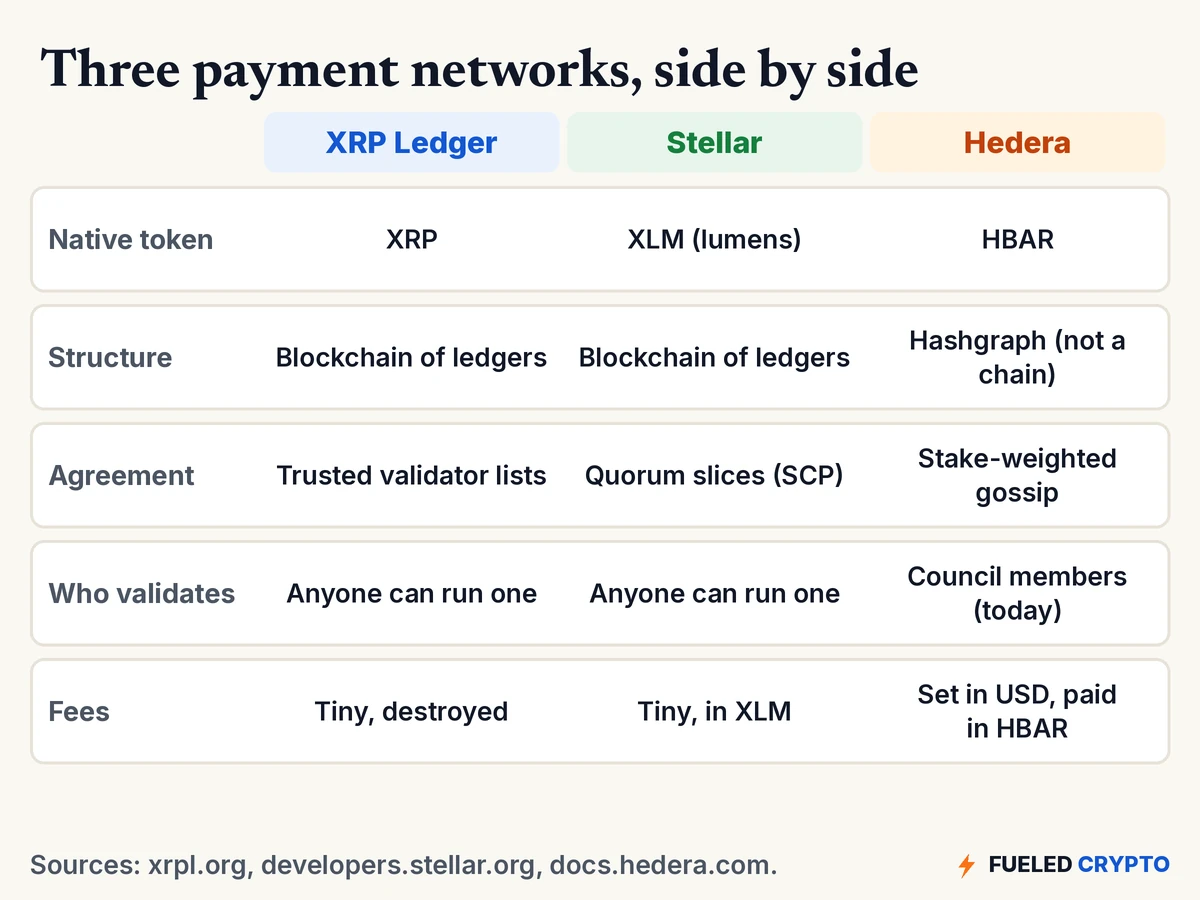
A few things worth noticing:
- Trust is chosen differently. On the XRP Ledger, each server picks a list. On Stellar, each validator picks overlapping groups. On Hedera, voting weight follows staked HBAR across Council-run nodes.
- Speed and finality. All three typically settle a transaction within seconds, and once it's settled it's final. There's no waiting for extra confirmations as you would on Bitcoin. (See How Crypto Transactions Work for the Bitcoin comparison.)
- Fees are meant to be small and predictable, but they're set in different ways: burned XRP, XLM with surge pricing, or dollar-pegged HBAR fees.
- No mining anywhere. That's why all three use far less computing power per transaction than a proof-of-work network.
What about "ISO 20022"?
You'll often see these three tokens grouped as "ISO 20022 coins." ISO 20022 is a messaging standard banks use for payment data. It's about the format of messages, not about any token. We've covered that in detail in What ISO 20022 Is and The Case for ISO 20022 Coins, including what's documented and what's speculation. Nothing in how these networks reach agreement depends on ISO 20022.
Common mix-ups
- "Ripple and XRP are the same thing." Ripple is a company. XRP is the currency built into the XRP Ledger, which is open-source software run by many independent servers.
- "No mining means no security." Mining is one way to secure a network, not the only one. These networks rely on voting among validators and are designed to tolerate a share of faulty or dishonest participants.
- "Hedera is a blockchain." It's a public ledger, but it uses a hashgraph rather than a chain of blocks.
- "Stellar is a copy of the XRP Ledger." The two share some history: Jed McCaleb helped create the XRP Ledger and later co-founded Stellar. But Stellar changed its consensus algorithm in 2015 and relaunched the network, and it has used its own protocol, SCP, since then.
- "Fast and cheap means centralized" (or "means decentralized"). Speed and cost tell you how a network is engineered, not who controls it. To judge that, look at who runs the validators and how they're chosen.
Words you'll keep hearing
- Validator: a computer that takes part in deciding which transactions are accepted.
- UNL (Unique Node List): the XRP Ledger's term for the list of validators a server trusts.
- Quorum set / quorum slice: Stellar's term for the group of validators a node needs to agree before it accepts a result.
- Anchor: on Stellar, a business that swaps regular money for tokens on the network and back.
- Hashgraph: Hedera's data structure, a web of linked gossip events instead of a chain of blocks.
- Virtual voting: working out how each node would vote from the shared gossip history, without sending actual votes.
- Byzantine fault tolerance (BFT): the ability to reach the right answer even if some participants fail or lie.
- Reserve: a small minimum balance some networks require to keep an account open.
- Finality: the point at which a transaction can't be reversed.
Frequently asked questions
Do the XRP Ledger, Stellar and Hedera use mining? No. None of them uses proof of work. The XRP Ledger and Stellar rely on validators that agree through rounds of voting. Hedera uses gossip and virtual voting weighted by staked HBAR.
How fast are transactions on these networks? All three typically settle transactions within a few seconds. Once a transaction is in a validated ledger (XRP Ledger, Stellar) or has reached consensus (Hedera), it's considered final.
Does Ripple control the XRP Ledger? Ripple is a company closely associated with the XRP Ledger and holds a large amount of XRP, much of it in escrow. But each server operator chooses which validators to trust, and the ledger's software is open-source. Ripple does not decide consensus by itself.
What is the difference between XRP and XLM? They are the native currencies of two separate networks. XRP pays transaction costs and reserves on the XRP Ledger. XLM (lumens) pays fees and minimum balances on Stellar. The two networks use different consensus protocols.
Why is Hedera not called a blockchain? Hedera records transactions in a hashgraph, a web of linked events created as nodes gossip with each other, rather than a single chain of blocks. Hedera's own documentation describes it as a distributed ledger that uses hashgraph consensus.
Who runs the nodes on Hedera? Hedera's network nodes are run by members of the Hedera Council, a group of organizations with equal voting rights and term limits. Hedera has said it aims to open node operation more widely over time.
Are XRP, XLM and HBAR "ISO 20022 coins"? ISO 20022 is a messaging standard for financial data, not a property of any token. Some companies connected to these networks take part in ISO 20022 work, but no token is "ISO 20022 compliant," and the standard doesn't affect how these networks reach consensus.
Where to go next
- How Blockchain Works, for the basics these networks build on.
- How Crypto Transactions Work, for what happens between "send" and "settled."
- What Is Bitcoin? and What Is Ethereum?, for how mining and staking networks compare.
- The Case for ISO 20022 Coins, and our XRP and HBAR pages for the news.
Sources
- XRP Ledger docs (xrpl.org): What Is the XRP Ledger?, Consensus Protocol, What Is XRP?, Reserves, Transaction Cost, Decentralized Exchange, History.
- Stellar Developer Docs: Stellar Consensus Protocol, Lumens, Fees, Resource Limits, and Metering, Ledgers, Anchors, Stellar Decentralized Exchange & Liquidity Pools. Stellar Development Foundation: Introducing Stellar (2014) and SDF appoints Denelle Dixon (Mar. 14, 2019; describes SDF as a nonprofit founded in 2014).
- Hedera docs and site: Hashgraph Consensus Algorithm, Staking, Mainnet Fees, What Is Hashgraph Consensus?, What Is Hedera Hashgraph?, Hedera Council.
All diagrams and animations are original Fueled Crypto graphics. Validator names and counts in the animation are illustrative.
Fueled Crypto publishes news and education, not investment, tax, or legal advice. Crypto assets are volatile and can lose value. Do your own research and consider a licensed professional before making financial decisions. See our full disclaimer.
Want plain-English crypto news once a week? Subscribe to Fueled Crypto.