Deck: Since January 2024, people in the U.S. can get exposure to bitcoin's price by buying shares of a spot bitcoin ETF in an ordinary brokerage account. That's a different thing from owning bitcoin. Here's what changes, what doesn't, and the questions people weigh either way.
Last reviewed: October 24, 2026
When spot bitcoin ETFs started trading, a lot of people asked a fair question: if I can buy bitcoin through my regular brokerage account, why would anyone bother with wallets and seed phrases? And if I own bitcoin myself, what am I missing?
The honest answer is that the two aren't better or worse versions of the same thing. They're different kinds of ownership, with different people in the middle and different risks. This guide explains both side by side. It doesn't recommend either path, any fund or any platform.
The short version
- A spot bitcoin ETF is a fund that holds bitcoin. You buy shares of the fund, usually through a brokerage account. The fund, not you, owns the bitcoin.
- Owning bitcoin yourself means you (or an exchange you use) hold the coins. If you keep the keys yourself, nobody else can move them, and nobody else can get them back if you lose the keys.
- Both follow bitcoin's price, and neither one protects you from its swings.
- The SEC approved the first spot bitcoin ETFs on January 10, 2024. The SEC chair at the time said plainly that the agency "did not approve or endorse bitcoin."
- Costs come in different forms. Funds charge an ongoing fee plus trading costs. Holding bitcoin directly involves exchange costs and network fees.
- The real question is what you want to hold and who you want to rely on. The diagrams below lay out the trade-offs.
Two ways to follow the same price
Picture two friends. Sam opens his brokerage app, searches for a spot bitcoin ETF, and buys shares the same way he'd buy shares of any company. His brokerage holds those shares in his account. The fund behind them owns bitcoin, and a separate company called a custodian holds the keys to that bitcoin on the fund's behalf.
Ana signs up with an exchange, buys bitcoin, and then moves it to a wallet she controls. Her wallet holds her private keys, the secret that lets her move her coins on the Bitcoin network. (Our guides on crypto wallets and keys and exchange vs. self-custody cover that part in detail.)
If bitcoin's price rises 10% tomorrow, both of them see roughly the same move, before costs. What's different is everything around that number.
What a spot bitcoin ETF is
An exchange-traded product (ETP) is a fund whose shares trade on a stock exchange during the trading day, like a stock. "ETF" is the name most people use. A spot bitcoin ETF holds actual bitcoin, as opposed to a fund that holds bitcoin futures contracts (agreements to buy or sell at a future date), which is a different product.
A few details are worth knowing:
- They're usually set up as trusts, not traditional mutual-fund-style ETFs. The SEC's Investor.gov explains that commodity-based trusts register their shares under the securities laws, but they "are not registered as investment companies under the Investment Company Act of 1940, even if they have the term ETF in their name." That law is the one that gives traditional funds extra rules around things like valuation and custody.
- You buy and sell shares at market prices. Large firms called authorized participants create new shares or redeem old ones directly with the fund, in big blocks. Their trading helps keep the share price close to the value of the bitcoin the fund holds. Regular investors don't deal with the fund directly.
- Shares trade during stock market hours. The SEC's approval order notes that an estimate of each fund's value is published every 15 seconds during regular trading hours. Bitcoin itself trades around the clock, every day, so its price can move while the stock market is closed.
How we got here: the SEC approval, in brief
For years, the SEC turned down requests to list funds holding spot bitcoin. In his statement on the approval, then-Chair Gary Gensler said the agency had disapproved more than 20 such filings between 2018 and March 2023. Then, in 2023, the U.S. Court of Appeals for the D.C. Circuit held that the SEC had failed to adequately explain its reasoning in denying Grayscale's proposed fund, and vacated that denial.
On January 10, 2024, the SEC approved rule changes allowing several exchanges (NYSE Arca, Nasdaq and Cboe BZX) to list and trade shares of 11 spot bitcoin trusts. Gensler's statement included three points worth knowing:
- The approval was "cabined to ETPs holding one non-security commodity, bitcoin."
- "We did not approve or endorse bitcoin."
- Required disclosures don't mean the SEC endorses a fund's setup, "such as custody arrangements."
At first, the funds could only create and redeem shares for cash. On July 29, 2025, the SEC voted to also allow "in-kind" creations and redemptions for crypto ETPs, meaning authorized participants can exchange bitcoin itself, rather than cash, with the fund. That's a behind-the-scenes change; regular shareholders still buy and sell shares.
Side by side
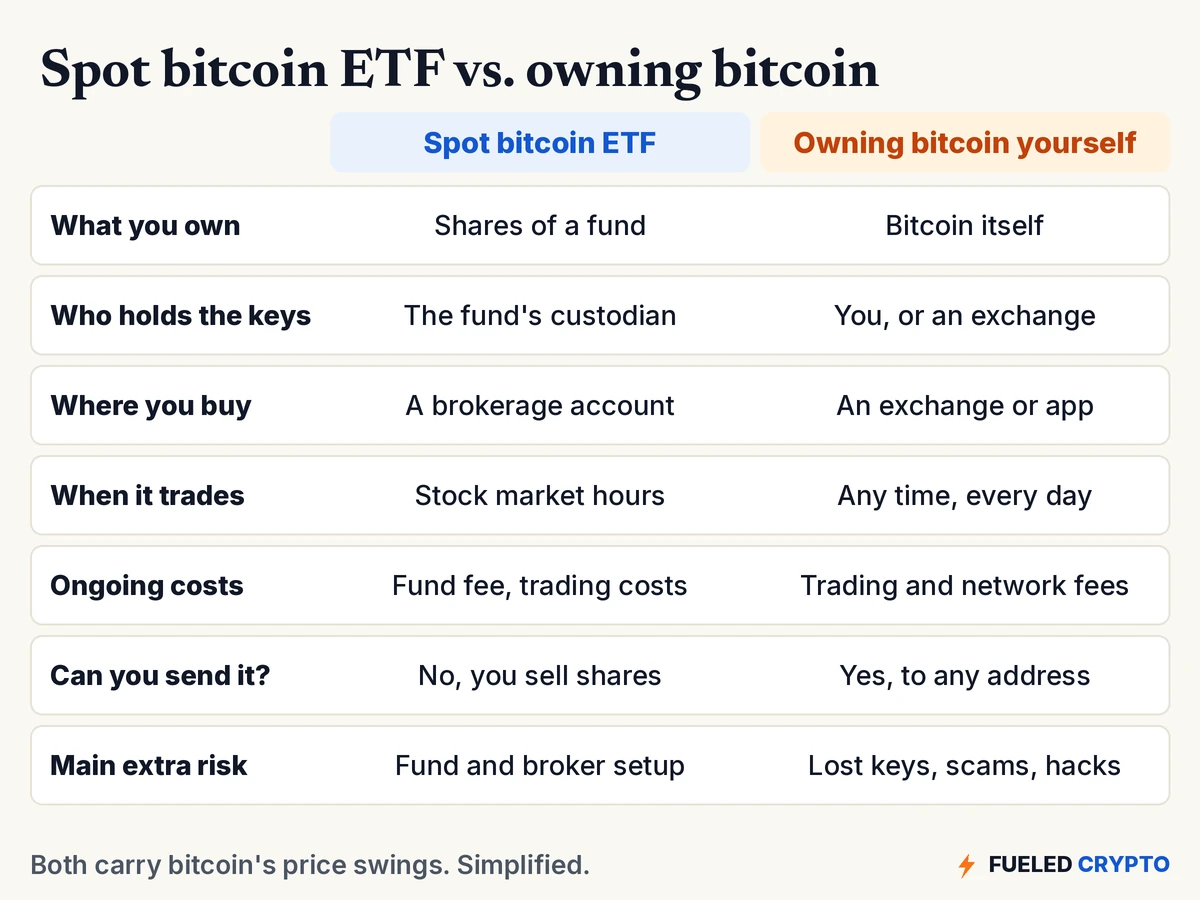
What you own. With an ETF, you own shares of a fund. With direct ownership, you own bitcoin, either in your own wallet or in an account at an exchange.
Who holds the keys. A fund's custodian holds its bitcoin. If you own bitcoin directly, you hold the keys yourself, or you trust an exchange to hold them for you.
What you can do with it. ETF shares can be bought, held and sold in your brokerage account. You can't send them to someone's bitcoin address or use them on the Bitcoin network. Bitcoin you hold yourself can be sent to any address, at any time, without asking anyone.
Where it can live. ETF shares can sit in the same accounts as your other investments, which for some people includes retirement accounts, depending on the account and its rules. Holding bitcoin directly in a retirement account is a separate topic; our crypto IRA comparison covers it.
Who's in the middle
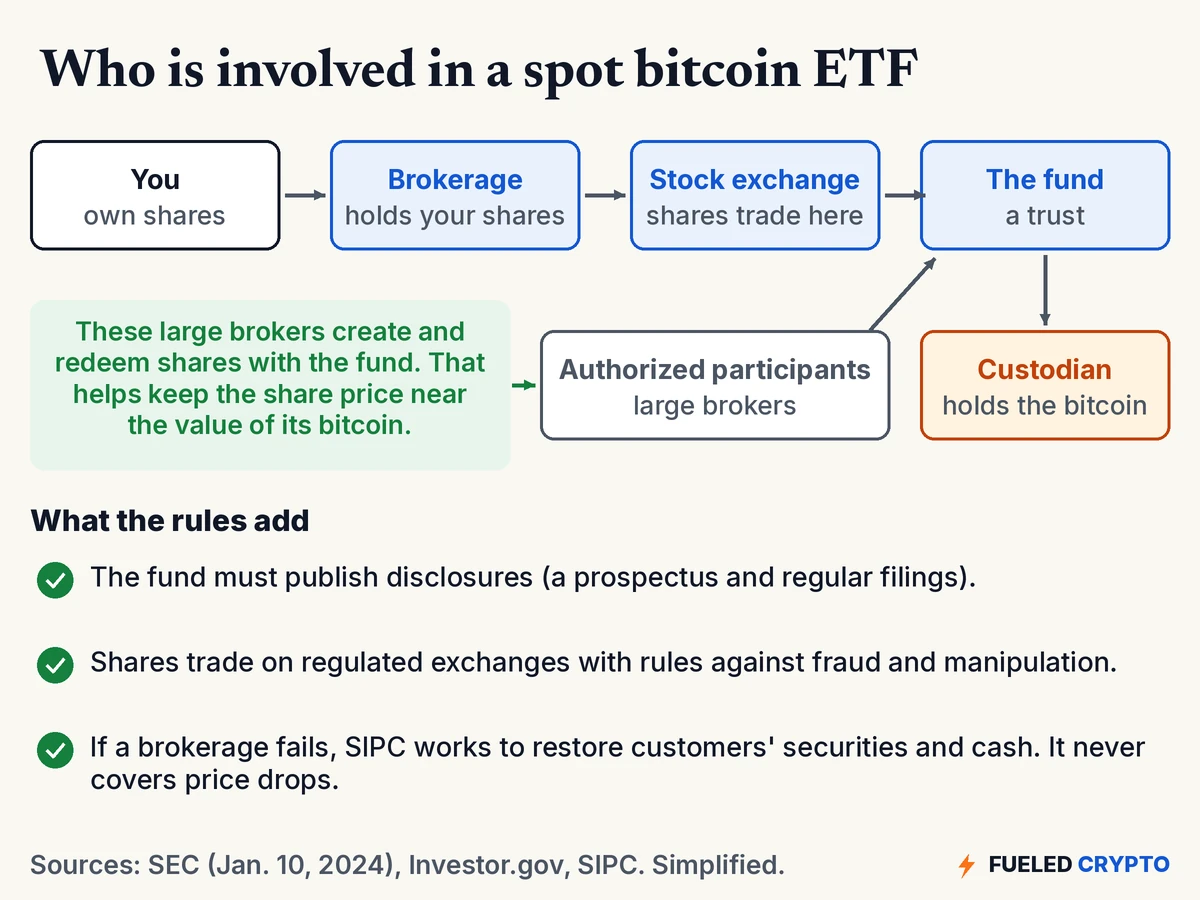
With an ETF, you rely on a chain of companies: your brokerage, the fund and its sponsor, the custodian, and the authorized participants who keep shares flowing. In return, you get the structure of the securities system:
- Disclosure. Each fund files a registration statement (its prospectus) and periodic reports. That's where you'll find its fee, its custodian and its risks.
- Regulated exchanges. Gensler noted the exchanges listing these products "are required to have rules designed to prevent fraud and manipulation."
- SIPC, within limits. If a brokerage that's a SIPC member fails, SIPC works to restore customers' missing securities and cash, up to its limits. SIPC says it does not protect against a drop in the value of an investment. How it applies to a given account is something to confirm with the brokerage.
With self-custody, there's no one in the middle once the coins are in your wallet. Nobody can freeze or block your transactions, and nobody can reverse a mistake or recover lost keys. Bitcoin's developer documentation explains that wallets use private keys to spend bitcoin, so whoever has the keys can move the coins. If you leave bitcoin on an exchange instead, you're relying on that company, which is a different trade-off again; see Exchange vs. Self-Custody.
The kinds of costs
This guide doesn't compare specific fees, because they differ by fund and platform and they change. The kinds of costs look like this:
With an ETF
- An expense ratio, an ongoing yearly fee taken from the fund's assets. Investor.gov notes fees like this reduce your returns over time.
- Any brokerage commission for buying or selling.
- The bid-ask spread, the small gap between the buying and selling price of shares.
- The chance the share price trades at a small premium or discount to the value of the fund's bitcoin.
Owning bitcoin yourself
- Exchange trading fees and spreads when you buy or sell.
- Network fees when you move bitcoin on the blockchain. How crypto transactions work explains how they're set.
- Any withdrawal fees an exchange charges.
- The cost of a hardware wallet, if you use one (hot vs. cold wallets).
Which adds up to more depends on how much you buy, how often you trade and how long you hold. Running your own numbers from each provider's official disclosures is the only way to compare.
The risks, honestly
Both paths share the biggest risk: bitcoin's price can fall sharply, and neither structure changes that.
ETF-specific risks include relying on the fund's custodian and sponsor, share prices drifting from the bitcoin's value, trading only during market hours while bitcoin moves around the clock, and the fund's own rules, which are spelled out in its prospectus.
Self-custody risks are mostly about you: losing your keys or seed phrase, falling for a scam, sending to a wrong address, or a device or computer being compromised. The upside of the same coin is that no company failure can take bitcoin you truly control. Our seed phrase guide and scam guide cover the basics.
Questions people weigh
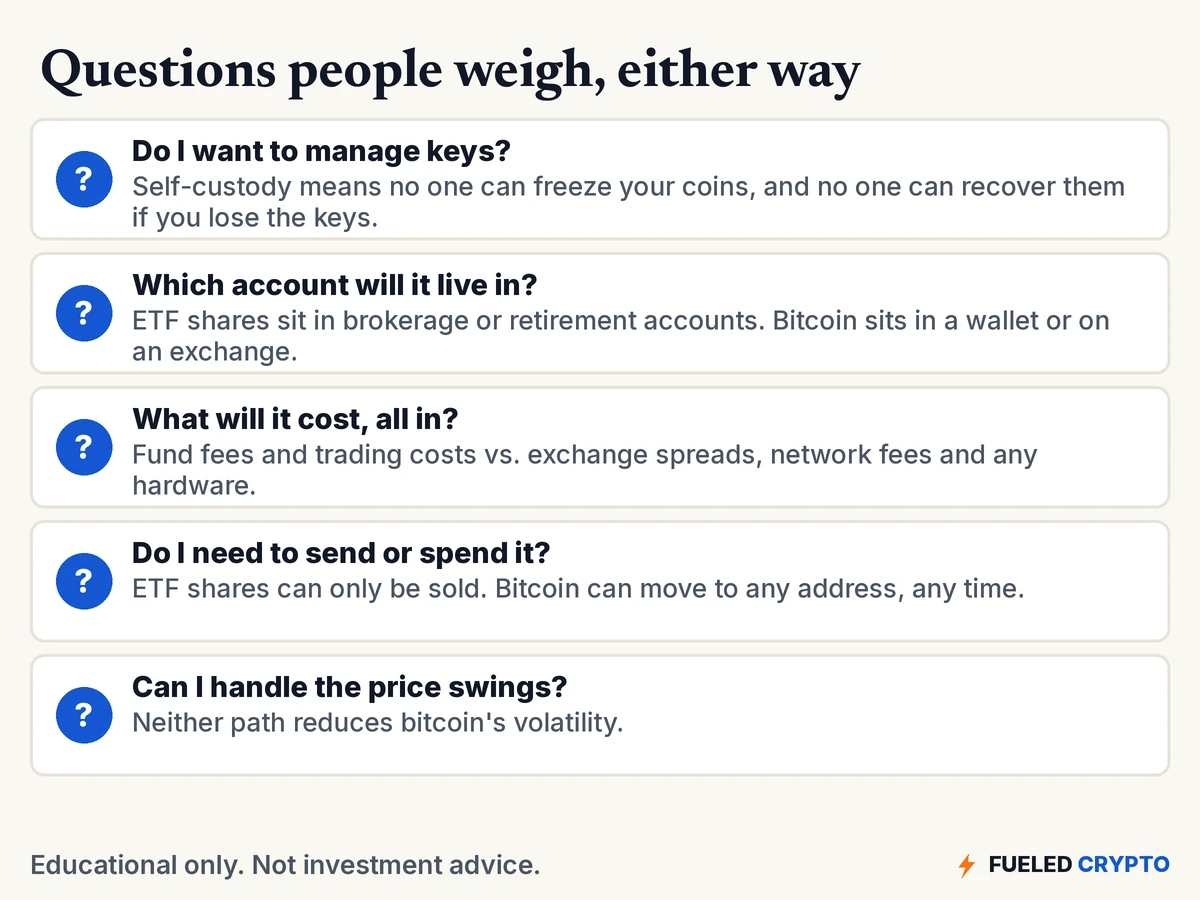
Some people care most about simplicity and keeping everything in one familiar account. Others care most about holding the asset directly with no company in between. Some do a bit of both. None of that is a recommendation; it's just how the trade-offs tend to shake out. A licensed financial professional can help you think through how either fits your situation.
A note on taxes: in the U.S., selling ETF shares or bitcoin at a gain can be taxable, and the records you get may look different for each. This isn't tax advice; see our guide to reporting crypto taxes and the IRS's digital assets page, and consider a tax professional.
Common mix-ups
- "Buying a bitcoin ETF means I own bitcoin." You own shares of a fund that owns bitcoin. You can't withdraw the bitcoin or send it anywhere.
- "The SEC approved bitcoin." The SEC approved the listing of certain funds. Its chair said directly that it "did not approve or endorse bitcoin."
- "An ETF is protected from losses." No. SIPC is about a failed brokerage, not falling prices.
- "All bitcoin funds are the same." Spot funds hold bitcoin; futures funds hold contracts. Fees, custodians and rules differ by fund too.
- "Self-custody has no costs." Moving bitcoin costs network fees, and buying it usually involves exchange costs.
Words you'll keep hearing
- ETF / ETP: a fund whose shares trade on a stock exchange like a stock.
- Spot: holding the actual asset, not a contract on its future price.
- Custodian: a company that holds assets, here the bitcoin's keys, for someone else.
- Authorized participant: a large firm that creates and redeems fund shares directly with the fund.
- Expense ratio: a fund's yearly fee, as a percentage of assets.
- NAV: net asset value, what the fund's holdings are worth per share.
- Self-custody: holding your own private keys.
Frequently asked questions
Do you own bitcoin if you buy a bitcoin ETF? No. You own shares of a fund, and the fund owns the bitcoin. A custodian holds the fund's bitcoin. You can sell your shares, but you can't withdraw or send the underlying bitcoin.
When were spot bitcoin ETFs approved? The SEC approved the listing and trading of shares of 11 spot bitcoin trusts on January 10, 2024, on NYSE Arca, Nasdaq and Cboe BZX. The SEC's chair said the agency did not approve or endorse bitcoin itself.
Who holds the bitcoin in a spot bitcoin ETF? A custodian chosen by the fund holds the bitcoin on the fund's behalf. Each fund names its custodian in its prospectus. The SEC has said its approval doesn't endorse any fund's custody arrangements.
Can I trade a bitcoin ETF at any time? ETF shares trade during stock market hours, and some brokerages add extended hours. Bitcoin itself trades around the clock, every day, so its price can move while the stock market is closed.
What fees does a bitcoin ETF have? Typically an ongoing expense ratio, plus any brokerage commission and the bid-ask spread when you trade. Each fund lists its fee in its prospectus. Owning bitcoin directly has different costs, such as exchange fees and network fees.
Is a bitcoin ETF safer than owning bitcoin? They carry different risks rather than more or less. An ETF relies on a brokerage, a fund and a custodian. Self-custody relies on you protecting your keys. Both carry the full price risk of bitcoin.
Is a bitcoin ETF covered by SIPC? SIPC protects customers if a member brokerage fails, by working to restore missing securities and cash within its limits. It never protects against a drop in value. Check with your brokerage how coverage applies to your account.
Where to go next
- What Is Bitcoin?, for the asset both paths follow.
- Exchange vs. Self-Custody, for the two ways to hold bitcoin directly.
- Hot vs. Cold Wallets, if you hold your own keys.
- Crypto IRA Comparison, for retirement accounts.
Sources
- U.S. Securities and Exchange Commission: Approval order, Release No. 34-99306 (January 10, 2024); Statement by Chair Gary Gensler on the approval (January 10, 2024); SEC permits in-kind creations and redemptions for crypto ETPs (July 29, 2025).
- Investor.gov (SEC): Exchange-traded products (ETPs), Exchange-traded funds (ETFs) investor bulletin, Mutual fund and ETF fees and expenses.
- SIPC: What SIPC protects.
- Bitcoin developer documentation: Wallets.
- IRS: Digital assets.
All diagrams and animations are original Fueled Crypto graphics. Names in the animation are made up, and no fund is named or recommended.
Fueled Crypto publishes news and education, not investment, tax, or legal advice. Crypto assets are volatile and can lose value. Do your own research and consider a licensed professional before making financial decisions. See our full disclaimer.
Want plain-English crypto news once a week? Subscribe to Fueled Crypto.