Deck: A dollar in your banking app, a dollar stablecoin and a central bank digital currency can all look the same on screen. The difference is who owes it to you, what protects it and who can see it. Here's a plain comparison, plus where things stand in the U.S.
Last reviewed: October 24, 2026
I used to think "digital dollar" meant one thing. Then I noticed people using it for three different things: the money in my bank account, stablecoins, and something governments were debating called a CBDC. Same dollar sign, very different promises behind it.
This guide lines them up side by side. It doesn't take a side in the policy debate. Reasonable people disagree about CBDCs and stablecoins, and the goal here is just to understand what each one is.
The short version
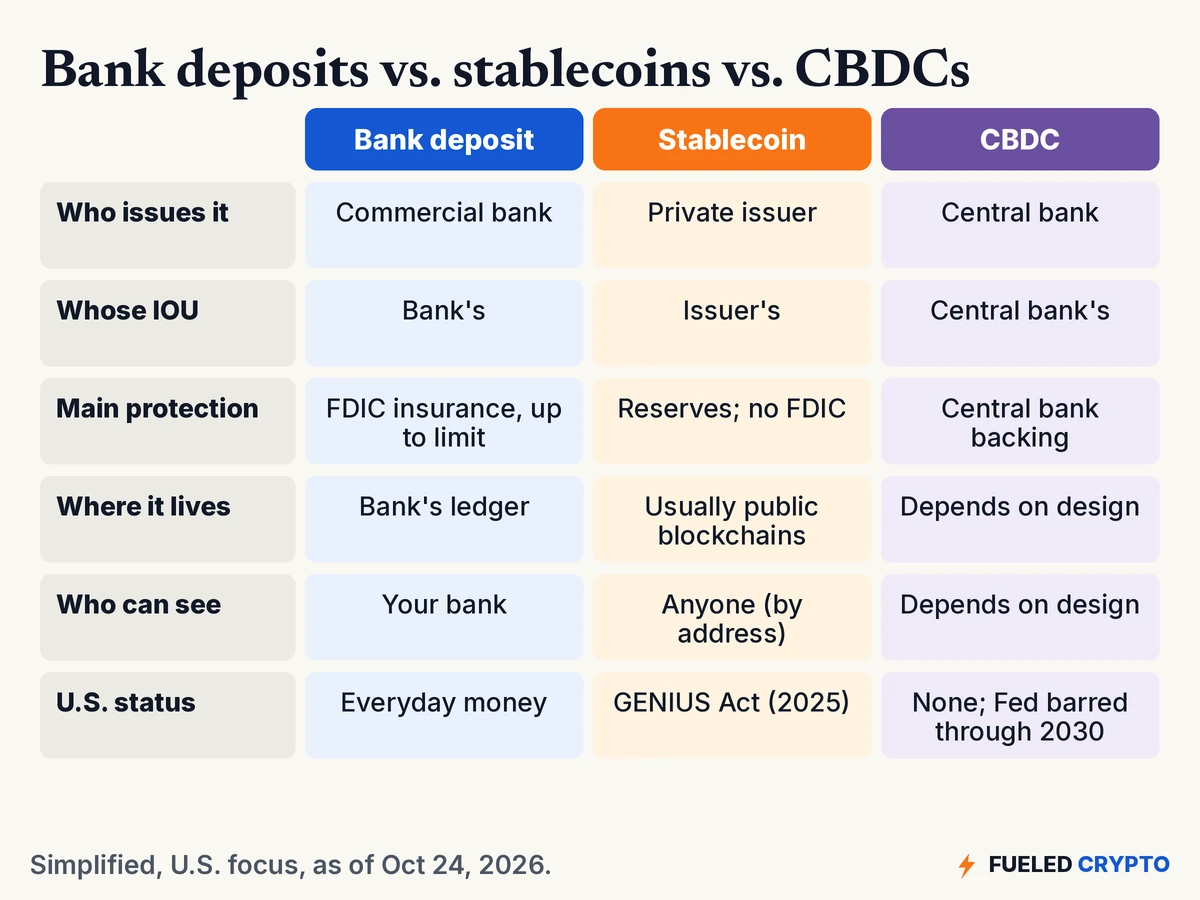
- A bank deposit is an IOU from your bank. In the U.S., FDIC insurance covers it up to $250,000 per depositor, per insured bank, per ownership category.
- A stablecoin is an IOU from a private company, backed by reserves the company holds. It isn't FDIC-insured.
- A CBDC (central bank digital currency) would be an IOU straight from the central bank, like a digital version of cash.
- The U.S. has no CBDC. A 2026 law bars the Federal Reserve from issuing one until December 31, 2030.
- Stablecoins have a federal framework, the GENIUS Act, signed July 18, 2025. Its rules take effect January 18, 2027.
- Who can see your payments depends on the form, and for a CBDC it would depend on how it was designed.
Three dollars, three IOUs
Money is mostly a promise. The question is who's making it.
The Federal Reserve put it this way in its 2022 paper on the topic: the money most people use digitally today is made up of "liabilities of private entities, such as commercial banks. Conversely, a CBDC would be a liability of a central bank, like the Federal Reserve."
Bank deposits: the money you already use
When you put $100 in a bank, the bank owes you $100. It lends and invests most deposits, which is why it can pay you interest.
The safety net is deposit insurance. The FDIC says its insurance "covers $250,000 per depositor, per FDIC-insured bank, for each account ownership category." It also says it "only covers deposits, and only if your bank is FDIC-insured," and it lists crypto assets as not covered.
Stablecoins: private digital dollars
A stablecoin is a token on a blockchain, issued by a private company that promises to redeem it for $1. The company holds reserves to back that promise. Our guide to what stablecoins are covers how they work.
In the U.S., the GENIUS Act (Public Law 119-27, signed July 18, 2025) sets federal rules for payment stablecoins. In short:
- Reserves have to be held in safe, liquid assets such as cash and short-term Treasury bills.
- Stablecoins aren't FDIC-insured or backed by the government.
- Issuers can't pay interest or yield just for holding the coin.
- Holders get priority over other creditors if an issuer fails.
The OCC says its final rule implementing the law and "the GENIUS Act take effect on January 18, 2027."
Stablecoins usually live on public blockchains, so you can hold them in an exchange account or in a wallet you control yourself. Our exchange vs. self-custody guide explains the trade-offs.
CBDCs: a central bank's digital money
A CBDC would be digital money issued directly by a country's central bank. The executive order of January 23, 2025 defined it as "a form of digital money or monetary value, denominated in the national unit of account, that is a direct liability of the central bank."
That last part is the key difference. Paper cash is already a direct claim on the central bank. A CBDC would be a digital form of that, rather than a claim on a private bank or company.
A CBDC could be designed in many ways: run on a central bank's own system or through banks, with different privacy rules and limits. Saying "a CBDC would do X" usually depends on which design someone means.
Side by side
Privacy: who can see your money?
This is where much of the debate sits, so here are the facts for each.
- Bank deposits. Your bank sees your transactions. Under the Bank Secrecy Act, banks must, among other things, "file reports of cash transactions exceeding $10,000 (daily aggregate amount)" and report suspicious activity, according to FinCEN.
- Stablecoins. On a public blockchain, anyone can see the transfers between addresses, though not necessarily who owns them. Exchanges and issuers know their own customers. Our GENIUS Act guide notes the law treats issuers as financial institutions under the Bank Secrecy Act.
- CBDCs. It depends on the design. The Fed's paper listed privacy as a central question: "Other key policy considerations include how to preserve the privacy of citizens and maintain the ability to combat illicit finance."
Supporters and critics of CBDCs often disagree most sharply here. Some see a public digital option as useful; others worry about government visibility into payments. This guide doesn't settle that, but the facts above are a starting point.
Where things stand in the U.S.
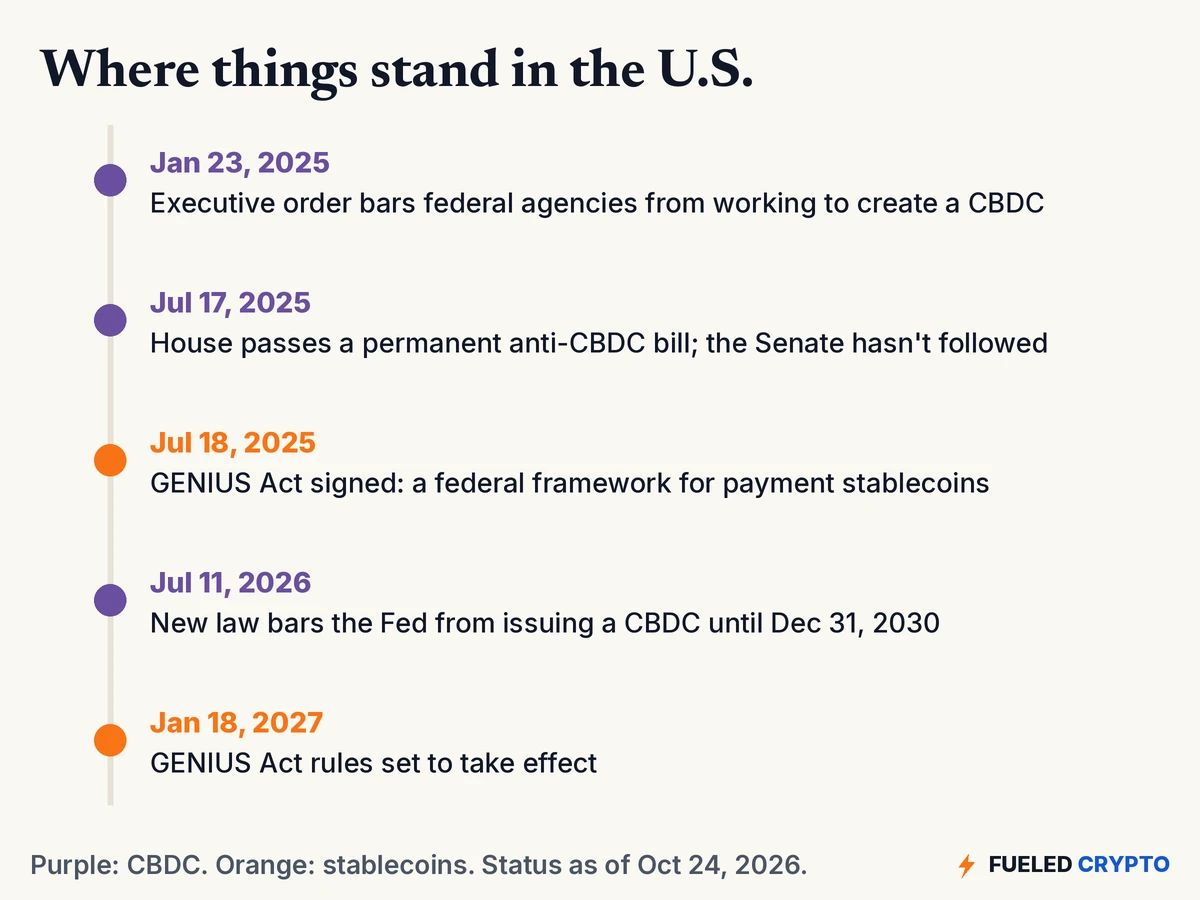
- January 23, 2025. Executive Order 14178 said federal agencies "are hereby prohibited from undertaking any action to establish, issue, or promote CBDCs" in the U.S. or abroad, except as required by law. The order gave its reasons: in its view, CBDCs "threaten the stability of the financial system, individual privacy, and the sovereignty of the United States."
- July 17, 2025. The House passed the Anti-CBDC Surveillance State Act (H.R. 1919), 219 to 210. The House later attached similar language to another bill (S. 1318) and passed it in April 2026; the Senate voted 47 to 52 against taking it up on June 5, 2026. As of this writing, that broader, permanent ban isn't law.
- July 18, 2025. The GENIUS Act became law.
- July 11, 2026. A new provision in the U.S. Code (12 U.S.C. § 423, added by Public Law 119-101) says the Fed Board and the regional Federal Reserve banks "may not issue or create a central bank digital currency," directly or through banks. It exempts any currency that is "open, permissionless, and private" with the privacy protections of cash. It says it doesn't allow a CBDC absent an Act of Congress, and the ban expires December 31, 2030.
- January 18, 2027. The GENIUS Act's rules take effect.
So in plain terms: no U.S. CBDC exists, issuing one is barred until at least the end of 2030, and stablecoins are on a regulated track.
Around the world
Other countries are in very different places. The Atlantic Council's CBDC tracker (last updated May 2026) says "146 countries & currency unions, representing over 98% of global GDP, are exploring a CBDC," and that three have fully launched one: the Bahamas, Jamaica and Nigeria.
In Europe, the European Central Bank says it aims "to be ready for a potential first issuance of the digital euro during 2029, assuming the necessary EU legislation is adopted in the course of 2026." Like everything in this section, that's a stated plan, not a done deal.
For other ways money moves across borders on blockchains, see our guide to payment networks like XRPL, Stellar and Hedera.
Common mix-ups
- "Stablecoins are a CBDC." No. Stablecoins are issued by private companies. A CBDC would be issued by a central bank.
- "The money in my banking app is already a CBDC." No. It's a bank deposit, a claim on your bank, even though it's digital.
- "Stablecoins are FDIC-insured." No. FDIC insurance covers deposits at insured banks. The GENIUS Act relies on reserves instead.
- "The U.S. banned CBDCs permanently." Not as of October 24, 2026. The current law is a ban on the Fed issuing one that runs through December 31, 2030. A permanent ban passed the House but not the Senate.
- "A CBDC would definitely track everything." Privacy depends on the design, and that's one of the most debated questions.
- "A stablecoin can't lose its peg." Reserves and rules reduce risk. They don't remove it.
Words you'll keep hearing
- CBDC: central bank digital currency, digital money that's a direct liability of a central bank.
- Stablecoin: a crypto token designed to hold a steady value, usually $1, backed by reserves.
- Deposit: money held at a bank, which the bank owes back to you.
- Liability: what an institution owes. Your deposit is your bank's liability.
- FDIC: the Federal Deposit Insurance Corporation, which insures deposits at member banks.
- Reserves: the assets a stablecoin issuer holds to back its coins.
- Peg: the value a stablecoin aims to hold, such as $1.
- Digital euro: the European Central Bank's proposed CBDC.
Frequently asked questions
What's the main difference between a CBDC and a stablecoin? Who issues it. A CBDC would be issued by a central bank. A stablecoin is issued by a private company and backed by reserves it holds.
Does the U.S. have a CBDC? No. As of October 24, 2026, a law in effect since July 2026 bars the Federal Reserve from issuing one until December 31, 2030.
Are stablecoins FDIC-insured? No. FDIC insurance covers deposits at insured banks. Stablecoins under the GENIUS Act are backed by reserves instead and aren't government-guaranteed.
Is the money in my banking app a CBDC? No. It's a bank deposit: your bank owes it to you, and FDIC insurance covers it up to the limit if the bank is insured.
Would a CBDC let the government see my purchases? It depends on the design. The Federal Reserve has called privacy a key policy question. Different proposals handle it very differently.
When do the GENIUS Act's stablecoin rules take effect? January 18, 2027, according to the OCC.
Do other countries have CBDCs? A few. The Atlantic Council's tracker (May 2026) lists the Bahamas, Jamaica and Nigeria as fully launched, with many others exploring one.
Where to go next
- What Are Stablecoins?, for how stablecoins hold their value.
- The GENIUS Act, Explained, for the U.S. stablecoin law in detail.
- How Blockchain Works, for the basics of where stablecoins live.
- Exchange vs. Self-Custody, for where to hold them.
- Payment Networks: XRPL, Stellar and Hedera, for blockchain payment rails.
- Crypto Glossary, for any other term.
Sources
- Board of Governors of the Federal Reserve System: Central Bank Digital Currency (CBDC) FAQs (on the 2022 paper "Money and Payments: The U.S. Dollar in the Age of Digital Transformation"; page last updated June 10, 2022).
- The White House: Executive Order 14178, Strengthening American Leadership in Digital Financial Technology (January 23, 2025).
- Office of the Law Revision Counsel, U.S. Code: 12 U.S.C. § 423 (added by Pub. L. 119-101, July 11, 2026).
- Office of the Clerk, U.S. House of Representatives: Roll Call 201, H.R. 1919, Anti-CBDC Surveillance State Act (July 17, 2025; passed 219–210).
- Congress.gov: S. 1318, all actions.
- FDIC: Understanding Deposit Insurance.
- FinCEN: The Bank Secrecy Act.
- Office of the Comptroller of the Currency: News release 2026-92 (October 21, 2026; GENIUS Act effective date).
- Atlantic Council: Central Bank Digital Currency Tracker (last updated May 2026).
- European Central Bank: Digital euro.
All diagrams and animations are original Fueled Crypto graphics. Sam is a made-up example.
Fueled Crypto publishes news and education, not investment, tax, or legal advice. Crypto assets are volatile and can lose value. Do your own research and consider a licensed professional before making financial decisions. See our full disclaimer.
Want plain-English crypto news once a week? Subscribe to Fueled Crypto.