Deck: Almost every crypto project has a whitepaper and a glossy website. Here's what each part should tell you, how to check the claims yourself, and the warning signs regulators keep pointing to. It's a reading method, not a list of picks.
Last reviewed: October 24, 2026
The first whitepaper I tried to read lost me by page two. It was full of diagrams and words like "sharded consensus," and I came away thinking it must be impressive because I didn't understand it. That's exactly backwards. A good paper should make the idea clearer, not cloudier.
This guide is the checklist I wish I'd had. It uses a made-up project, "Glimmer," so nothing here reads as a pick. It doesn't tell you what to buy, and it can't tell you whether any project will work.
The short version
- A whitepaper is the project's own pitch. It usually isn't reviewed by any regulator before it's posted.
- Read it as a list of claims. For each one, ask who stands behind it and how you could check it.
- Eight questions cover most papers: problem, how it works, what the token does, supply, team, roadmap, use of funds, and risks.
- Check claims at the source. Audit reports on the auditor's site, contract addresses on the official site, holders on a block explorer.
- Watch for regulator red flags. Promised returns, jargon-heavy pitches, hard sells and vague token rights.
- Clarity isn't proof. A well-written paper can still describe a project that fails or a scam.
What a whitepaper is (and isn't)
In crypto, a whitepaper is a document where a project explains what it's building, how it works and what its token is for. The term took off with the 2008 paper that first introduced Bitcoin, "Bitcoin: A Peer-to-Peer Electronic Cash System," and nearly every project since has published one.
What it isn't: a checked disclosure. When a company sells stock to the public, it files detailed documents with the SEC. A crypto whitepaper is usually written and posted by the project itself. (The SEC notes that some token sales may count as securities offerings, which must be registered or exempt; a whitepaper on its own isn't that.) The SEC's investor bulletin on token sales puts the burden on you: "carefully read any materials you are given and verify the truth of every statement you are told about the investment." It also warns that "it is relatively easy for anyone to use blockchain technology to create an ICO that looks impressive, even though it might actually be a scam."
The project page, meaning the website, social accounts and chat groups, is usually where the bolder claims live. So it's worth reading both.
Read it as a list of claims
Here's a made-up project page, the kind you might land on from a social media post.
None of these lines is a fact until you've checked it. Some can't be checked at all, and that's useful to know too.
The eight questions most papers should answer
Whitepapers don't follow one format, but most cover these areas. If a section is missing, that's worth noticing.
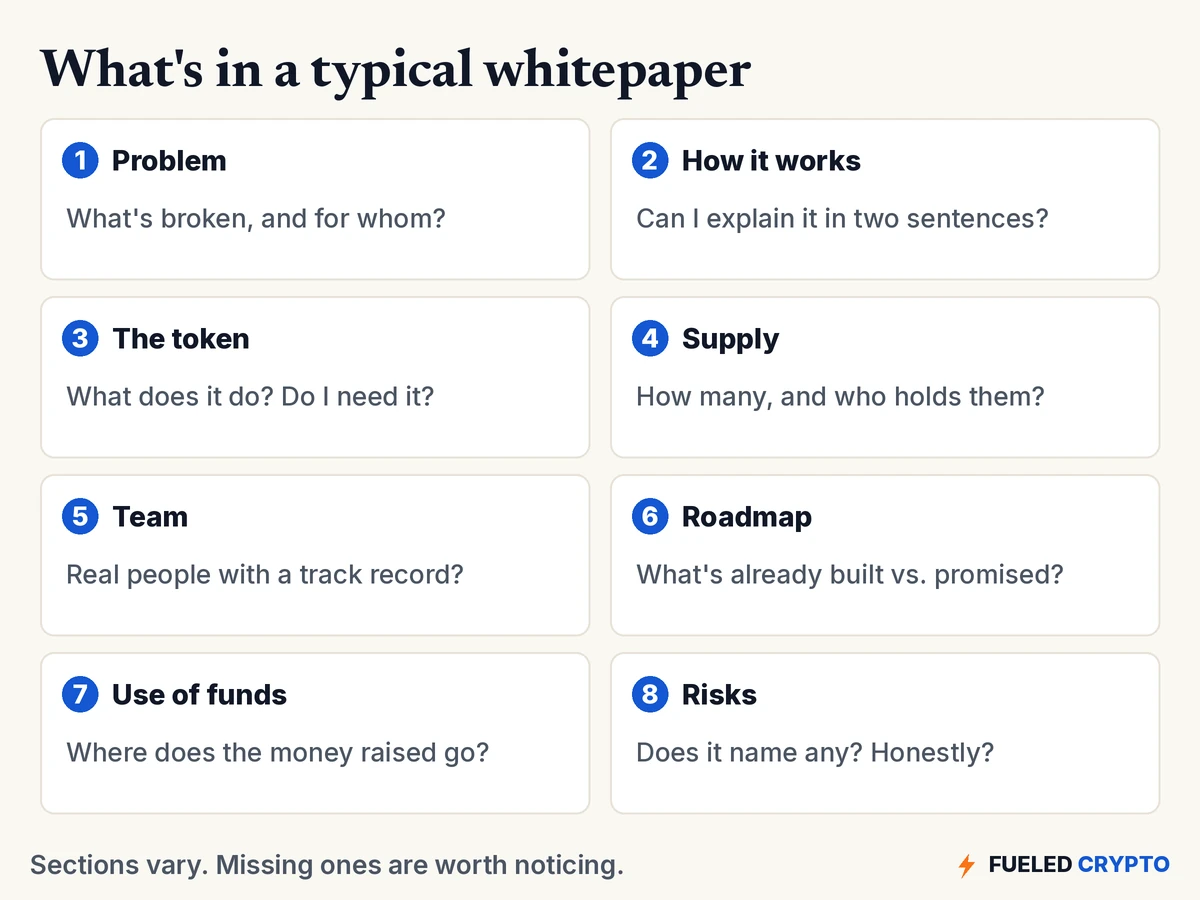
- The problem. What's broken, and for whom? A real problem usually has real people who'd use a fix.
- How it works. Can you explain it to a friend in two sentences? If the paper can't make it clear, that's on the paper.
- What the token does. Why does this need a token at all? The SEC suggests asking "what rights the virtual coin or token provides to you," and says those rights "should be clearly laid out, often in a white paper or development roadmap."
- Supply. How many tokens exist, how many will exist, and who holds them? Big team or insider allocations that unlock over time matter. Our market cap and supply guide explains why.
- The team. Are there named people with a track record you can look up? Anonymous teams aren't automatically scams, but there's no one with a reputation at stake.
- The roadmap. What already exists today, and what's only promised? A demo you can use is different from a plan.
- Use of funds. If the project raised money, where does it go? The SEC suggests asking "what your money will be used for."
- Risks. Does the paper name any? A paper that lists no risks at all isn't being straight with you.
For the token's rights, also ask the SEC's practical question: "how and when you can get your money back." Can you sell it, redeem it, or neither?
Check the claims at the source
Many claims on a project page can be checked. The trick is to check them somewhere the project doesn't control.
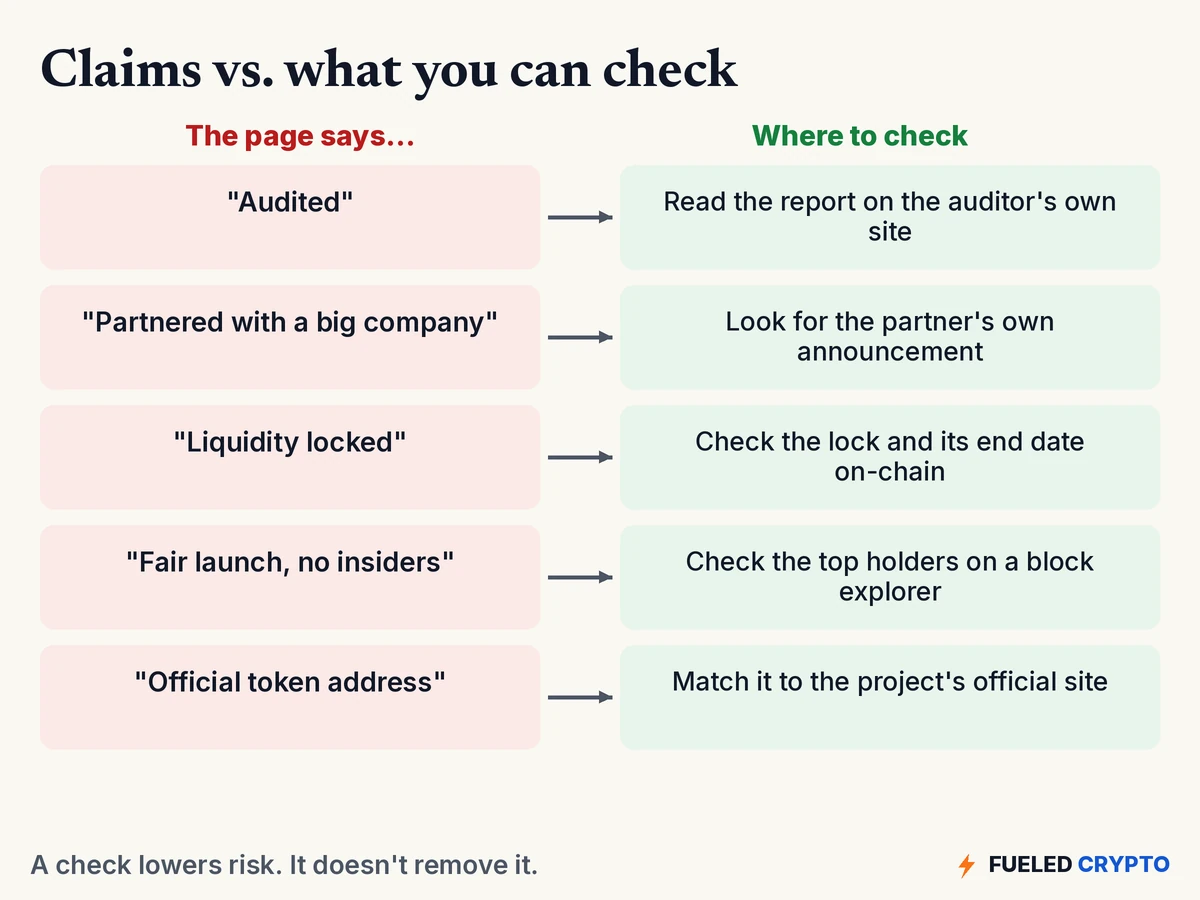
- "Audited." Find the report on the auditor's own website, not a screenshot. Check what it covered and whether issues it found were fixed. An audit reviews code; it doesn't vouch for the team.
- "Partnered with [big company]." Look for the partner's own announcement. A logo on a website isn't a partnership.
- "Liquidity locked." Check the lock and when it ends. Our rug pull guide explains why a lock isn't a guarantee.
- "Fair launch, no insiders." Look at the top holders on a block explorer.
- The token's address. Copycat tokens are common. Ethereum.org notes that tokens "can have the same symbol and name" as other tokens, so "you cannot count on those fields for security." Its advice: "The best source for the address of the legitimate token is the organization whose token it is." Use the project's official site, reached from a bookmark, not a link in a chat.
- Published code. The SEC suggests asking "whether the blockchain is open and public, whether the code has been published, and whether there has been an independent cybersecurity audit."
Red flags regulators keep pointing to
These come straight from SEC and CFTC investor warnings. None proves fraud alone, but they tend to travel together.
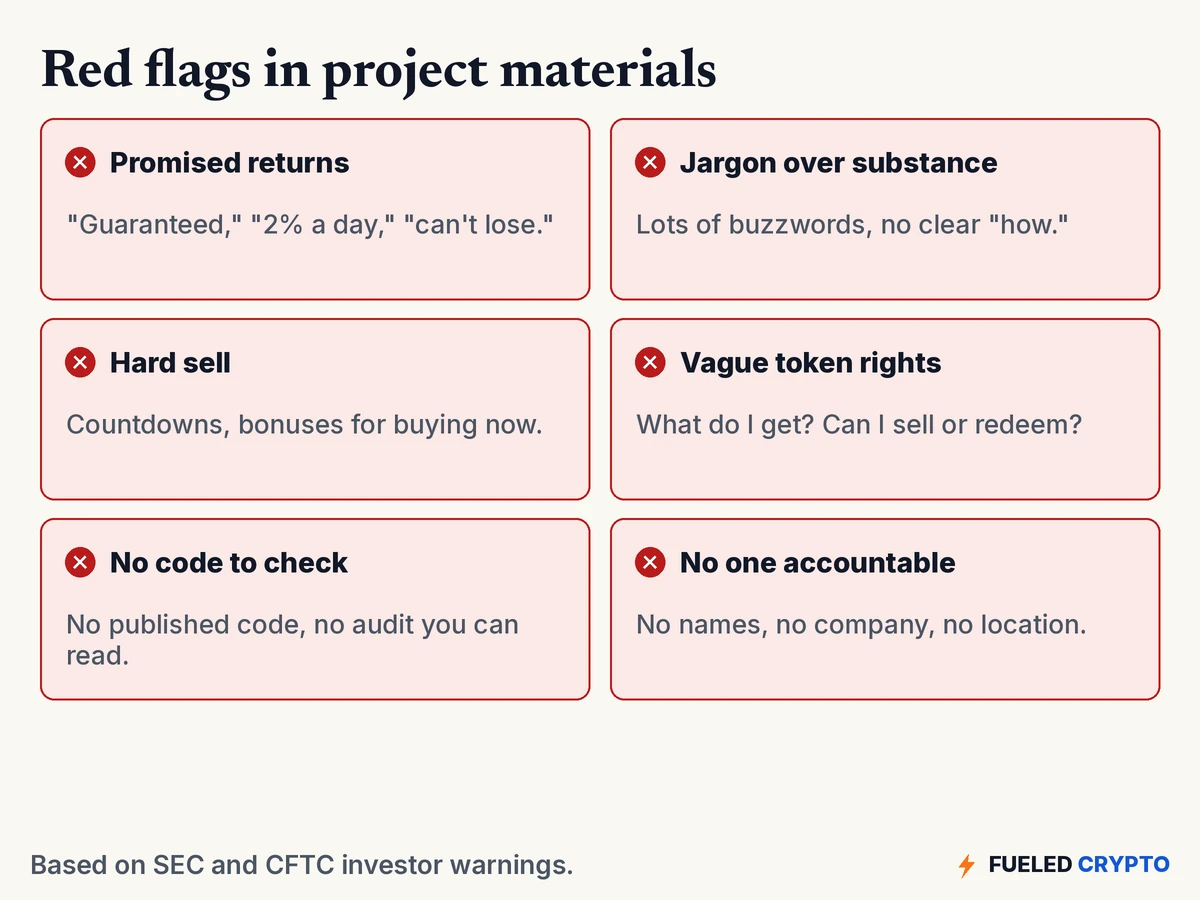
- Promised returns. The SEC says "There is no such thing as guaranteed high investment returns."
- Jargon over substance. The SEC says investors "should always be suspicious of jargon-laden pitches, hard sells, and promises of outsized returns."
- Urgency. The CFTC lists "Pressure to buy RIGHT NOW" as a warning sign.
- Vague rights. If you can't tell what the token entitles you to, or how you'd ever get money back, that's a gap.
- Nothing to check. No published code, no readable audit, no verifiable team or company.
For more scam patterns, see our guides to avoiding crypto scams and spotting rug pulls.
A simple way to work through it
- Find the paper and site from a source you trust, not a DM.
- Read the paper once without judging. Write down the eight answers in your own words.
- List every claim the paper and site make.
- Check what you can, at the source.
- Notice what you couldn't check, and weigh it.
- Never connect a wallet or sign anything just to "read more." Our token approvals guide explains why.
Common mix-ups
- "It has a whitepaper, so it's legit." Anyone can publish one, and it usually isn't reviewed by a regulator first.
- "I didn't understand it, so it must be advanced." Confusing writing is a warning, not a credential.
- "It's audited, so it's safe." An audit reviews code at one point in time. It doesn't control what the team does.
- "The token has the right name, so it's the real one." Names and symbols can be copied. Contract addresses can't.
- "The roadmap says it'll launch next quarter." A roadmap is a plan, not a product.
- "Lots of people in the chat are excited." Chat activity can be bought, and it isn't evidence about the project.
Words you'll keep hearing
- Whitepaper: a project's own document explaining what it's building and how its token works.
- Litepaper: a shorter, simpler version of a whitepaper.
- Tokenomics: a token's supply, how it's split, and how new tokens are released.
- Vesting / unlock: a schedule for releasing tokens held by the team or early backers.
- Audit: an outside review of smart contract code for bugs and security holes.
- Contract address: the unique on-chain address of a token's smart contract.
- Roadmap: a project's plan for what it intends to build and when.
- ICO / token sale: a sale of new tokens to raise money.
Frequently asked questions
What is a crypto whitepaper? A document a project publishes to explain what it's building, how it works and what its token is for. It's written by the project itself.
Does anyone check a whitepaper before it's published? Usually not. If a token sale counts as a securities offering, U.S. law requires it to be registered with the SEC or exempt, but a whitepaper itself is typically just posted by the project, so the claims are yours to check.
What should I look for first? What problem it solves, what the token actually does, who holds the supply, and who is behind it. If those aren't clear, the rest matters less.
How do I know a token is the real one and not a copy? Get the contract address from the project's official site, reached from a bookmark. Names and symbols can be copied; addresses can't.
Does an audit mean a project is safe? No. An audit reviews code for bugs at a point in time. It doesn't guarantee the code is bug-free or that the team acts honestly.
Is an anonymous team a deal-breaker? Not automatically, but it removes accountability. Combined with other red flags, it's a stronger warning.
Can a good whitepaper tell me if a token's price will go up? No. A paper explains a plan. Whether a project succeeds, or what its token is worth, is a separate and uncertain question.
Where to go next
- How to Spot a Rug Pull, for token red flags in depth.
- How to Avoid Crypto Scams, for the wider scam picture.
- Market Cap and Supply, Explained, to make sense of tokenomics.
- How to Read a Block Explorer, to check holders and contracts yourself.
- Token Approvals and DeFi Basics, before you connect a wallet anywhere.
- What Is a DAO?, if a project says token holders will run it.
- Crypto Glossary, for any other term.
Sources
- U.S. Securities and Exchange Commission, Investor.gov: Investor Bulletin: Initial Coin Offerings (July 25, 2017; questions to ask, token rights, published code and audits, warning signs).
- U.S. Commodity Futures Trading Commission: Watch Out for Digital Fraud (pressure to buy, guaranteed returns).
- Ethereum.org: How to identify scam tokens (copied names and symbols, checking the contract address).
- Bitcoin.org: Bitcoin: A Peer-to-Peer Electronic Cash System (the original paper, as a historical example).
All diagrams and animations are original Fueled Crypto graphics. Glimmer, GLM and everything on its project page are made up.
Fueled Crypto publishes news and education, not investment, tax, or legal advice. Crypto assets are volatile and can lose value. Do your own research and consider a licensed professional before making financial decisions. See our full disclaimer.
Want plain-English crypto news once a week? Subscribe to Fueled Crypto.