Deck: An airdrop is free crypto sent to many wallets at once. Real ones exist, but "claim your airdrop" is also one of the most common ways people get their wallets drained. Here's how to tell the difference, plus what the IRS has said about taxes.
Last reviewed: October 24, 2026
"Free tokens" is a phrase that makes a lot of people pause, and also one that makes a lot of people click. Both reactions make sense: airdrops are a real and common way projects hand out tokens, and fake airdrops are a real and common way scammers steal them.
This guide walks through how genuine airdrops work, how the fake "claim" sites operate, the red flags that give them away, and what the IRS has published about how airdrops are taxed.
The short version
- An airdrop is a project sending tokens to many wallet addresses at once. The IRS describes it as "a means of distributing units of a cryptocurrency to the distributed ledger addresses of multiple taxpayers."
- Real airdrops are announced on a project's official channels, with published rules about who qualifies.
- Fake airdrops often start with a token you didn't expect, carrying a link to a "claim" site. The site asks you to connect your wallet and approve something, and that approval or your recovery phrase is how your funds get taken.
- A surprise token sitting in your wallet generally can't move your funds by itself. The danger comes from interacting with it or following its link.
- Taxes: the IRS says "Income from digital assets is taxable," and its specific airdrop guidance treats new crypto received from an airdrop after a hard fork as ordinary income. Talk with a tax professional about your own situation.
How a real airdrop works
Projects run airdrops for a few reasons: to spread a new token among people who already use the app, to reward early users, or as marketing. When a blockchain splits in what's called a hard fork, holders of the old coin can also end up receiving units of the new one.
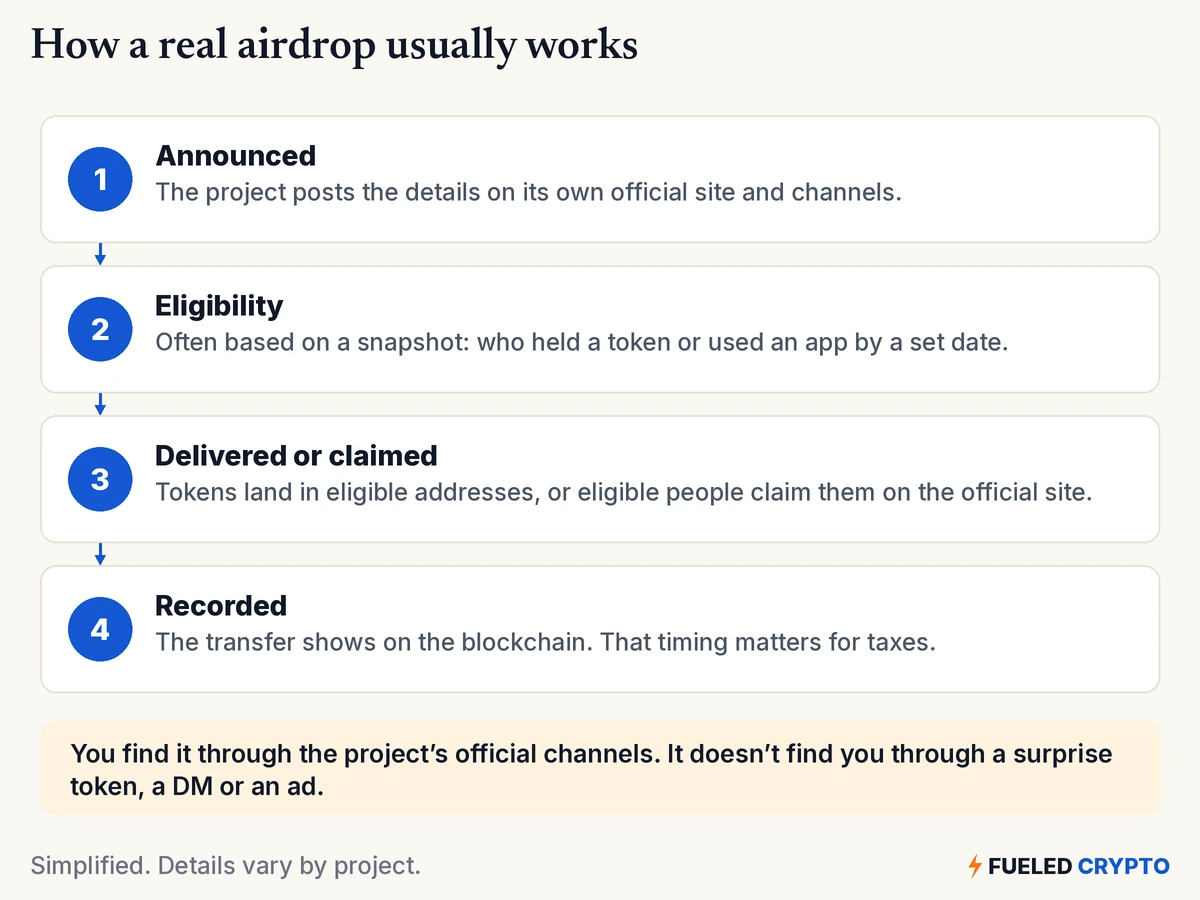
The details vary, but genuine airdrops tend to share a few traits:
- Public rules. The project explains who qualifies, often based on a "snapshot" of wallets that held a token or used its app before a certain date.
- Official channels. Announcements come from the project's own website and accounts, not from a stranger's direct message.
- Two delivery styles. Some airdrops send tokens straight to eligible addresses. Others let eligible people claim them on the project's site, which usually means a normal blockchain transaction with a network fee.
The FBI describes the range of ways people end up receiving airdropped tokens: they "must either hold the specific token offered, be a part of the community, or simply own a non-custodial wallet." That last group matters. Anyone with a self-custody wallet can be sent tokens without asking, which is exactly what scammers use.
How fake airdrop claim sites work
The most common version goes like this:
- A token shows up that you never asked for. Sometimes it's an NFT. Its name or description often includes a web address, like "claim at [some site]."
- You're nudged to visit a site. The link might be in the token's name, a transaction memo, a social media post, an ad or an email. If you try to sell or swap the token, it may simply fail, because scam tokens can be built so they can't be transferred.
- The site asks you to connect your wallet and approve something. ethereum.org describes the setup: you're sent "to a scam website to claim the airdropped asset," then "prompted to sign in with your Ethereum wallet and 'approve' a transaction when attempting to claim."
- The approval does the damage. Instead of giving you tokens, it gives the site permission to move yours. Another version simply has you confirm a transaction that sends funds to the scammer. Some sites skip the tricks and ask for your recovery phrase outright.
The FBI warned about this pattern in a June 2025 alert. Criminals put links in airdrop memos and also "advertise malicious phishing URLs for fraudulent NFT airdrop rewards tokens on social media or through a third-party website," or send "a phishing email to cryptocurrency users offering an airdrop of free tokens." Once a victim connects and hands over access, the criminal "moves the user's cryptocurrency to a wallet owned by the cyber criminal, draining the user's wallet of cryptocurrency."
There's a quieter trick too. ethereum.org notes that scam tokens often "airdrop significant balances" to wallets so they look like a popular, legitimate token. Seeing a big balance of something doesn't mean it's real or worth anything. If you want to understand why a copied name means nothing, our coins vs. tokens guide covers contract addresses.
Red flags of a fake airdrop
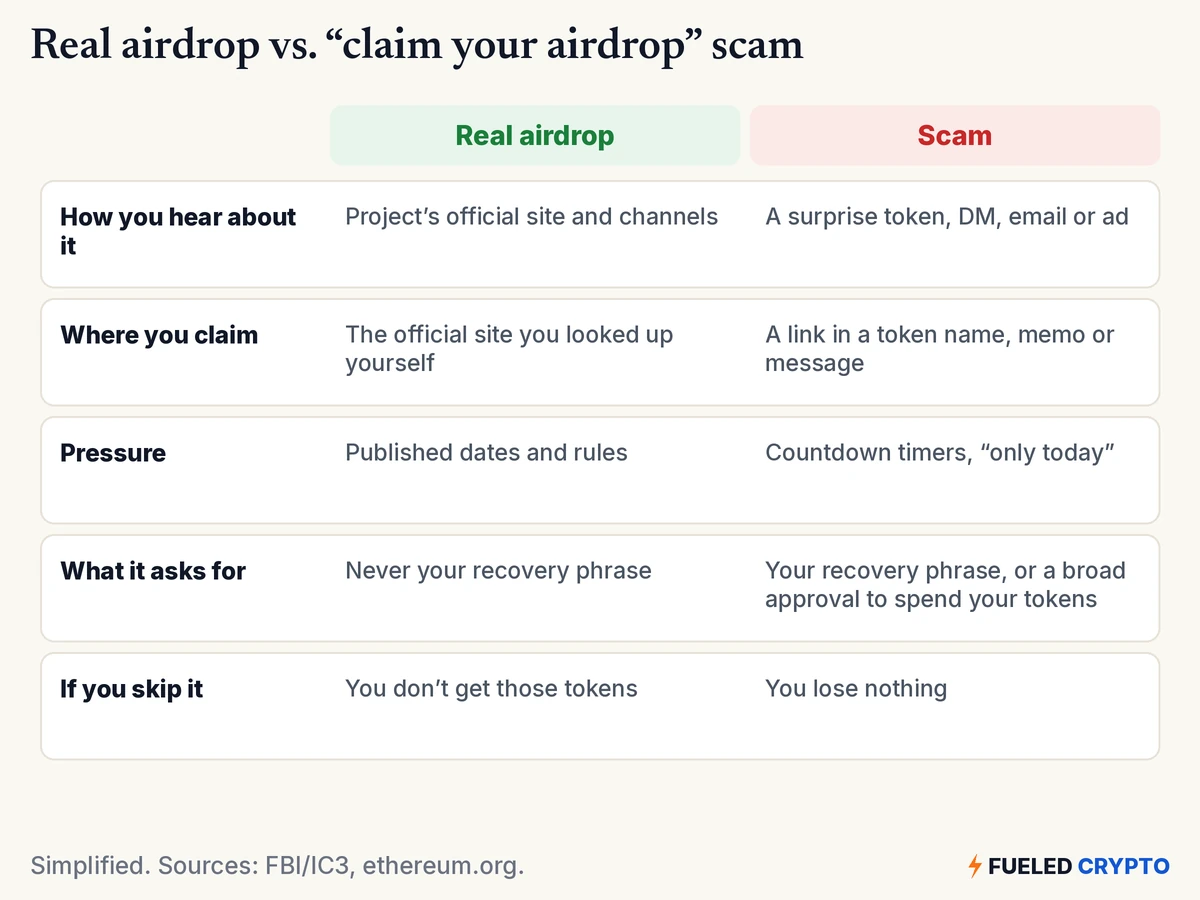
- It found you, instead of you finding it. A surprise token, a DM, an email or an ad. The FBI's advice: if you didn't sign up for a rewards program and an offer of free tokens arrives, "verify the offer is from the cryptocurrency provider before accepting and/or providing any information."
- The link came from the token or message itself. A web address in a token's name, NFT image or transaction memo is a classic setup.
- It asks for your recovery phrase. ethereum.org: "No legitimate service, support agent, or website will ever ask you for these." Our seed phrase guide explains why that phrase is the master key.
- It asks for a broad or unlimited approval. ethereum.org advises against unlimited spend limits because they "could enable the smart contract to drain your wallet." Our token approvals guide explains what you're agreeing to.
- It rushes you. Countdown timers and "claim before it's gone" exist to keep you from stopping to check.
- The web address is almost right. An extra letter, a different ending or a lookalike character. ethereum.org suggests bookmarking the official sites you use.
- It promises to multiply what you send. ethereum.org is direct: "No one is giving away free ETH. These offers are always scams."
If a surprise token shows up in your wallet
Unknown tokens arrive in wallets all the time, often sent to many addresses at once. Having one there doesn't mean your wallet was hacked. What matters is what you do next:
- Leave it alone. Don't try to sell, swap or send it, and don't visit any link attached to it. Many wallets let you hide tokens you don't recognize.
- Check the official source yourself. If you think a project might really be airdropping, go to its official site by typing it or using a bookmark, not by clicking the token's link. A block explorer can show which contract a token came from.
- If you already connected or approved something, ethereum.org's scam help page suggests moving remaining funds to a new, secure wallet and revoking token approvals. Our stolen crypto guide walks through reporting, including to the FBI's Internet Crime Complaint Center at ic3.gov.
For a wider look at scam patterns, see How to Avoid Crypto Scams.
What the IRS has said about airdrops
This section summarizes IRS publications. It isn't tax advice, and it doesn't cover every kind of airdrop.
On its digital assets page, the IRS says plainly: "Income from digital assets is taxable." The Form 1040 digital asset question asks whether you received digital assets "as a reward, award or payment for property or services," and the IRS's list of reasons to answer "Yes" includes receiving digital assets as "a reward or award" and "an airdrop as it relates to a hard fork."
The IRS's most specific guidance is Revenue Ruling 2019-24 and its matching FAQs. They deal with one situation in particular: a hard fork followed by an airdrop.
- Income: "If a hard fork is followed by an airdrop and you receive new cryptocurrency, you will have taxable income in the taxable year you receive that cryptocurrency."
- Amount: "ordinary income equal to the fair market value of the new cryptocurrency when it is received, which is when the transaction is recorded on the distributed ledger, provided you have dominion and control over the cryptocurrency so that you can transfer, sell, exchange, or otherwise dispose of" it.
- Basis (the starting value later used to figure a gain or loss when you sell): equal to "the amount you included in income."
- No new coins, no income: if a hard fork happens but you don't receive any new cryptocurrency, the IRS says "you don't have taxable income."
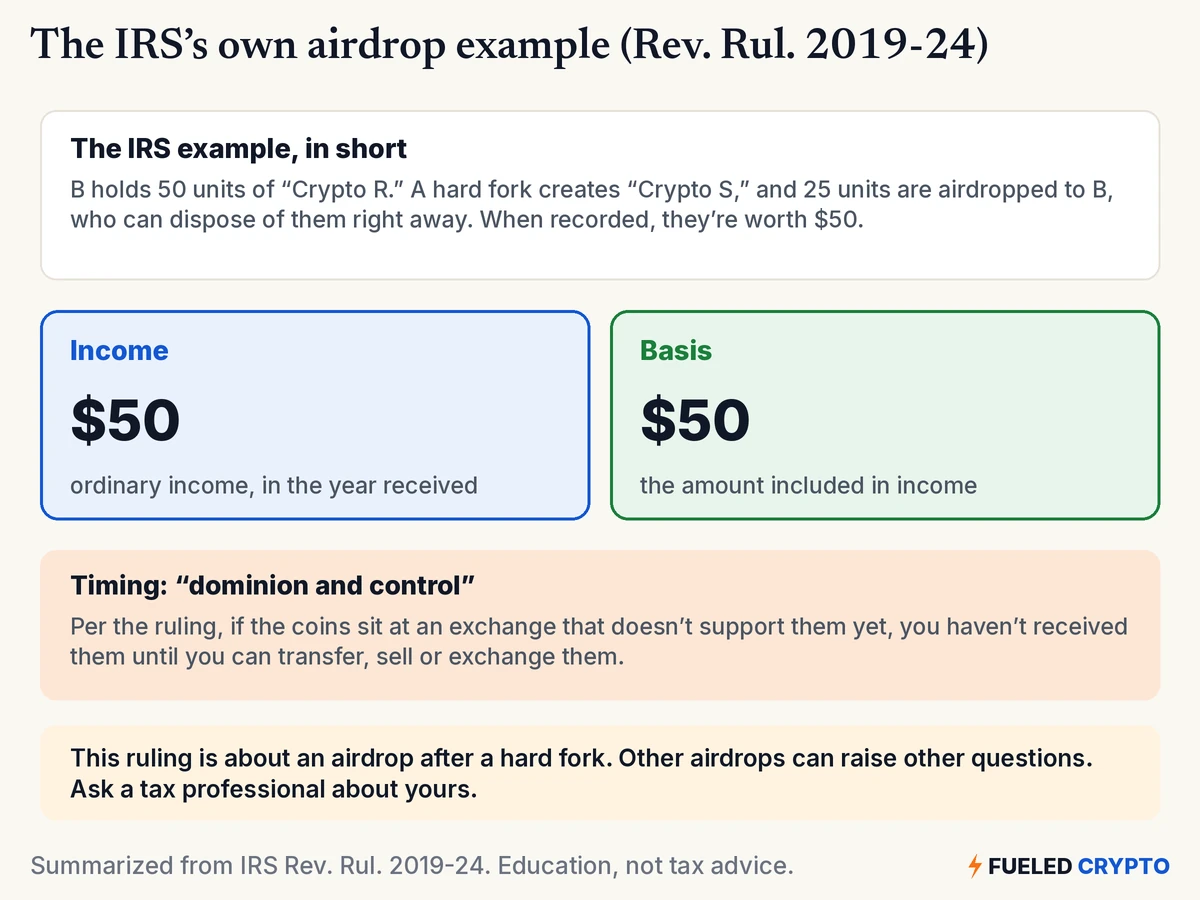
The ruling also explains timing. You don't have "dominion and control," and so haven't received the coins yet, if they were airdropped to an address in a wallet managed by an exchange that doesn't support the new coin. In that case, receipt comes later, once you're able to transfer, sell or exchange them.
What this doesn't settle. The ruling is about airdrops after a hard fork. Many airdrops today are promotional or reward-based and have nothing to do with a fork. The IRS's general statements above apply broadly, but how a specific airdrop should be treated, including unwanted spam tokens or tokens you can't sell, depends on the facts. That's a question for a CPA or tax professional.
The IRS also tells taxpayers to keep records of the fair market value, in U.S. dollars, of digital assets received as income. For reporting basics, see our crypto tax guide.
Common mix-ups
"An airdrop means someone hacked my wallet." No. Anyone can send tokens to any address. Receiving one doesn't mean someone has access to your wallet.
"If it's in my wallet, it must be worth something." Not necessarily. Scam tokens can show large balances and copy the name of a real token, and some can't be sold at all.
"I have to connect my wallet to see what I got." Your wallet already shows what's at your address. Connecting to an unknown site to "claim" is the step scammers want.
"Real airdrops never involve a transaction." Some legitimate airdrops do require a claim transaction on the official site. The difference is where you found the site and what it asks for. A real one never needs your recovery phrase.
"Free tokens aren't taxable." The IRS has said new crypto received from an airdrop after a hard fork is ordinary income. Ask a tax professional how this applies to anything you receive.
Words you'll keep hearing
- Airdrop: sending tokens to many wallet addresses at once, often for free.
- Snapshot: a record of which addresses held a token or used an app at a set moment, used to decide eligibility.
- Claim: collecting airdropped tokens by making a transaction on the project's site.
- Hard fork: a permanent split in a blockchain that can create a new coin.
- Token approval: permission you give a smart contract to move a certain token from your wallet.
- Wallet drainer: a scam site or contract built to empty wallets that connect and approve.
- Phishing: tricking someone into giving up access, usually through a fake site or message.
- Fair market value: what an asset would sell for at the time, in U.S. dollars, for tax purposes.
More terms are in our crypto glossary.
Frequently asked questions
What is a crypto airdrop? It's when a project sends tokens to many wallet addresses at once, often for free, to reward users, spread a new token or market itself. Some airdrops happen after a blockchain splits in a hard fork.
Are crypto airdrops legit? Many are, and many aren't. Real ones are announced on a project's official channels with public rules. Unexpected tokens with links to "claim" sites are a common scam.
I got a random token in my wallet. Is it dangerous? On its own, an unexpected token generally can't move your funds. The risk comes from trying to sell or swap it, or from visiting the site it points to and connecting your wallet.
How do fake airdrop sites steal crypto? They ask you to connect your wallet and approve a transaction to "claim." The approval actually lets them move your tokens, or the transaction sends your funds to them. Some ask for your recovery phrase outright.
Can I get my crypto back after a fake airdrop? Blockchain transfers usually can't be reversed. Moving what's left to a new wallet, revoking approvals and reporting to ic3.gov are common next steps. Our stolen crypto guide has more.
Are airdrops taxable in the U.S.? The IRS says income from digital assets is taxable, and its guidance treats new crypto received from an airdrop after a hard fork as ordinary income at fair market value when you receive it. A tax professional can tell you how that applies to you.
When does the IRS consider an airdrop received? For an airdrop after a hard fork, generally when it's recorded on the blockchain and you can transfer, sell or exchange it. If an exchange holding your address doesn't support the coin yet, receipt can come later.
Where to go next
- How to Avoid Crypto Scams, for the bigger picture.
- DeFi Basics and Token Approvals, for what "approve" really means.
- What to Do If Your Crypto Is Stolen, for steps and reporting.
- Seed Phrase vs. Password, for why no site should ever ask for it.
- How to Read a Blockchain Explorer, for checking where a token came from.
- How to Spot a Rug Pull, for other token red flags.
- How to Report Crypto on Your Taxes, for reporting basics.
- Crypto Glossary, for any other term.
Sources
- IRS: Revenue Ruling 2019-24 (hard forks and airdrops).
- IRS: Frequently asked questions on virtual currency transactions (Q22 to Q25).
- IRS: Digital assets (the Form 1040 question, when to answer "Yes," record keeping).
- FBI: Cybercriminals Defraud Hedera Hashgraph Network Non-Custodial Wallet Users Through Nonfungible Token Airdrops Disguised as Free Rewards, Alert I-060325-PSA (June 3, 2025). Also posted at ic3.gov.
- ethereum.org: Ethereum security and scam prevention.
- ethereum.org: Scam help and reporting.
- ethereum.org: How to identify scam tokens.
All diagrams and animations are original Fueled Crypto graphics. Sam, the "50,000 FREE" token and the claim site are made-up examples.
Fueled Crypto publishes news and education, not investment, tax, or legal advice. Crypto assets are volatile and can lose value. Do your own research and consider a licensed professional before making financial decisions. See our full disclaimer.
Want plain-English crypto news once a week? Subscribe to Fueled Crypto.