Deck: Crypto amounts often come with a lot of zeros after the decimal point. Sats, gwei and other small units exist to make those numbers readable. Here's what each one means, how fee quotes use them, and why a token's "decimals" setting matters.
Last reviewed: October 24, 2026
Look at a wallet balance or a fee estimate and you'll often see something like 0.00001400 BTC, or a fee rate in "sat/vB," or a gas price in "gwei." None of that is complicated once you know the units. They work like cents and dollars, just with more decimal places.
This is a short reference. It covers the small units of a few well-known coins, how to read the fee quotes that use them, and the "decimals" setting behind every token balance.
The short version
- Most coins split into much smaller units, the way a dollar splits into 100 cents.
- One bitcoin is 100,000,000 satoshis, usually shortened to "sats." A sat is 0.00000001 BTC.
- One ether is a billion gwei, and a gwei is a billion wei. Gwei is used for gas prices; wei is the smallest unit.
- One SOL is a billion lamports.
- Fee quotes use small units because the numbers would otherwise be long strings of zeros: sats per vbyte on Bitcoin, gwei per unit of gas on Ethereum.
- Tokens have a "decimals" setting that tells apps where to put the decimal point. Usually you never see it, but it explains some confusing numbers.
- Check which unit an amount field uses before you send. Typing sats into a BTC field, or the other way around, is an easy mistake.
Why small units exist
A single coin can be worth a lot, while everyday amounts and network fees are tiny fractions of one. Writing those fractions in whole coins means strings of zeros that are easy to misread. Small units fix that, the same way you'd say "50 cents" instead of "0.50 dollars."
The units aren't separate coins. A sat is just a small amount of bitcoin, and a gwei is just a small amount of ether. Nothing gets converted; it's the same balance written a different way.
Bitcoin: sats
The Bitcoin developer glossary puts it simply: "One bitcoin equals 100,000,000 satoshis." That means bitcoin goes to eight decimal places, and the eighth place, 0.00000001 BTC, is one satoshi, or sat.
Some quick conversions:
- 0.001 BTC = 100,000 sats
- 0.0001 BTC = 10,000 sats
- 0.00001 BTC = 1,000 sats
Many wallets let you switch the display between BTC and sats. Our Bitcoin guide covers bitcoin itself, including why you never have to buy a whole coin.
Ether: gwei and wei
Ether goes much further, to 18 decimal places. ethereum.org explains that "Wei is the smallest possible amount of ether," and that "Gwei, short for giga-wei, is often used to describe gas costs on Ethereum."
- 1 ETH = 1,000,000,000 gwei (a billion)
- 1 gwei = 1,000,000,000 wei (another billion)
- So 1 ETH = 1,000,000,000,000,000,000 wei (a billion billion)
You'll mostly see gwei in fee estimates. Wei is what the software works in behind the scenes: ethereum.org notes that the amount in each Ethereum transaction is "denominated in wei." Our Ethereum guide explains gas and ether.
Other coins have their own
Many networks name their smallest unit. Solana's documentation, for example, defines a lamport as "a fractional native token with the value of 0.000000001 sol," so one SOL is a billion lamports. It also lists an even smaller unit used only in fee settings: "1,000,000 micro-lamports = 1 lamport."
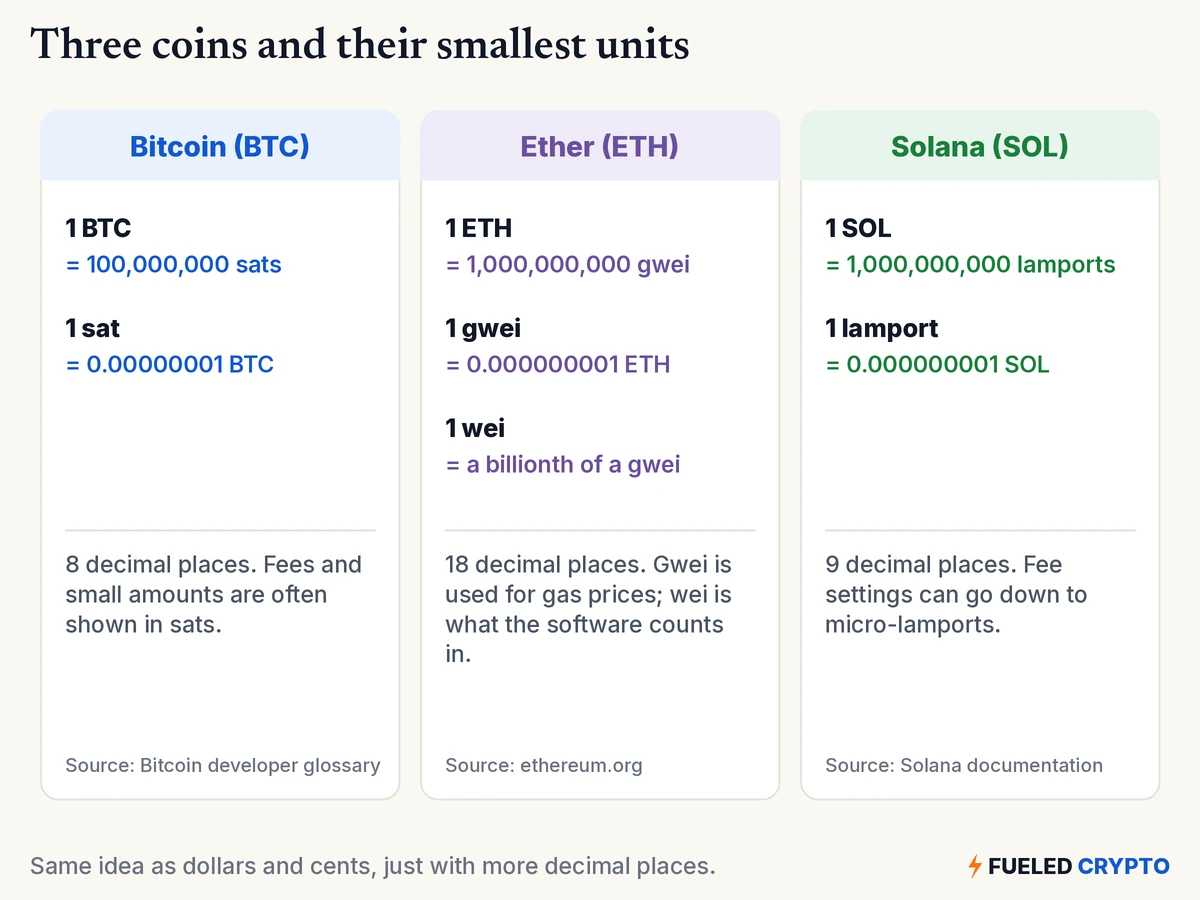
These three are examples, not a list to choose from. If you hold something else, its documentation or your wallet's settings will show how far it divides.
Reading fee quotes
Fees are where small units show up most, and they usually come as a rate, not a total. That's the part that trips people up.
Bitcoin: sats per vbyte (sat/vB). Bitcoin fees depend mainly on how much block space a transaction takes up, measured in virtual bytes (vbytes), rather than on how much bitcoin you send. Bitcoin Core's own documentation gives examples like sending "with a fee rate of 25 sat/vB." To get the total, multiply the rate by the size.
Here's a made-up example: Sam's transaction is 140 vbytes and the fee rate is 10 sat/vB. The fee is 10 × 140 = 1,400 sats, or 0.000014 BTC.
Ethereum: gwei per unit of gas. Ethereum fees are gas used times the price per unit of gas. ethereum.org's own example: a simple transfer uses 21,000 gas, the base fee is 10 gwei and the tip is 2 gwei, so the fee is "21,000 * (10 + 2) = 252,000 gwei (0.000252 ETH)."
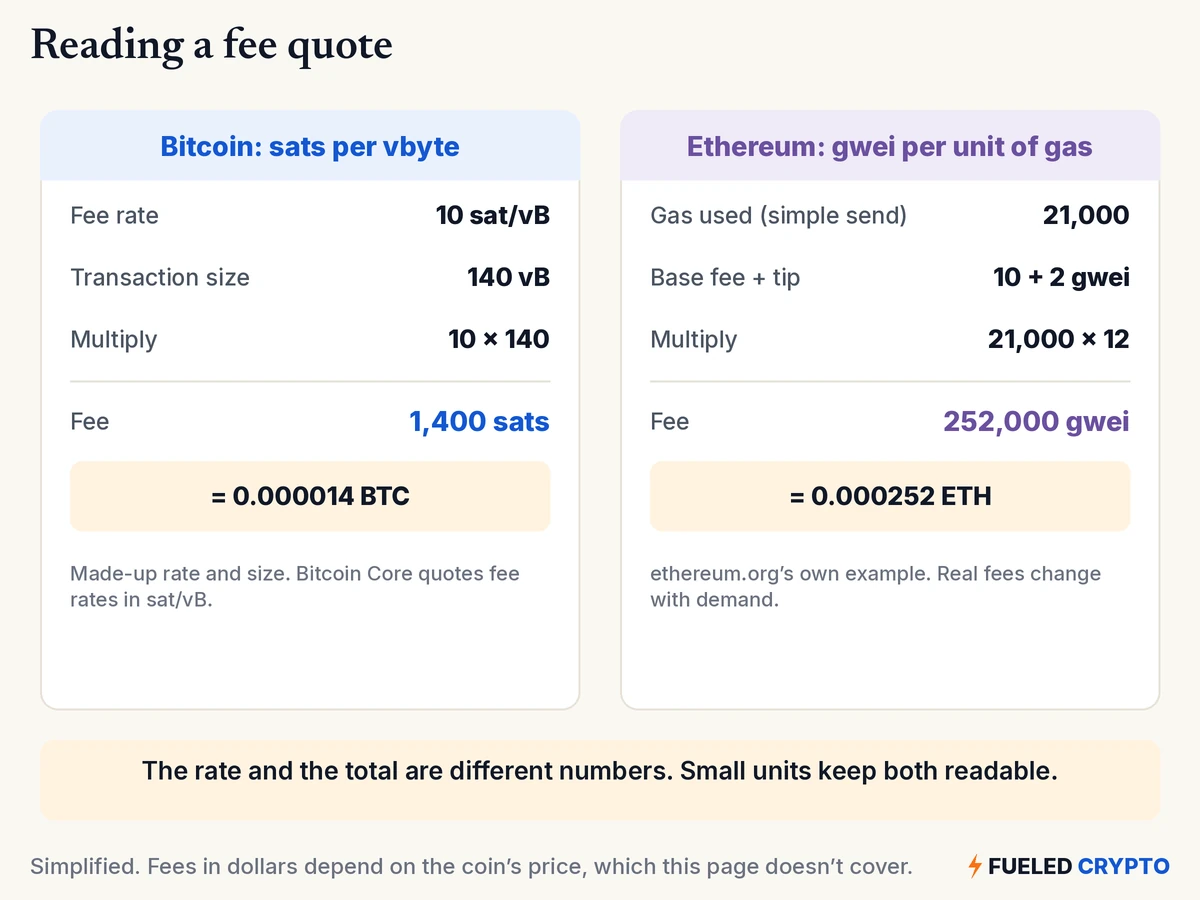
Real fees change with demand, often quickly. Our network fees guide explains why, and what you can and can't control.
Token decimals: where the decimal point lives
Tokens add one more layer. A token contract stores every balance as a whole number, with no decimal point. A separate setting called "decimals" tells wallets and apps where to put the point when they display it.
The Ethereum token standard (EIP-20) describes it like this: decimals "returns the number of decimals the token uses - e.g. 8, means to divide the token amount by 100000000 to get its user representation."
So the same 1.5 tokens can be stored three different ways:
- With 18 decimals: 1500000000000000000
- With 8 decimals: 150000000
- With 6 decimals: 1500000
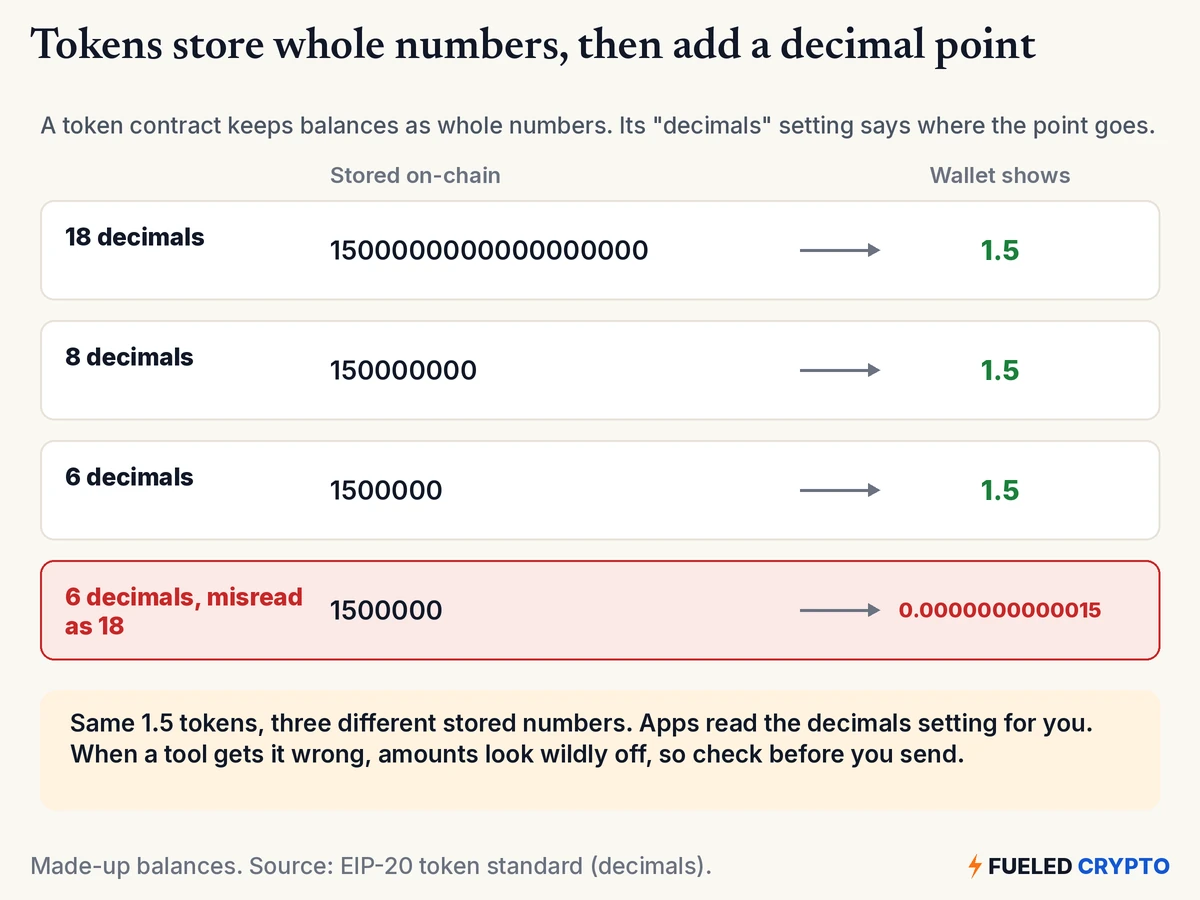
Wallets and block explorers read this setting for you, so most of the time it's invisible. It matters in two situations:
- When you look at raw data, for example in a block explorer's technical view, amounts can appear without the decimal point.
- When a tool gets it wrong, a balance can look a trillion times too big or too small. That's a reason to stop and double-check, not to act.
The standard also says decimals is "OPTIONAL," so a token's name, symbol and decimals are just settings its creator chose. Two tokens can share a name and have different decimals. The contract address is what identifies a token; our coin vs. token guide explains why.
Avoiding unit mistakes when you send
Most unit mistakes happen in an amount field. A few checks that reduce the risk:
- Check the unit next to the amount field before you type. Some wallets let you enter BTC, sats or a currency value, and switch between them with a tap.
- Read the amount back in both units if your wallet shows them. 0.0001 BTC and 10,000 sats are the same; 0.0001 BTC and 0.001 BTC are not.
- Check the fee separately from the amount. A fee rate in sat/vB or gwei isn't the total fee. The confirmation screen should show the total.
- Look at the confirmation screen, not the field you typed in. It's the last place to catch an extra zero.
Our before-you-send guide covers the rest of a safe send: addresses, networks and memos.
Common mix-ups
"Sats and gwei are separate coins." They're just smaller units of bitcoin and ether, the way cents are part of a dollar.
"A fee of 10 sat/vB means I pay 10 sats." That's the rate. The total is the rate times the transaction's size in vbytes.
"A gas price of 12 gwei is the whole fee." It's the price per unit of gas. A simple transfer uses 21,000 units.
"My token balance is wrong because it shows a huge number." It may be the raw stored number without the decimal point applied. Check it in your wallet or a block explorer's standard view.
"I need to own a whole coin." No. Coins divide into tiny units, so you can hold a small fraction.
Words you'll keep hearing
- Satoshi (sat): 0.00000001 BTC, the smallest unit of bitcoin.
- sat/vB: satoshis per virtual byte, the usual way Bitcoin fee rates are quoted.
- vbyte (virtual byte): the unit used to measure a Bitcoin transaction's size for fees.
- Wei: the smallest unit of ether, 0.000000000000000001 ETH.
- Gwei: a billion wei, or 0.000000001 ETH. Used for gas prices.
- Gas: the unit that measures the work an Ethereum transaction needs.
- Lamport: 0.000000001 SOL, the smallest unit on Solana.
- Decimals: a token setting that says where the decimal point goes when a balance is displayed.
More terms are in our crypto glossary.
Frequently asked questions
How many sats are in one bitcoin? 100,000,000. One sat is 0.00000001 BTC, the smallest unit of bitcoin, which goes to eight decimal places.
What is gwei? Gwei is a small unit of ether: one billionth of an ETH. It's used to quote gas prices on Ethereum, like "12 gwei."
How many wei are in one ETH? A billion billion: 1,000,000,000,000,000,000. Wei is the smallest unit of ether, and the software works in wei behind the scenes.
What does sat/vB mean? Satoshis per virtual byte. It's a Bitcoin fee rate. Multiply it by the transaction's size in vbytes to get the total fee in sats.
How do I convert gwei to ETH? Divide by 1,000,000,000. For example, ethereum.org's fee example of 252,000 gwei is 0.000252 ETH.
What are token decimals? A setting in a token's contract that says where the decimal point goes. Balances are stored as whole numbers, and apps use the decimals setting to display them.
Why does my wallet show so many zeros? Because small amounts of a coin are long decimals when written in whole coins. Some wallets let you switch to a smaller unit, like sats, to make them easier to read.
Where to go next
- Network Fees in Plain English, for why fees go up and down.
- What Happens When You Send Crypto, for where fees fit in a transaction.
- Before You Hit Send, for checking addresses, networks and amounts.
- What Is Bitcoin? and What Is Ethereum?, for the two coins in most of the examples.
- Coin vs. Token, for why a token's contract address matters more than its name.
- How to Read a Blockchain Explorer, for seeing amounts and fees on-chain.
- Crypto Glossary, for any other term.
Sources
- Bitcoin developer documentation: Glossary (denominations; maximum block size in vbytes).
- Bitcoin developer documentation: sendtoaddress RPC reference (fee rates in sat/vB).
- ethereum.org: Intro to ether (denominations of ether).
- ethereum.org: Gas and fees (the 21,000-gas fee example).
- Ethereum Improvement Proposals: EIP-20: Token Standard (decimals).
- Solana documentation: Terminology (lamport, micro-lamport).
All diagrams and animations are original Fueled Crypto graphics. Sam, the Bitcoin fee rate and size, and the token balances are made-up examples.
Fueled Crypto publishes news and education, not investment, tax, or legal advice. Crypto assets are volatile and can lose value. Do your own research and consider a licensed professional before making financial decisions. See our full disclaimer.
Want plain-English crypto news once a week? Subscribe to Fueled Crypto.