Deck: Not every blockchain is open to everyone. Some let anyone join, read and add blocks; others only let approved members in. Here's how the two models differ, what each one asks you to trust, and why "private" doesn't mean what it sounds like.
Last reviewed: October 24, 2026
When people talk about crypto, they're almost always talking about public blockchains: networks anyone can use, read and help run. But you'll also see companies, banks and industry groups announce that they're "using blockchain." Often that means a different kind of network, one where only invited participants can take part.
Both are called blockchains, and both keep a shared record in blocks. The difference is who's allowed in. This guide explains the two models, where they overlap, and the questions worth asking about any network that calls itself a blockchain.
The short version
- A public (permissionless) blockchain is open. Anyone can read it, send transactions and, by following the rules, help add blocks.
- A private (permissioned) blockchain is invite-only. Only approved participants can add blocks, and reading or sending may be restricted too.
- Openness and trust trade off. Public networks rely on rules and costly consensus to keep strangers honest; permissioned networks rely on known operators who can be removed.
- It's not a strict either/or. Some networks let anyone read and use them but only approved operators add blocks.
- "Private" means restricted, not secure or anonymous. And a private blockchain has nothing to do with your private key.
- Neither model is simply better. They suit different needs. The useful question is always who you're trusting.
What makes a blockchain "public"
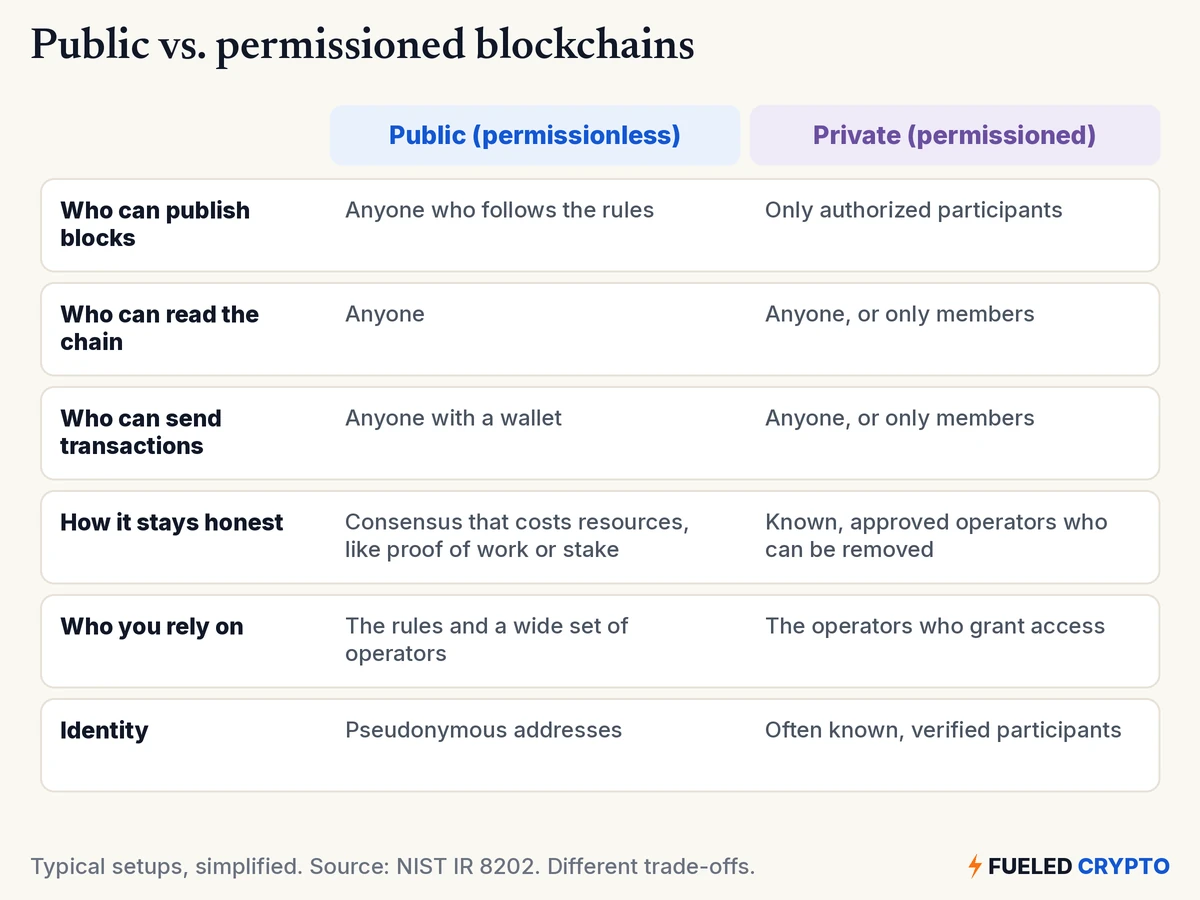
The US National Institute of Standards and Technology (NIST), in its Blockchain Technology Overview, sorts blockchains by one question: who can add blocks? "If anyone can publish a new block, it is permissionless. If only particular users can publish blocks, it is permissioned."
In a permissionless network, according to NIST, "anyone can read and write to the blockchain without authorization." The software is usually open source and free to download. That's how most cryptocurrencies work, including the networks covered in our Bitcoin and Ethereum guides.
Openness creates a problem: if anyone can add blocks, someone will try to cheat. NIST explains that permissionless networks handle this with consensus systems "that requires users to expend or maintain resources when attempting to publish blocks," such as proof of work and proof of stake, and usually reward honest block publishers with the network's own coin. (Our how a blockchain works and staking guides cover those systems.)
What makes a blockchain "private" or permissioned
In a permissioned network, NIST says, "users publishing blocks must be authorized by some authority (be it centralized or decentralized)." Because the people running it are approved, the operators can also limit who reads the chain and who sends transactions, though they don't have to.
These networks are often set up for a group of organizations. NIST notes they are "often deployed for a group of organizations and individuals, typically referred to as a consortium." ethereum.org describes a consortium network in similar terms: "The consensus process is controlled by a pre-defined set of nodes that are trusted."
Both sources reach for the same comparison. NIST: "a permissioned blockchain network is like a corporate intranet that is controlled, while a permissionless blockchain network is like the public internet, where anyone can participate."
Side by side
Two questions, not one
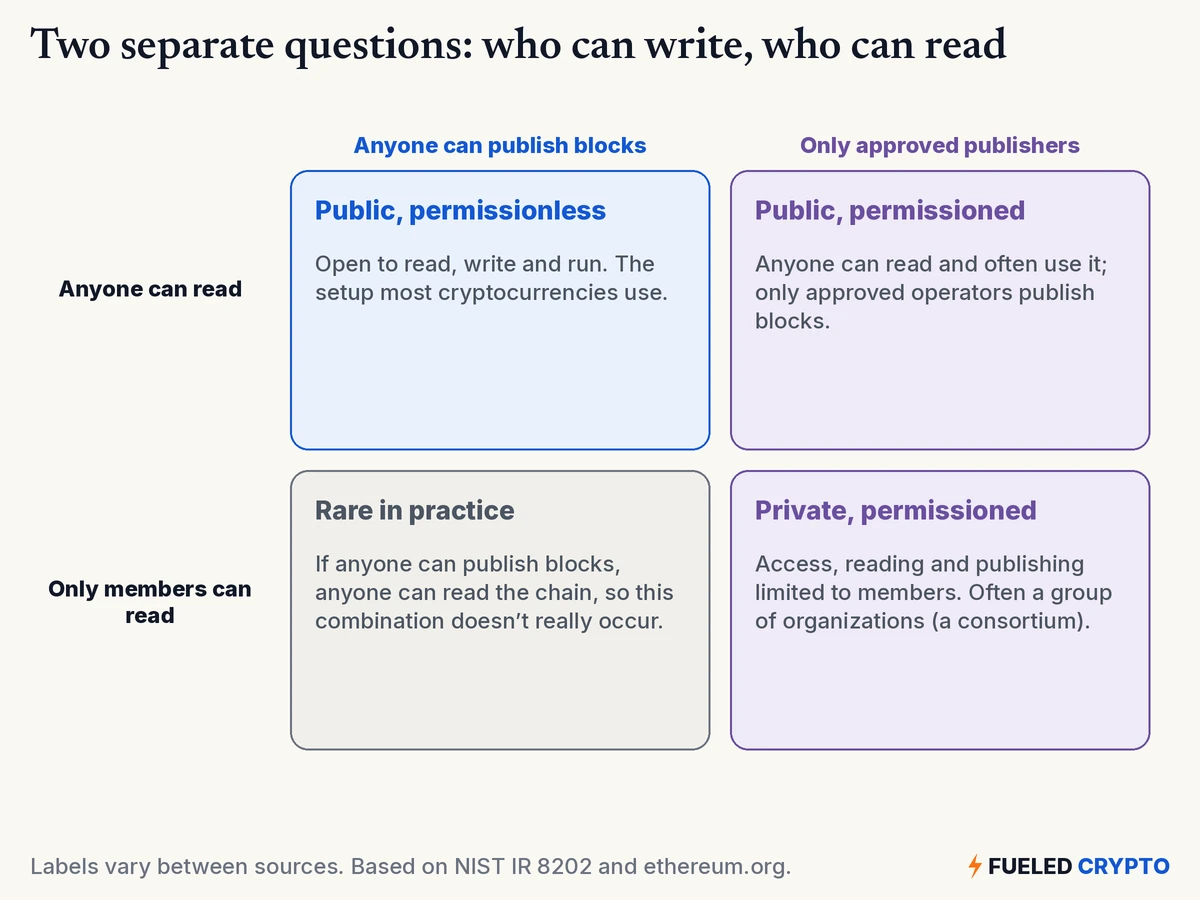
"Public" and "private" mix together two separate questions: who can add blocks, and who can see the data. NIST notes that permissioned networks "may thus allow anyone to read the blockchain or they may restrict read access to authorized individuals."
That gives three common setups:
- Public and permissionless: anyone can read, use and help run it.
- Public and permissioned: anyone can read and often use it, but only approved operators add blocks. Our payment networks guide covers one network that describes itself this way.
- Private and permissioned: reading, sending and adding blocks are all limited to members.
The fourth combination, anyone can add blocks but only members can read, doesn't really happen. If anyone can publish blocks, NIST notes, that "results in the property that anyone can read the blockchain."
The trade-offs
NIST is even-handed about this, and it's worth staying that way. Each model gives something up to get something else.
Speed and cost. Because permissioned operators are known and approved, their consensus methods "often do not require the expense or maintenance of resources," and NIST says they are "usually faster and less computationally expensive."
Who you have to trust. A permissioned network moves trust onto its operators. NIST is direct about it: "if a single entity controls who can publish blocks, the users of the blockchain will need to have trust in that entity." A public network spreads that trust across rules and a wide, open set of participants, at the cost of the resources its consensus uses.
Privacy. Public chains are visible to everyone. Addresses aren't names, but NIST describes the result as a "varying degree of pseudo-anonymity," not privacy. Some permissioned networks can "selectively reveal transaction information" so that only the parties involved see the details. (You can see how open a public chain is in our block explorer guide.)
Accountability. In permissioned networks where every participant is identified, NIST notes, misbehavior has consequences outside the network too: "it is well known where the organizations are incorporated, what legal remedies are available." On a public network, participants can join without asking anyone, which is the point, and also means there's no membership to revoke.
Who can use it. You can use a public network with a wallet and no one's permission. A permissioned network is only open to you if its operators let you in.
Where you'll run into each
If you buy, hold or send cryptocurrency, you're almost always using a public network. Permissioned networks are more common behind the scenes, for example among businesses sharing records with partners or in some projects that put traditional assets on a blockchain. Our tokenization guide covers that area.
You may also see a company say its product runs on "its own blockchain." That can be perfectly legitimate, but it changes what "on the blockchain" means. If one company decides who adds blocks and who can see them, you're trusting that company much as you would trust its regular database. That's not good or bad on its own. It's just worth knowing.
NIST suggests a starting point for organizations deciding whether to use a blockchain at all: start from "how could blockchain technology potentially benefit us?" rather than "how can we make our problem fit into the blockchain technology paradigm?"
Common mix-ups
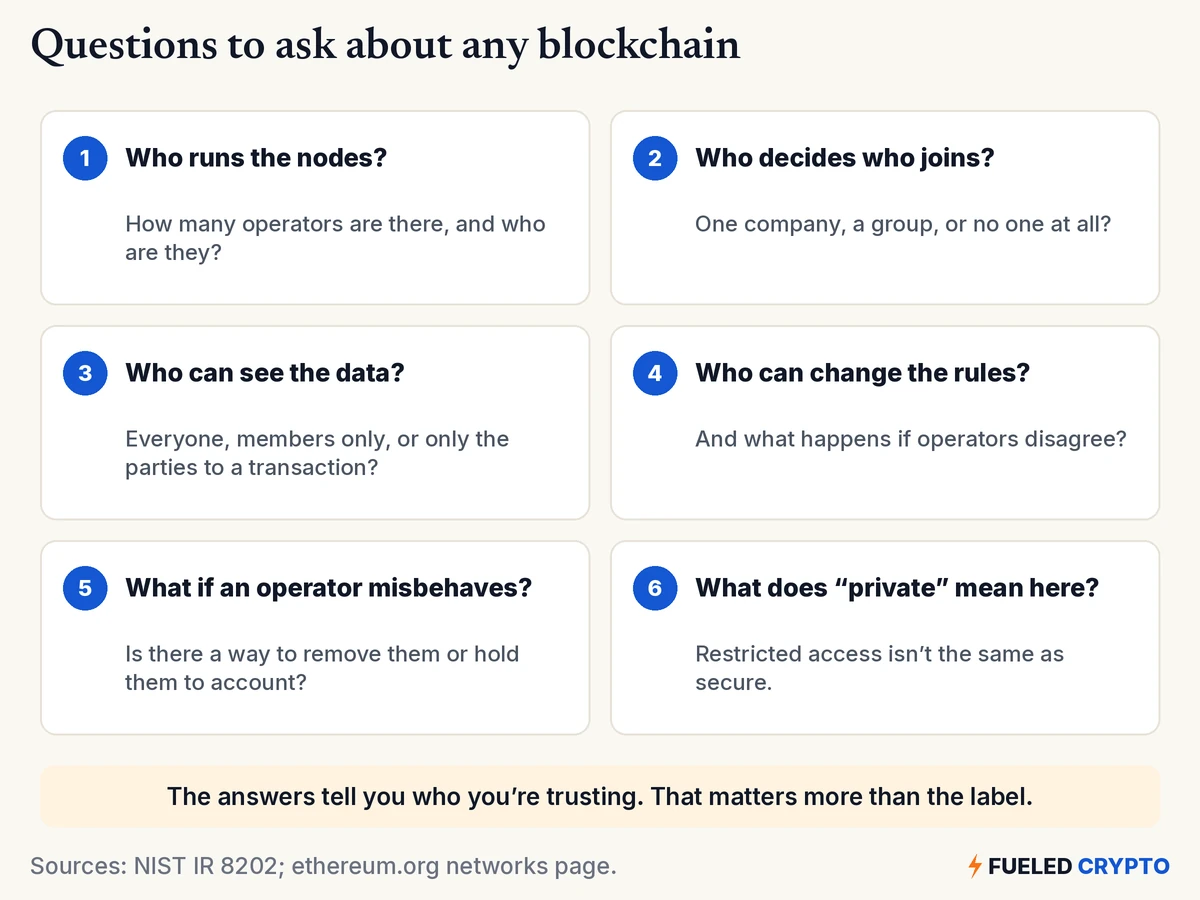
"Private means secure." Not by itself. ethereum.org puts it plainly: "private only means reserved or isolated, rather than protected or secure."
"A private blockchain is where my private key lives." Unrelated. Your private key controls your funds on whatever network you use. See keys, addresses and wallets.
"Public means my name is on it." Public chains show addresses and amounts, not names. But addresses can sometimes be linked to people, so public isn't private either.
"Permissioned means centralized." Not always. NIST says the authority that approves publishers can be "centralized or decentralized," such as a group of organizations.
"One model is the real blockchain." Both use blocks and a shared ledger. They answer the question "who's allowed in?" differently.
Words you'll keep hearing
- Public blockchain: a network anyone can read and use. Usually also permissionless.
- Permissionless: anyone can add blocks by following the rules, without asking anyone.
- Permissioned: only approved participants can add blocks.
- Private blockchain: a permissioned network that also limits who can read and use it.
- Consortium: a group of organizations that run a permissioned network together.
- Node: a computer running the network's software and keeping a copy of the ledger.
- Consensus: the process a network uses to agree on which blocks are valid.
- Proof of authority: a consensus method that relies on publishers' known, verified identities. NIST says it only applies to permissioned networks with high levels of trust.
More terms are in our crypto glossary.
Frequently asked questions
What is the difference between a public and a private blockchain? A public blockchain lets anyone read it, use it and help add blocks. A private blockchain limits those things to approved members, usually a company or a group of organizations.
What is a permissioned blockchain? One where only authorized participants can add blocks. It may still let anyone read the chain or send transactions, or it may limit those to members as well.
Is Bitcoin a public or private blockchain? Public and permissionless. Anyone can download the software, read the chain, send transactions and take part in adding blocks by following the network's rules.
Are private blockchains more secure? Not automatically. They limit who can take part, which changes who you have to trust. ethereum.org notes that "private" means reserved or isolated, not protected or secure.
What is a consortium blockchain? A permissioned network run jointly by a group of organizations, where a set of known, trusted nodes controls which blocks get added.
Can a blockchain be public and permissioned? Yes. Some networks let anyone read and use them while only approved operators add blocks. That's often called "public permissioned."
Which is better, public or private? Neither in general. Public networks trade speed and resources for openness; permissioned networks trade openness for speed and known operators. It depends on what a network is for and who you're willing to trust.
Where to go next
- How a Blockchain Works, for blocks, nodes and consensus.
- What Is Staking?, for how proof of stake keeps a public network honest.
- Tokenization of Real-World Assets, for one place permissioned networks come up.
- Payment Networks: XRPL, Stellar and Hedera, for networks with different approaches to who runs nodes.
- How to Read a Blockchain Explorer, for seeing how open a public chain is.
- Keys, Addresses and Wallets, for the other kind of "private."
- Crypto Glossary, for any other term.
Sources
- NIST: Blockchain Technology Overview, NISTIR 8202 (Yaga et al., October 2018); full text PDF, sections 2 (permissionless and permissioned), 3.4 (addresses) and 4.4 (proof of authority).
- ethereum.org: Networks (private networks and consortium networks).
All diagrams and animations are original Fueled Crypto graphics. No real network is shown.
Fueled Crypto publishes news and education, not investment, tax, or legal advice. Crypto assets are volatile and can lose value. Do your own research and consider a licensed professional before making financial decisions. See our full disclaimer.
Want plain-English crypto news once a week? Subscribe to Fueled Crypto.