Deck: A fork is a change to a blockchain's rules. Most are planned upgrades that holders never notice. Once in a while, people disagree and one chain becomes two. Here's how to tell the difference and what it means for the coins you hold.
Last reviewed: October 24, 2026
"Fork" is one of those words that shows up in crypto headlines as if everyone already knows what it means. Sometimes the story is a routine upgrade. Sometimes it's a split that created a whole new coin. The same word covers both, which is confusing.
This guide explains what a fork is, the difference between a soft fork and a hard fork, why most forks end with one chain and a few end with two, and what holders actually see when that happens.
The short version
- A fork is a change to the rules that computers on a blockchain network use to decide which blocks are valid.
- A soft fork is backward compatible. Computers that haven't upgraded still accept the new blocks.
- A hard fork isn't. Computers that don't upgrade reject the new blocks, so everyone has to upgrade or the network splits.
- Most hard forks are planned upgrades that end with one chain, because nearly everyone upgrades together.
- A split happens when people disagree. Then there are two chains with the same history up to the split, and often a second coin.
- If you hold coins through a split, you may end up with a balance on both chains, but wallets and exchanges decide whether to support the new one.
- Scams and taxes come with splits. Never give your recovery phrase to "claim" anything, and in the US the IRS treats new coins received after a hard fork as income.
What a fork actually is
A blockchain is run by many independent computers, called nodes, that each keep a copy of the chain and check every new block against the same set of rules. (Our guide to how a blockchain works covers the basics.)
Those rules sometimes need to change: to fix a bug, add a feature or change how the network reaches agreement. ethereum.org explains why that's harder than updating an app: "Blockchains work differently because there is no central ownership." Every node operator has to install new software.
A fork is that change. In ethereum.org's words, forks happen "when major technical upgrades or changes need to be made to the network" and they "change the 'rules' of the protocol."
The name comes from the shape. For a moment, or sometimes for good, there can be two versions of the chain: one that follows the new rules and one that follows the old ones.
One note before going further. Developers also use "fork" for two unrelated things: a short-lived fork when two blocks are found at almost the same time (the network settles on one within a block or two), and copying a project's open-source code to start a new project. This guide is about rule changes.
Soft forks vs. hard forks
The difference comes down to one question: will a node that hasn't upgraded still accept blocks made under the new rules?
Soft fork: yes. The new rules are stricter, so blocks that follow them still look valid under the old rules. ethereum.org's glossary says a soft fork "is backwards compatible." Nodes that don't upgrade keep working, though they don't enforce the new rules themselves. Bitcoin's Segregated Witness change is a well-known example; Bitcoin Core's developers call it "the Segregated Witness soft-fork (segwit)."
Hard fork: no. The new rules allow something the old rules didn't, so old nodes reject the new blocks. ethereum.org defines a hard fork as "a permanent divergence in the blockchain" that "commonly occurs when nonupgraded nodes can't validate blocks created by upgraded nodes that follow newer consensus rules."
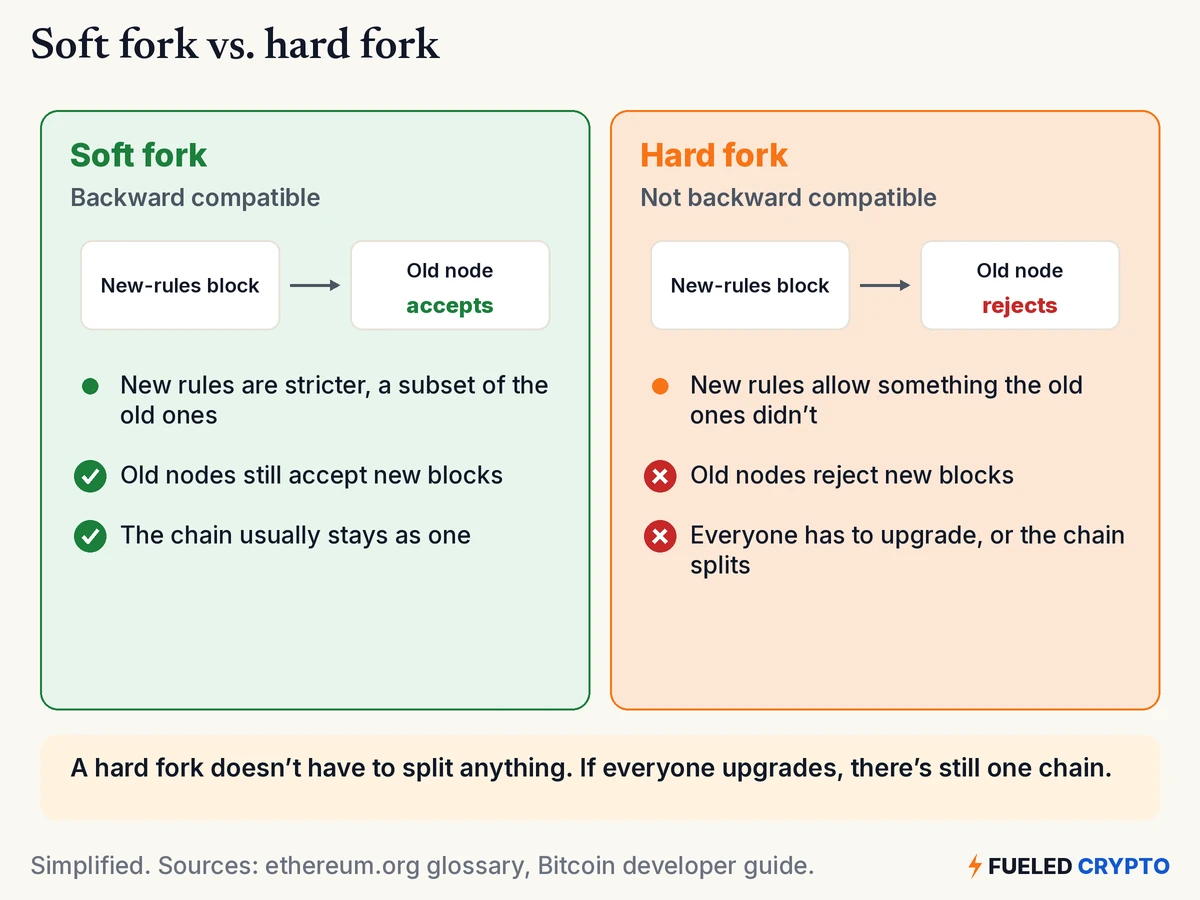
The Bitcoin developer guide adds a useful nuance: changes to the rules "are often described by their potential to create either a hard or soft fork." In other words, "hard fork" describes the kind of change. It doesn't mean a split actually happened.
Most forks are upgrades, not splits
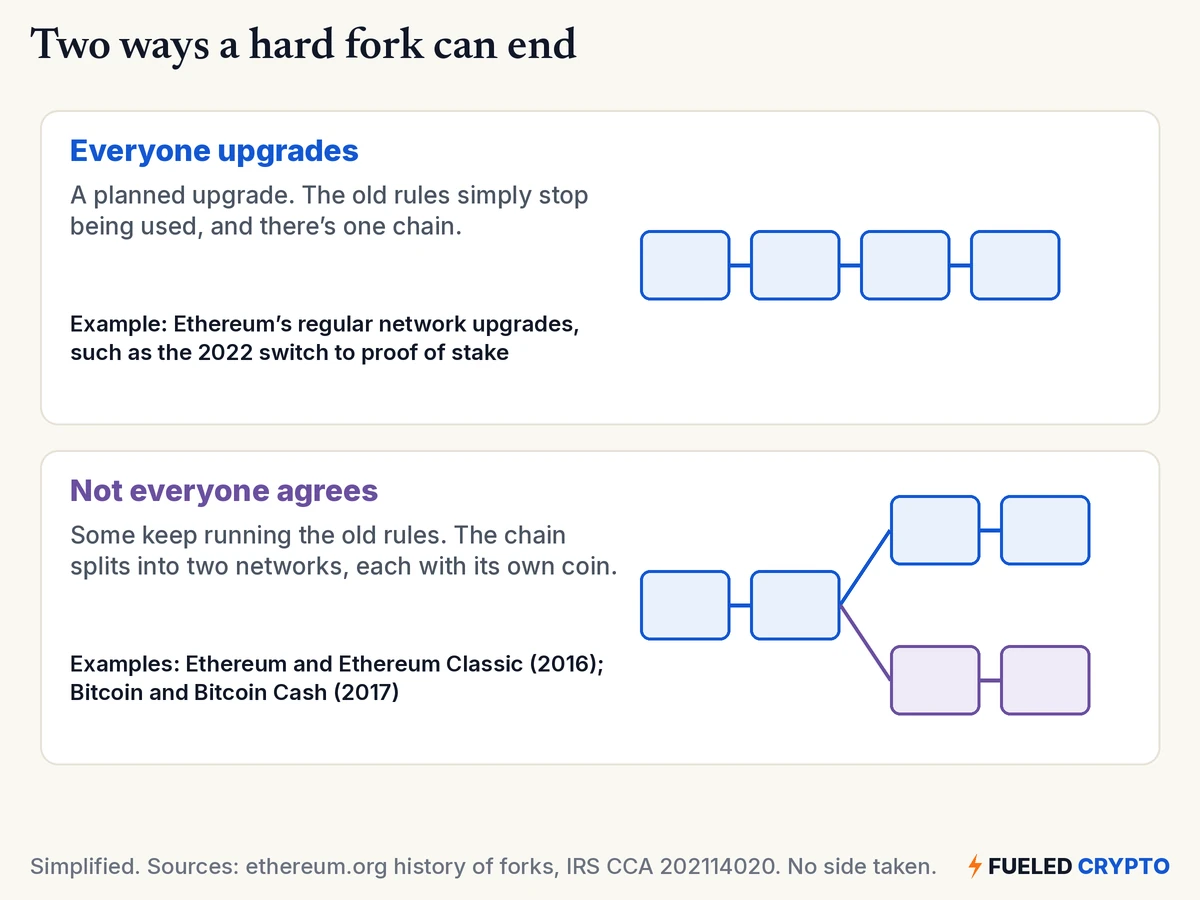
A hard fork sounds dramatic, but most of them are scheduled maintenance. Developers propose a change, it's debated in public, node operators agree on a date or block number, and on that block everyone switches together.
ethereum.org describes it this way: "Forks are usually agreed upon ahead of time so that clients adopt the changes in unison and the fork with the upgrades becomes the main chain." Ethereum has had many of these. One of the largest was the 2022 upgrade known as the Merge, which ethereum.org's fork timeline lists on September 15, 2022, when the network switched from proof of work to proof of stake. (Our Ethereum guide explains both.)
When an upgrade like that goes as planned, holders don't need to do anything. Your coins are on the same chain before and after. If you hold coins on an exchange, the exchange handles the software update. If you use your own wallet, you may be asked to update the app, which you'd do through its official app store page or website.
When a chain splits in two
ethereum.org notes that "in rare cases, disagreements over forks can cause the network to permanently split." Two historical splits come up often.
Ethereum and Ethereum Classic (2016). ethereum.org describes a 2016 attack in which "an insecure contract was drained of over 3.6 million ETH." The fix was a hard fork that moved the funds to a new contract from which people who lost funds could withdraw. ethereum.org records that "the decision to fork reached over 85% of the votes," and that some miners "refused to fork because the DAO incident wasn't a defect in the protocol. They went on to form Ethereum Classic." Both chains still exist.
Bitcoin and Bitcoin Cash (2017). A hard fork of Bitcoin on August 1, 2017, produced a separate chain whose coin is called Bitcoin Cash. The IRS later used that fork as the example in a 2021 legal memo on taxes (more on that below). Our Bitcoin guide covers Bitcoin itself.
In both cases, each side had its reasons, and this guide doesn't take one. The useful point for a beginner is mechanical: after a split, there are two networks that share every block up to the split and go their separate ways after it.
What holders see after a split
Here's a made-up example. Kim holds 10 coins on a chain that splits. Because both chains share the same history, Kim's 10 coins are recorded on both. In principle, Kim now has 10 coins on Chain A and 10 on Chain B.
In practice, a few things decide what Kim can do with them:
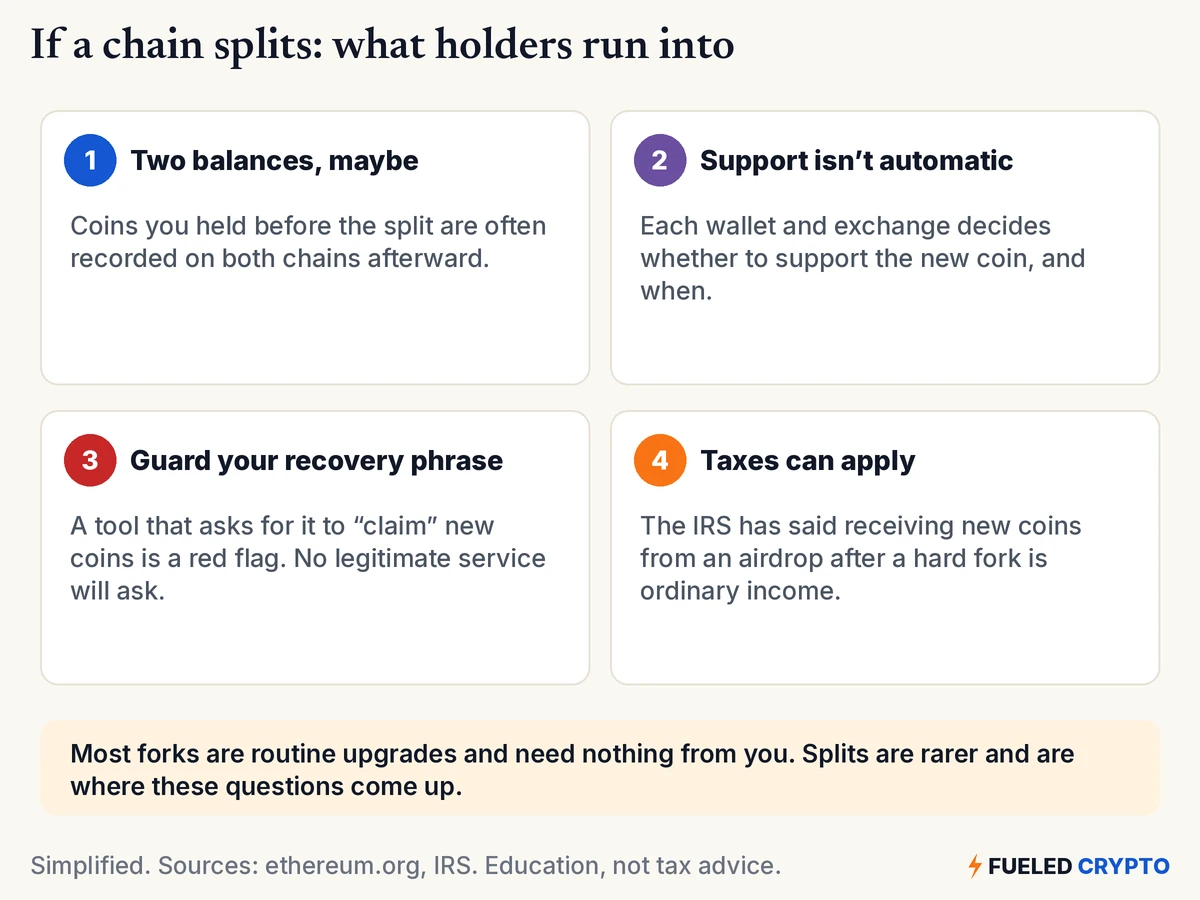
- Where the coins are held. If Kim's coins are on an exchange, the exchange decides whether to credit the new coin, and when. If Kim uses a self-custody wallet, the keys usually work on both chains, but the wallet app has to support the new chain to show it. (See exchange vs. self-custody and how wallets and keys work.)
- Whether the new coin is supported at all. Wallets and exchanges each make their own call. A coin you technically hold may not be usable for a while, or ever, in the apps you use.
- Replay risk. Right after a split, a transaction signed on one chain can sometimes be copied and accepted on the other too, unless developers have added protection. Ethereum's own upgrade later in 2016 listed "adding replay attack protection" among its changes, according to ethereum.org. It's one reason many people wait for their wallet or exchange to confirm support before moving anything on either chain.
Scams that ride on forks
Any event that leaves people wondering "do I have free coins?" attracts scammers. The common pattern is a website, app or "support agent" offering to help you claim your new coins, as long as you enter your recovery phrase.
Don't. Your recovery phrase controls every coin on every chain that phrase works on. ethereum.org is blunt about it: "No legitimate service, support agent, or website will ever ask you for these." If you want a fork's new coin, use the official, already-installed wallet app you trust, or wait for your exchange to announce support. Our guides on recovery phrases, avoiding crypto scams and airdrop claim scams go deeper.
Do forks have tax consequences?
In the US, they can. This is general information, not tax advice, so talk with a tax professional about your situation.
The IRS's virtual currency FAQ says that if your crypto "went through a hard fork, but you did not receive any new cryptocurrency," then "you don't have taxable income." If a hard fork is followed by an airdrop and you do receive new coins, "you will have taxable income in the taxable year you receive that cryptocurrency," and the IRS says that's "ordinary income equal to the fair market value of the new cryptocurrency when it is received," as long as you can actually transfer or sell it. The formal guidance is Revenue Ruling 2019-24. A 2021 IRS legal memo applied the same idea to the 2017 Bitcoin Cash fork, though the memo itself says it "may not be used or cited as precedent." Our crypto tax reporting guide covers how income gets reported.
Common mix-ups
"A hard fork means a split." Not necessarily. "Hard fork" describes a change old software can't accept. If everyone upgrades, there's still one chain.
"A soft fork is a smaller change." It's about compatibility, not size. A soft fork can be a big change, as long as old nodes still accept the new blocks.
"A fork means free money." A split may leave you with a balance on a new chain, but its value, support and usability are all uncertain, and it may be taxable.
"I have to do something during every upgrade." Usually not. Planned upgrades are handled by node operators, exchanges and wallet apps. Watch for official announcements, not messages that contact you first.
"A forked project is the same as a fork." Copying a project's open-source code to launch a new project is also called forking, but it doesn't split an existing chain or give anyone a balance.
Words you'll keep hearing
- Fork: a change to a blockchain's rules, or the point where one chain becomes two.
- Soft fork: a backward-compatible rule change; old nodes still accept new blocks.
- Hard fork: a rule change old nodes reject; everyone upgrades or the chain splits.
- Chain split: when two chains continue separately after a hard fork.
- Node: a computer running the network's software and checking blocks against the rules.
- Consensus rules: the rules every node uses to decide which blocks are valid.
- Network upgrade: a planned hard fork most of the network adopts together. Ethereum names its upgrades.
- Replay attack: reusing a transaction signed on one chain on the other chain after a split.
More terms are in our crypto glossary.
Frequently asked questions
What is a hard fork in crypto? A hard fork is a change to a blockchain's rules that older software won't accept. Everyone running the network has to upgrade. If some don't, the chain splits into two.
What is the difference between a hard fork and a soft fork? A soft fork is backward compatible: computers that haven't upgraded still accept the new blocks. A hard fork isn't, so it needs everyone to upgrade or it creates a split.
Do I lose my coins in a hard fork? A planned upgrade doesn't change your balance. In a split, coins you held before are usually recorded on both chains, but whether you can use the new coin depends on your wallet or exchange.
Do I need to do anything when a blockchain forks? Usually not. For planned upgrades, exchanges and wallet apps handle the software. If an app asks you to update, do it through its official store page or website.
How do I claim coins from a chain split? Wait for your exchange or wallet to announce support, and use only the official app you already trust. Never enter your recovery phrase into a site or tool to "claim" coins.
Are hard forks taxable in the US? The IRS says a hard fork with no new coins received isn't taxable income, but new coins received through an airdrop after a hard fork are ordinary income. Talk with a tax professional.
Why do some chains split into two? Because the people running the network disagree on a rule change, and some keep using the old rules. Ethereum and Ethereum Classic (2016) and Bitcoin and Bitcoin Cash (2017) are two examples.
Where to go next
- How a Blockchain Works, for blocks, nodes and consensus.
- What Is Bitcoin? and What Is Ethereum?, for the two networks in the examples.
- Coin vs. Token, for why a split creates a new coin rather than a token.
- Exchange vs. Self-Custody, for who decides what you can access after a split.
- Seed Phrase vs. Password and How to Avoid Crypto Scams, for staying safe around "claim" offers.
- How to Report Crypto Taxes, for how income from crypto is reported.
- Crypto Glossary, for any other term.
Sources
- ethereum.org: Glossary (hard fork and soft fork entries; last updated October 22, 2026).
- ethereum.org: Timeline of all Ethereum forks (DAO fork, July 20, 2016; Paris / the Merge, September 15, 2022; last updated October 22, 2026).
- Bitcoin developer documentation: Block Chain guide (consensus rule changes, hard and soft forks).
- Bitcoin Core: Segregated Witness Benefits.
- ethereum.org: Ethereum security and scam prevention.
- IRS: Frequently asked questions on virtual currency transactions (Q22 to Q24).
- IRS: Revenue Ruling 2019-24.
- IRS: Chief Counsel Advice 202114020 (released April 9, 2021).
All diagrams and animations are original Fueled Crypto graphics. Kim and all balances are made-up examples.
Fueled Crypto publishes news and education, not investment, tax, or legal advice. Crypto assets are volatile and can lose value. Do your own research and consider a licensed professional before making financial decisions. See our full disclaimer.
Want plain-English crypto news once a week? Subscribe to Fueled Crypto.